
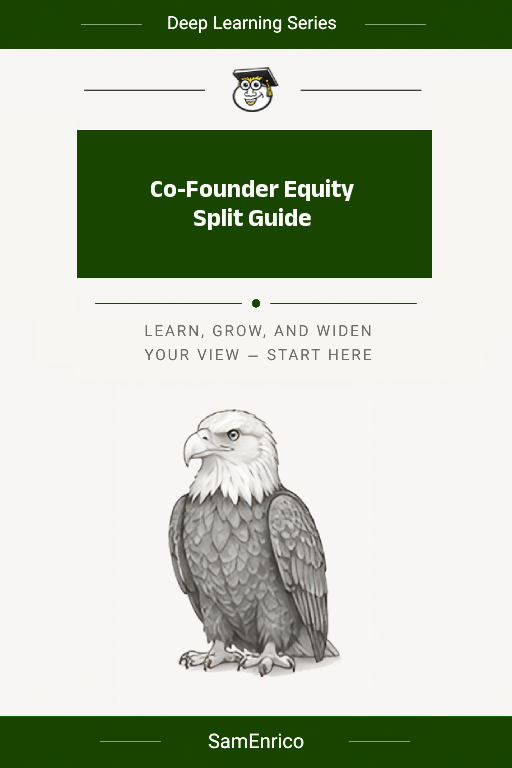
Non-FictionFirst 30 DaysEquity Strategy
Co-Founder Equity Split Guide eBook
Negotiate fair equity divisions using online calcu
by Coates Hyman
Negotiate fair equity divisions using online calculators and role based contribution tracking before legal incorporation.
Formats
Free sample
Chapter 1: The 24% Lie...--–- Every 50/50 split is a ticking time bomb. Here’s the data that proves it—and why “fair” usually isn’t.The Conversation That Destroys Startups It happens in coffee shops, dorm rooms, and Slack channels every single day. Two co-founders—let’s call them Alex and Jordan—have just agreed to build something together. They’ve validated the idea, sketched the product, and mapped out the first ninety days. Excitement is high.
Trust is absolute.Then someone says the seven words that will almost certainly destroy their company: *“So… should we just do 50/50?”*Alex nods. Jordan nods. They shake hands. They incorporate. They build.
And eighteen months later, they hate each other.This is not a hypothetical. This is not an edge case. This is the single most common, most predictable, and most preventable failure mode in early-stage startups. And it begins with the assumption that 50/50 is the default “fair” choice.This chapter will show you exactly why that assumption is wrong—and why reframing “fair” as “proportional to contribution” is the only way to build a startup that survives its first co-founder departure.The 24% Statistic That Should Terrify You Let’s start with the data, because this is not a feelings conversation. This is math.Noam Wasserman, a professor at Harvard Business School, spent more than a decade studying thousands of startup founders for his book The Founder’s Dilemmas.
His finding was stark: approximately 24% of two-founder teams experience a co-founder departure by year four.Let that sink in. Nearly one in four two-founder startups loses a co-founder before their fourth birthday. That’s not a failure rate. That’s a crisis.But here’s what makes it even worse. Wasserman’s research, combined with internal data from Carta (which tracks equity ownership across more than 40,000 startups), identified the primary trigger for these departures.
It wasn’t fraud. It wasn’t incompetence. It wasn’t even a bad product-market fit.It was perceived contribution inequality.One founder feels they are working harder, taking more risk, or delivering more value. The other founder—often through no malicious intent—appears to be coasting. The original 50/50 split, which felt so fair on Day 1, now feels like theft.
Resentment builds silently. Communication breaks down. And then, usually on a Tuesday afternoon, one founder says, “I’m out.”The remaining founder is left with dead equity—stock owned by someone who no longer contributes—and a cap table that scares away investors.All because they chose 50/50.The Sunk Cost Fallacy of Equal Splits Why do so many founders default to 50/50? The answer is uncomfortable but simple: it avoids a difficult conversation.Sitting across from a co-founder and saying, “I think I should get more equity than you” feels confrontational. It feels like a lack of trust.
It feels like planning for failure. So founders take the path of least resistance. They tell themselves that 50/50 is “fair enough” and that they’ll figure out the details later.This is the sunk cost fallacy of equity splits. You invest emotional energy into avoiding a hard conversation today, only to pay ten times that energy in legal fees, lost time, and destroyed relationships tomorrow.But here’s what the data actually shows: equal splits are only fair when contributions are truly equal. And contributions are almost never equal.Consider the most common two-founder structure: a technical founder (let’s say a software engineer) and a non-technical founder (a business or product person).
On paper, they each bring critical skills. In practice, their hourly commitment, risk tolerance, and cash contribution are rarely identical.The technical founder might work eighty hours a week building the product. The business founder might work twenty hours a week on customer development and fundraising. Under a 50/50 split, the technical founder is effectively subsidizing the business founder’s lifestyle. And that subsidy will not go unnoticed forever.The Math of Resentment Let me show you exactly how this plays out in numbers.Meet Sarah and Mike.
They are founding a B2B Saa S startup. Sarah is a brilliant engineer. Mike is a skilled salesperson. They agree to a 50/50 split because they like each other and want to be fair.Here’s what happens over the first twelve months.Sarah’s contribution:Works 60 hours per week, every week (3,120 hours total)Quits her $180,000 per year job to work full-time Brings no cash (she’s living off savings)Opportunity cost: $180,000Mike’s contribution:Works 15 hours per week (780 hours total)Keeps his $120,000 per year day job (works nights and weekends on the startup)Brings no cash Opportunity cost: $0 (he didn’t quit anything)Under a 50/50 split, Mike receives exactly the same ownership as Sarah for approximately one quarter of the hours and zero dollars of forgone salary.Now let’s say the company exits in five years for 10million.Sarah’s5010 million. Sarah’s 50% is worth 10million.Sarah’s505 million.
Mike’s 50% is also worth $5 million.But Sarah worked 15,600 hours over five years (assuming 60 hours per week, 50 weeks per year). That means she earned approximately $320 per hour for her work.Mike worked 3,900 hours over five years (15 hours per week). That means he earned approximately $1,282 per hour for his work—four times Sarah’s hourly rate.Ask yourself: would Sarah have agreed to that arrangement on Day 1 if she had known? Almost certainly not. But she didn’t know, because she never did the math.
And she never did the math because the 50/50 conversation lasted thirty seconds.This is the math of resentment. It’s not about bad intentions. It’s about bad incentives baked into a broken default.Why “Fair” Is Not the Same as “Equal”Here is the single most important reframe in this entire book:Fairness is not equality. Fairness is proportionality.Equality means everyone gets the same thing regardless of contribution. Proportionality means everyone gets what they have earned based on what they have contributed.In a family, equality might make sense.
You don’t give your children different amounts of love based on how many chores they did. But a startup is not a family. It is a commercial enterprise designed to generate returns for people who take risks and create value. Treating it like a family is a recipe for disaster.Proportionality requires measurement. You cannot give someone what they have earned unless you know what they have contributed.
And you cannot know what they have contributed unless you track it.This is where most founders fail. They assume that “tracking contributions” feels corporate, bureaucratic, or distrustful. But the opposite is true. Tracking contributions is the single most trust-building action you can take, because it removes ambiguity. Instead of arguing about who worked harder, you look at the data.
Instead of guessing who took more risk, you add up the numbers.Think of it like a restaurant bill. When you split the bill evenly with friends, someone always subsidizes someone else. The person who ordered a salad pays for the person who ordered a steak. That’s fine for dinner. It’s not fine for a company.The Five Dimensions of Contribution To move from equality to proportionality, you need to measure five distinct dimensions of contribution.
Most founders only think about one or two. That’s why their splits break.Dimension 1: Time (Hours Worked)This is the most…
This is the end of the free sample. Get the eBook to keep going. Buy now
About this book
Details
- Author
- Coates Hyman
- Publisher
- SamEnrico
- Language
- English
- Genre
- Non-Fiction, First 30 Days, Equity Strategy
- Released
- 2026-05-30
- Pages (approx.)
- 128
- Available as
- eBook, Audiobook

Read better in the ZLOADR app
Your eBooks on your phone or tablet. Sign in with your SamEnrico account and start reading.
More by Coates Hyman
 TMJ Jaw RelaxationCoates Hyman$11.99
 Wholesaling Real Estate GuideCoates Hyman$11.99
 Business Canvas CreativityCoates Hyman$11.99
 Tai Chi Longevity GuideCoates Hyman$11.99
 The Sebastião SalgadoCoates Hyman$11.99
 Cognitive Restructuring for MenCoates Hyman$11.99
 Microbiome Psychobiotic GuideCoates Hyman$11.99
 Gambling Addiction for SeniorsCoates Hyman$11.99
 The Unbreakable Spirit of Osei Bonsu: The 18th-Century Warrior Who Defied the OddsCoates Hyman$11.99
 Ashes of the Forgotten: The Lost Battalion of the Great WarCoates Hyman$11.99
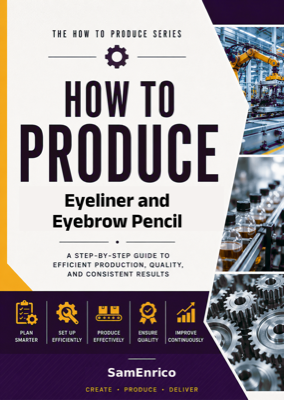 How to Produce Eyeliner and Eyebrow PencilCoates Hyman$11.99
 A Collector's Handbook to the Alfa Romeo 6c-2300 TurismoCoates Hyman$11.99
You may also like
 Hong Kong Handover 1997Dunn Johnnie$11.99
 Zumba For Postnatal Recovery CourseNeal Christian$11.99
 Zumba for BeginnersLadner Nikia$11.99
 YouTube Comment Mining GuideHumes Pandora$12.99
 Worry Box MeditationCarlin Rudy$11.99
 Workplace Stress MeditationNguyen Lynn$11.99
 Workplace Stress and Sleep RepairHawley Ivory$11.99
 Workplace Perfectionism CureDelaney Jeffry$11.99
 Workplace Injustice Anger GuideWallen Isabelle$11.99
 Work Addiction and Burnout LinkGreenwood Ester$11.99
 Women in Yoga and WellnessBeattie Galina$11.99
 Women in Stand Up ComedyChun Evangeline$11.99