
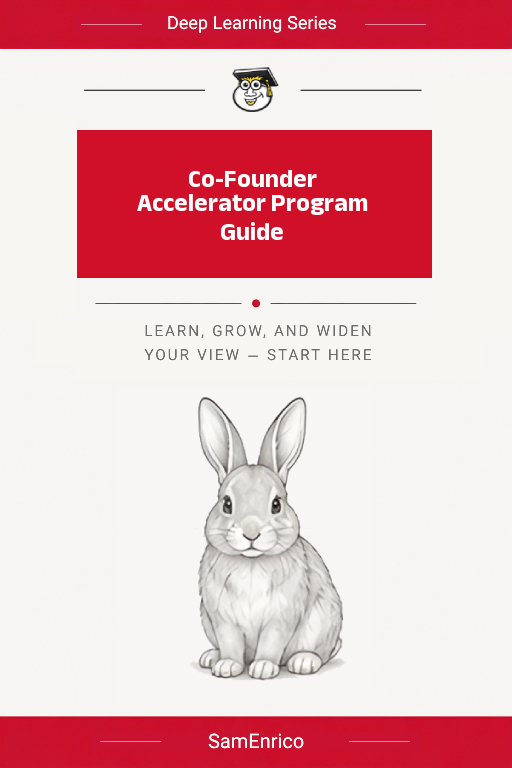
Co-Founder Accelerator Program Guide eBook
Apply to startup accelerators that offer structure
Apply to startup accelerators that offer structured co-founder matching as part of their application process.
Formats
Free sample
Chapter 1: The Solo Delusion--–- The email arrived at 11:47 PM on a Tuesday. Sarah had been staring at her screen for fourteen hours, tweaking the same pitch deck slide for the twelfth time. She had a Harvard MBA, seven years of consulting experience, and a "revolutionary" idea for supply chain software. She had applied to fourteen accelerators. She had been rejected by thirteen.
The one acceptance came with a catch: "We love your background, but we don't fund solo founders. Find a co-founder, and we'll reconsider."Sarah did what any rational, overachieving consultant would do. She posted on Linked In: "Seeking technical co-founder for exciting supply chain startup. Equity available. Must be passionate and hardworking." She received forty-three responses.
She scheduled fifteen coffee chats. She picked the person with the most impressive Git Hub portfolio. Within six weeks, they had stopped speaking. Within eight, the technical co-founder had forked the codebase and started a competing company. Within twelve, Sarah had withdrawn her accelerator application entirely.This book exists because Sarah's story is not the exception.
It is the default.The Myth of the Lone Genius Silicon Valley has sold us a seductive lie: the lone founder, coding in a garage, who changes the world through sheer force of will. Steve Jobs. Bill Gates. Mark Zuckerberg. The narrative is intoxicating because it promises total control, no compromise, and pure vision.
It is also, for the vast majority of founders, a complete fantasy.Let me be precise with the data, because this matters. A comprehensive study conducted by Harvard Business School professor Noam Wasserman, analyzing over ten thousand founders across two decades, found that solo founders are 2.7 times more likely to fail than teams of two or three. Not slightly more likely. Nearly three times. Paul Graham of Y Combinator, who has funded over three thousand startups, puts it even more bluntly: "A single founder is a red flag.
We almost never fund them unless they have a truly exceptional track record."Why? The reasons are structural, not personal.First, there is the problem of cognitive load. A startup requires simultaneous mastery of product development, customer acquisition, fundraising, hiring, legal compliance, and operational management. No single human being can excel at all of these. Attempting to do so leads to what psychologists call "decision fatigue" and what founders call "burnout by Wednesday."Second, there is the problem of emotional regulation.
When you are alone, every setback feels catastrophic because there is no one to absorb half the weight. When you miss a revenue target, when a key hire quits, when a customer threatens to sue, a co-founder provides a mirror that says, "We will figure this out." A solo founder stares into the void and hears only their own panicked breathing.Third, there is the problem of investor psychology. Venture capitalists are not rational actors. They are pattern-matching machines. The pattern they have seen succeed thousands of times is a balanced team: one business mind, one technical mind.
The pattern they have seen fail is the solo visionary who cannot delegate. When you walk into a pitch meeting alone, the investor is not thinking, "What a powerful individual." They are thinking, "Who will challenge this person? Who will tell them when they are wrong?"This is not a critique of your abilities. It is a description of the system. And the system has spoken.The New Solution You Have Never Heard Of For the past decade, aspiring founders faced a cruel choice: force a co-founder relationship with a friend, a roommate, or a stranger from a networking event, or go it alone and accept the statistical penalty.
Both options were terrible. Forced relationships crumbled under pressure. Solo journeys ended in exhaustion.Then, quietly, a new category of startup accelerator emerged. Antler launched in Singapore in 2017 with a radical premise: we will accept individuals, and we will match them with co-founders as part of our program. Entrepreneur First, founded in London in 2011, followed a similar model: find exceptional people, put them in a room together, and let the teams form organically.
Techstars, the global accelerator giant, launched remote and city-specific tracks that prioritize individual applicants and provide structured matching support.These programs are not dating apps. They are not networking events. They are intensive, mentored, time-boxed processes designed to compress years of co-founder vetting into weeks. You do not need to arrive with a partner. You do not need to have a fully formed idea.
You need to bring one thing: a demonstrated ability to build or sell something that matters.The results have been astonishing. Antler has backed over seven hundred companies across thirty cities, with portfolio valuations exceeding ten billion dollars. Entrepreneur First has helped launch over two hundred companies worth more than fifteen billion dollars collectively, including Magic Pony Technology (acquired by Twitter for 150million)and Tractable(valuedatover150 million) and Tractable (valued at over 150million)and Tractable(valuedatover1 billion). These are not minor experiments. They are proof that structured co-founder matching can work at scale.Consider the story of Rohan and Priya.
Rohan was a machine learning engineer who had built a recommendation engine for a failed fitness app. Priya was a former doctor who had spent five years watching hospitals mismanage surgical inventory. They applied separately to the same accelerator program. They were matched during the first week. Within three months, they had built a prototype, secured a pilot with a regional hospital chain, and raised $1.2 million in pre-seed funding.
Neither would have succeeded alone. Together, they became unstoppable.Or consider Marcus, a former teacher who had never written a line of code. He applied to a co-founder accelerator with nothing but a deep understanding of how special education paperwork drained teachers' time. He was matched with a former Google engineer who had a disabled child and had experienced the same frustration. They built a simple document automation tool.
Eighteen months later, they had two hundred thousand users and a Series A round. Marcus still cannot code. He does not need to.These stories share a common structure. An individual with domain expertise or technical skill. A structured matching process.
A compressed timeline. And a willingness to let go of the solo delusion.What This Book Will Do For You You are reading this book for one of three reasons. First, you are a solo founder who has been rejected by accelerators and cannot figure out why. Second, you have tried to find a co-founder through networking, Linked In, or friend referrals, and every attempt has ended in frustration or failure. Third, you have heard about co-founder accelerators but have no idea how to navigate their unique application process, matching dynamics, and compressed timelines.Whatever your reason, this book will give you a complete, step-by-step playbook.I am not a theorist.
I am a practitioner who has advised over two hundred founders through co-founder accelerators, watched hundreds of matches succeed and fail, and distilled the patterns into a repeatable process. The chapters ahead will teach you:Chapter 2 – The Readiness Assessment: How to determine if you are truly ready for a co-founder accelerator, including the Inventory Audit and the distinction between the two founder profiles (Idea Person vs. Builder).Chapters…
This is the end of the free sample. Get the eBook to keep going. Buy now
About this book
Details
- Author
- Naranjo Patrica
- Publisher
- SamEnrico
- Language
- English
- Genre
- Non-Fiction, First 30 Days, Accelerator Access
- Released
- 2026-06-01
- Pages (approx.)
- 124
- Available as
- eBook, Audiobook

Read better in the ZLOADR app
Your eBooks on your phone or tablet. Sign in with your SamEnrico account and start reading.
More by Naranjo Patrica
 The Empathy WorkbookNaranjo Patrica$11.99
 Transactional Funding GuideNaranjo Patrica$11.99
 Trigeminal Neuralgia PracticeNaranjo Patrica$11.99
 Quality Control CreativityNaranjo Patrica$11.99
 Emergency Freelance SavingsNaranjo Patrica$11.99
 The ED Understanding GuideNaranjo Patrica$11.99
 Anger Restructuring for Brain InjuryNaranjo Patrica$11.99
 Gambling Therapy OptionsNaranjo Patrica$11.99
 The Petrobras Scandal: Brazil's Billion-Dollar Corruption WebNaranjo Patrica$11.99
 Ra and the Stormborn: A Norse-Egyptian Cosmic ClashNaranjo Patrica$11.99
 A Collector's Handbook to the Alfa Romeo Giulia 1300Naranjo Patrica$11.99
 Days Sales Outstanding GuideNaranjo Patrica$12.99