
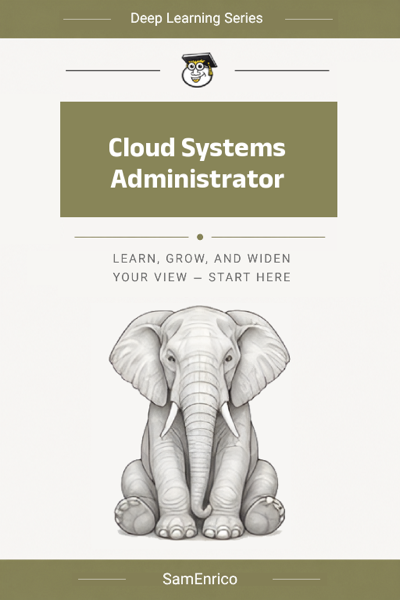
Non-FictionInformativeEducational
Cloud Systems Administrator eBook
A Coursebook on Cloud Systems Administrator
by Finnegan Ewa
A Coursebook on Cloud Systems Administrator
Formats
Free sample
Chapter 1: The Snowflake Cemetery...–- The first time you spend four hours trying to resuscitate a server that someone named “Dave’s Special Box,” you are not doing system administration. You are performing digital necromancy. And you are losing money.This chapter opens not with a diagram of a Virtual Private Cloud or a cheerful bullet list of “cloud benefits.” It opens with a funeral. The deceased is a server. It had a name, a personality, and a carefully curated collection of manual patches that only one离职 engineer understood.
When it died at 2:17 AM on a Sunday, the on-call administrator spent three hours searching through old Confluence pages, another hour trying to reach the former engineer on his personal phone, and finally resorted to restoring from a backup that was, it turned out, seventeen days old.That administrator is you, in an alternate timeline. This book exists to ensure you never become that person.The Pet Server Delusion If you came from the world of traditional, on-premise system administration, you were likely taught—implicitly or explicitly—that servers are precious. Each server has a name, a purpose, a history, and a set of quirks. You have a mental map of which server runs which cron job. You know that “mail02” has a weird network card that needs a specific driver.
You know that “db-primary” cannot be rebooted without first stopping the replication service manually, because someone wrote a script six years ago that nobody fully understands.This is the pet server model, and it worked reasonably well when you had thirty servers, a predictable workload, and a maintenance window once a month. But in the cloud, with hundreds or thousands of ephemeral instances spinning up and down every hour, the pet server model becomes not just inefficient but actively dangerous.The alternative is the cattle model. In the cattle model, servers are not named. They have serial numbers. They are identical, interchangeable, and disposable.
If a server becomes unhealthy, you do not attempt to heal it. You do not SSH into it to manually edit configuration files. You do not run a series of arcane diagnostic commands. You shoot it and spin up a new one.This sounds cold. It sounds like you are abandoning the craft of system administration.
In fact, you are elevating it. The craft is no longer about nurturing individual servers. It is about designing systems that make individual servers irrelevant.The Hidden Cost of Click-Ops Before we go further, we need to name the enemy. The enemy is not the cloud provider, not the networking team, not the developers who keep asking for more permissions. The enemy is click-ops—the practice of managing infrastructure by clicking buttons in a web console.Click-ops is seductive.
The console is visual, seemingly intuitive, and gives you immediate feedback. You launch an instance, you see it appear in the list, and you feel a small dopamine hit of accomplishment. You attach a volume, you modify a security group, you take a snapshot. Each click feels like progress.But each click is also a debt. Every manual action you take in the console is an action that no one else knows about, that cannot be reproduced automatically, that will not be captured in version control, and that will almost certainly be forgotten by the time you need to perform it again during an outage.Let us be precise about the cost of click-ops:First, it is unrepeatable.
If you create a resource by clicking through a series of dialog boxes, can you guarantee that you will remember the exact sequence of choices you made? Can someone else on your team replicate it? The answer, almost always, is no. The best you can hope for is a set of incomplete notes in a shared document that has not been updated since the Obama administration.Second, it is undebuggable. When something goes wrong with a resource you created manually, how do you know what “correct” looks like?
You do not have a source of truth. You have only the running configuration, which may have been modified a dozen times since creation by a dozen different people, each of whom made a small change and then forgot to document it.Third, it is unscalable. The console works fine for one instance. It sort-of works for five instances. By the time you need to manage fifty instances, you have already given up and started copy-pasting configuration values, which is just click-ops with extra steps.
By the time you need to manage five hundred instances, the console is not even a joke; it is a tragedy.Fourth, it is the primary cause of snowflake servers.What Is a Snowflake Server, Really?We introduced the term “snowflake server” earlier. Now let us define it with surgical precision.A snowflake server is any server that cannot be automatically recreated from a known, version-controlled, auditable source of truth. Snowflake servers have unique characteristics that are not codified. They are the result of manual interventions, undocumented changes, and accumulated technical debt.Snowflake servers are not necessarily bad because they are unstable. They are bad because they are unreproducible.
When a snowflake server fails, you cannot simply terminate it and launch a replacement. You must perform forensic analysis. You must attempt to understand what made it special. You must hope that the person who made it special is still employed and remembers what they did.Here are the telltale signs that you are caring for a snowflake server:You have ever said, “That server is a bit delicate, so be careful when you reboot it.”There is a document (or, worse, a sticky note) with a list of “important commands to run after a restart.”The server has been running for more than six months without being replaced—not because it is reliable, but because no one is brave enough to test whether a replacement would work.You know the server by a nickname, and that nickname is not its hostname.The server has accumulated custom repositories, manually installed packages, and edited configuration files that are not present in your configuration management system—because you do not have a configuration management system.If any of these descriptions made you nod uncomfortably, you are not alone. Snowflake servers are the default state of organizations that have moved to the cloud without changing their operational philosophy.
They have simply taken their pets and put them on EC2.The Resilience Paradox There is a profound misunderstanding that haunts many cloud migrations. It sounds like this: “The cloud is more reliable than our data center, so we will have fewer failures.”This is false.The cloud does not reduce the frequency of failures. It changes the shape, scope, and character of failures. But the total number of things that can and will go wrong remains approximately constant. This is not cynicism; it is a statement about distributed systems.In your on-premise data center, failures tended to be infrequent but catastrophic.
You might have one server failure every few months, but when a failure occurred, it was often because a disk died or a power supply failed or a network switch melted. These failures were…
This is the end of the free sample. Get the eBook to keep going. Buy now
About this book
Details
- Author
- Finnegan Ewa
- Publisher
- SamEnrico
- Language
- English
- Genre
- Non-Fiction, Informative, Educational
- Released
- 2026-05-08
- Pages (approx.)
- 128
- Available as
- eBook, Audiobook

Read better in the ZLOADR app
Your eBooks on your phone or tablet. Sign in with your SamEnrico account and start reading.
More by Finnegan Ewa
 Phobia Myths DebunkedFinnegan Ewa$11.99
 Portugal Consumer GuideFinnegan Ewa$11.99
 Affirmations For Public Speaking GuideFinnegan Ewa$11.99
 Touch Sensitivity After TraumaFinnegan Ewa$11.99
 Letting Go of Emotional SufferingFinnegan Ewa$11.99
 The Phantom Gold: The 1968 Mexico City 200m Scandal That Shook the OlympicsFinnegan Ewa$11.99
 Creative Split Test First GuideFinnegan Ewa$12.99
 Brian Armstrong GuideFinnegan Ewa$12.99
 How to Become a DriverFinnegan Ewa$11.99
 Understanding Pallister–killian SyndromeFinnegan Ewa$17.99
You may also like
 Hong Kong Handover 1997Dunn Johnnie$11.99
 Zumba For Postnatal Recovery CourseNeal Christian$11.99
 Zumba for BeginnersLadner Nikia$11.99
 YouTube Comment Mining GuideHumes Pandora$12.99
 Worry Box MeditationCarlin Rudy$11.99
 Workplace Stress MeditationNguyen Lynn$11.99
 Workplace Stress and Sleep RepairHawley Ivory$11.99
 Workplace Perfectionism CureDelaney Jeffry$11.99
 Workplace Injustice Anger GuideWallen Isabelle$11.99
 Work Addiction and Burnout LinkGreenwood Ester$11.99
 Women in Yoga and WellnessBeattie Galina$11.99
 Women in Stand Up ComedyChun Evangeline$11.99