
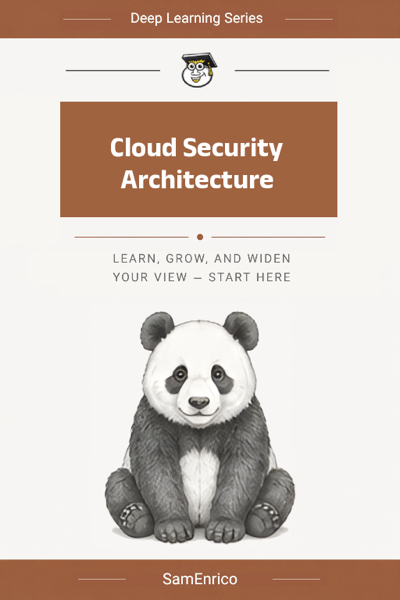
Non-FictionInformativeEducational
Cloud Security Architecture eBook
A Coursebook on Cloud Security Architecture
A Coursebook on Cloud Security Architecture
Formats
Free sample
Chapter 1: The Perimeter Lie--The greatest lie ever sold to security professionals was the perimeter. For three decades, we built castles—firewalls at the gates, IDS on the walls, VPNs as drawbridges—and we told ourselves that anything inside the moat was trustworthy. We called it "defense in depth," but what we really built was a sugar-coated shell around a soft, chewy center. And then we handed our enemies the recipe.The cloud did not kill the perimeter. The perimeter was already dead.
We just refused to bury it.In the era of smartphones, remote work, Saa S applications, and API-driven everything, the castle walls have turned to vapor. Your corporate network is now a sprawling archipelago of coffee shops, home offices, AWS availability zones, Slack workspaces, and Salesforce instances. There is no moat. There is no drawbridge. There is only identity, data, and the thin wire that connects them—and somewhere in that wire, an adversary is already moving laterally through your supposedly "secure" environment, laughing at the firewall rules you spent six months tuning.This book is not about tools.
It is not a cheatsheet of CLI commands or a memorization guide for compliance checkboxes. This book is about architecture—the blueprints, the trust boundaries, the control planes, and the enforcement paths that either protect your organization or betray it. And Chapter 1 has a single, brutal job: to convince you that everything you thought you knew about security is built on a foundation of sand, and that the only way forward is to burn that foundation down and rebuild from first principles.If you are looking for a gentle introduction, close this book now. What follows is an unflinching autopsy of why cloud security fails, a demolition of the perimeter mindset, and the first glimpse of what replaces it. By the time you finish this chapter, you will never look at a virtual private cloud the same way again.The Anatomy of a Cloud Security Architecture Before we diagnose the failures, we must define the cure.
Cloud security architecture is not a product, a certification, or a team. It is a structured blueprint—a set of design decisions that answer five fundamental questions:Who is trusted? (Identity and access boundaries)What can they do? (Authorization and policy enforcement)Where can they go? (Network segmentation and data flows)How do we know?
(Observability and detection)What happens when trust fails? (Incident response and resilience)Every cloud workload, from a serverless function that runs for 100 milliseconds to a petabyte-scale data lake, must be placed within this blueprint. The architecture defines the trust boundaries—the lines across which trust is not assumed but verified. It defines the control plane—the API layer through which every configuration, every permission, and every audit log flows. And it defines the enforcement paths—the specific points where policy is evaluated and actions are allowed or denied.Here is the hard truth: Most organizations have none of this.
What they have are accumulated configurations—a decade of Terraform scripts, click-ops decisions, emergency firewall rule changes made at 2 AM, and permissions granted "just to make it work." That is not architecture. That is entropy masquerading as infrastructure.The difference between architecture and accumulated configuration is the difference between a cathedral and a rubble pile. Both use the same stones. One has a blueprint.The Perimeter Delusion: Why Castles Never Worked Let us perform an honest autopsy of the perimeter model, because until we understand exactly why it failed, we will keep rebuilding its ghost inside the cloud.The traditional perimeter assumed that your network was a container. Traffic inside the container was "trusted" because it had passed through the firewall.
This assumption required three things to be simultaneously true:The network was physically owned and controlled. Your cables, your switches, your buildings.Users were inside the building. Work happened from 9 to 5, at a desk, on a desktop.Attackers were outside the building. The threat was external, and internal traffic was safe.By 2015, not one of these assumptions held. By 2026, they are laughable.The first crack appeared with wireless networks.
Suddenly, "inside" meant anyone within signal range—including the van parked outside with a directional antenna. The second crack appeared with bring-your-own-device. A compromised personal laptop on the guest Wi-Fi was now "inside" the perimeter. The third crack was the smartphone—a device that leaves the building every night, connects to unsecured networks, and returns each morning with whatever malware it collected.But the real demolition came with the cloud. When your data lives in AWS and your users work from home and your applications are Saa S subscriptions, what exactly is the perimeter protecting?
The answer is nothing. The perimeter became a conceptual relic—a comforting story we told ourselves while adversaries walked straight through the front door using stolen credentials.The data is stark. According to industry reporting over the 2022-2025 period, over 80% of cloud breaches involved compromised credentials, not firewall exploits. The adversary did not break the wall. They logged in.
And the perimeter—designed to keep "bad people out"—had nothing to say about a legitimate user with a stolen password.This is not a technology failure. It is an architectural failure. And until we stop building cloud environments as if they were just someone else's data center, we will keep bleeding.The 2026 Threat Landscape: What You Are Actually Fighting Let us set aside abstract fear and look at the actual threat landscape facing cloud architects today. This is not a complete list—that would require its own book—but these are the attack patterns that should keep you awake at night.Compromised Credentials: The Uncontested King A credential is a key. In the cloud, that key opens everything—not just one server, but the entire control plane.
An attacker with a valid AWS access key and secret can, in minutes, enumerate every resource in an account, exfiltrate every S3 bucket, launch crypto miners, and delete your backups. The firewall does not blink. The intrusion detection system sees API calls from a legitimate user. The only evidence is a line in Cloud Trail, buried among millions of others.The average dwell time—the period between initial compromise and detection—varies widely by industry and organization maturity, but industry reports consistently show that attackers often have weeks or months of free rein. They are not rushing.
They are exploring, escalating privileges, and mapping your environment while you sleep.Misconfiguration: The Self-Inflicted Wound Here is the insult: You do not need to be hacked. You will hack yourself.A misconfigured S3 bucket—set to "public" by accident or ignorance—is discovered by automated scanners within minutes of being created. A database with a default password, exposed to the internet because someone checked the wrong box in the console. A security group with a rule allowing 0.0.0.0/0 on port 22 (SSH), left over from a developer's testing three years ago. These are not sophisticated attacks.
They are self-inflicted gunshot wounds.And they are everywhere. Cloud security posture management (CSPM) tools, scanning millions of cloud accounts, consistently find that the majority of organizations have at least one publicly exposed storage bucket or database. Not because they are incompetent, but because the cloud's…
This is the end of the free sample. Get the eBook to keep going. Buy now
About this book
Details
- Author
- Billings Agatha
- Publisher
- SamEnrico
- Language
- English
- Genre
- Non-Fiction, Informative, Educational
- Released
- 2026-06-02
- Pages (approx.)
- 160
- Available as
- eBook, Audiobook

Read better in the ZLOADR app
Your eBooks on your phone or tablet. Sign in with your SamEnrico account and start reading.
More by Billings Agatha
 Self Hypnosis For Phobia Relief GuideBillings Agatha$11.99
 Alcohol Free Dream JournalingBillings Agatha$11.99
 Indonesian Chinese EscapeBillings Agatha$11.99
 Lagos Power Outage Pop UpBillings Agatha$11.99
 Stress Immune System ConnectionBillings Agatha$11.99
 Five Minute Walking ResetBillings Agatha$11.99
 Workaholism For Tech WorkersBillings Agatha$11.99
 GWOT Master GuideBillings Agatha$11.99
 Water Dreams In ChildhoodBillings Agatha$11.99
 The Vanishing Act of the Amber RoomBillings Agatha$11.99
 The Golden Harps of Axum: Africa's Royal SymphoniesBillings Agatha$11.99
 The Great Train Robbery That Wasn’t: The Phantom Heist of 1963Billings Agatha$11.99
You may also like
 Hong Kong Handover 1997Dunn Johnnie$11.99
 Zumba For Postnatal Recovery CourseNeal Christian$11.99
 Zumba for BeginnersLadner Nikia$11.99
 YouTube Comment Mining GuideHumes Pandora$12.99
 Worry Box MeditationCarlin Rudy$11.99
 Workplace Stress MeditationNguyen Lynn$11.99
 Workplace Stress and Sleep RepairHawley Ivory$11.99
 Workplace Perfectionism CureDelaney Jeffry$11.99
 Workplace Injustice Anger GuideWallen Isabelle$11.99
 Work Addiction and Burnout LinkGreenwood Ester$11.99
 Women in Yoga and WellnessBeattie Galina$11.99
 Women in Stand Up ComedyChun Evangeline$11.99