
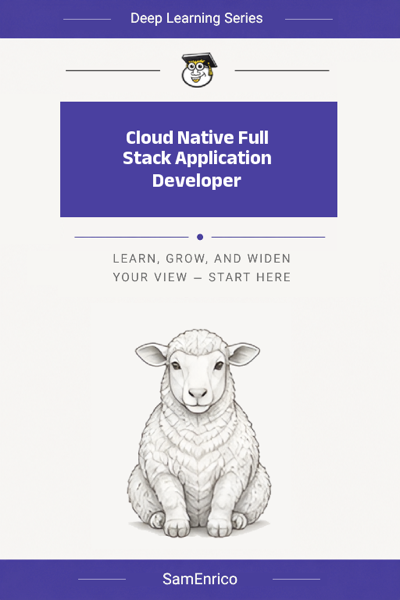
Cloud Native Full Stack Application Developer eBook
A Coursebook on Cloud Native Full Stack Applicatio
A Coursebook on Cloud Native Full Stack Application Developer
Formats
Free sample
Chapter 1: The Deployment Nightmare...--–- It was 2:47 AM on a Saturday when Sarah’s phone erupted with the sound she dreaded most: Pager Duty’s relentless, screeching alert. She stumbled out of bed, knocking over a half-empty glass of water, and squinted at the blinding screen. "Checkout service – 99th percentile latency > 10 seconds. Availability at 72%." Her e-commerce startup, Trendly, had just launched its biggest Black Friday campaign. And it was failing.
Hard.She opened her laptop, the cold blue light illuminating a face that hadn’t seen eight hours of sleep in weeks. Three other engineers were already on the emergency bridge call, their voices a mix of panic and exhaustion. "Did we push something?" someone asked. "No, the last deploy was Wednesday," another replied. "It was working fine yesterday.
This came out of nowhere."For the next four hours, Sarah and her team did what they always did in a crisis: they guessed. They restarted the checkout service. No change. They added more servers. The latency got worse.
They rolled back to a three-day-old build. The site came back up, but the database was now out of sync, and customers were seeing phantom orders. By 7 AM, they had "stabilized" things – meaning the site was semi-functional, but no one knew why it had broken or whether it would happen again. Sarah’s CEO sent a Slack message: "What happened? And how do we make sure this never happens again?"Sarah stared at the message for a long time.
She didn't have an answer. She had been coding for seven years. She knew React. She knew Node.js. She even knew a bit about databases.
But the failure she had just lived through wasn't about code. It was about everything around the code – how the application was deployed, how it scaled, how it recovered, how it communicated, and how it could be observed. She had built a beautiful monolith that ran perfectly on her laptop. And then she had tried to run it in the cloud, at scale, under real traffic.That night changed everything for Sarah. It was the night she stopped being just a "full stack developer" and started her journey toward becoming a Cloud Native Full Stack Application Developer.This book is for every Sarah out there.
For every developer who has felt the cold terror of a production outage they couldn't explain. For every engineer who has pushed code at 11 PM on a Friday, hoping nothing would break. For every team that has accepted slow deployments, fragile infrastructure, and sleepless nights as just "part of the job."They don't have to be.This chapter isn't about code. It's about a mindset. Before we write a single line of YAML or Type Script, before we spin up a single container or deploy a single microservice, we need to understand why we're doing any of this.
We need to confront the fundamental flaws in the way most applications are still built today – and we need to see a better way.Let's start by diagnosing the patient: the traditional monolithic application.The Hospital of Broken Dreams: Diagnosing the Monolith Sarah's e-commerce platform, like the vast majority of applications built in the last fifteen years, was a monolith. That doesn't mean it was a bad application. It probably started beautifully. A small team, a clear idea, a single codebase. Everything together: the user interface, the business logic, the database access layer, the authentication, the checkout flow, the inventory management.
All of it compiled into one giant deployable unit.For the first year, this was a superpower. You could make a change to the checkout flow and immediately use that same change in the inventory management. No network calls. No versioning headaches. No distributed transactions.
Development was fast. Deployment was simple. Life was good.Then the second year arrived.The team grew from three to fifteen engineers. Now, every time someone wanted to change the product catalog, they had to wait for the checkout team to finish their testing. The codebase, once a neatly organized directory structure, became a tangled nightmare of interdependencies.
Changing one line in a utility function broke three seemingly unrelated features. The test suite, which used to take ninety seconds, now took forty-five minutes to run. Deployment, which used to be a five-minute git push, now required a two-hour ritual of coordination, database migrations, and prayers.This is the accidental complexity that Fred Brooks warned about in his seminal work, The Mythical Man-Month. Not the essential complexity of solving your business problem – that's unavoidable. But the accidental complexity that arises from your architecture choices.
The monolith, for all its initial speed, eventually becomes a prison.Let's examine the specific ways the monolith fails in production – the same ways Sarah's application failed at 2:47 AM.The Single Point of Catastrophic Failure In a monolith, everything is connected. The checkout flow shares memory with the product catalog. The user authentication service is on the same thread pool as the inventory update job. What this means in practice is that a bug in any part of the system can bring down the entire system.Sarah saw this firsthand. A memory leak in a low-level logging library – a library that every service used – slowly consumed all available heap space over the course of forty-eight hours.
By the time Black Friday traffic hit, the entire application was gasping for RAM. Requests backed up. Threads blocked. The whole site became unresponsive.In a monolith, there is no "partial outage." You cannot say, "Well, the checkout is slow, but at least users can still browse." The checkout, the browsing, the search, the recommendations – they all live in the same process. One bad actor takes down the whole show.The Scaling Lie When your application is monolith, you cannot scale individual components.
If the checkout flow needs ten instances to handle the Black Friday rush, but the product catalog only needs two instances, too bad. You scale the entire monolith – all ten instances of everything. You are paying for compute power you don't need, and you are still limited by the bottleneck of your slowest component.This is what happened to Sarah. The team added more servers. But the latency didn't improve because the bottleneck was a shared database connection pool, not CPU.
Adding more monolith instances actually made the problem worse, as each new instance competed for the same limited database connections. They were applying a brute-force solution to a scalpel problem.The Deployment Death Spiral Perhaps the most insidious problem with the monolith is what happens to deployment velocity over time. In a startup's first year, you might deploy ten times a day. By year three, if you've grown, you're lucky to deploy once a week. Why?Because the monolith becomes too big to fail safely.
Every deployment carries the risk of taking down the entire application. Therefore, every deployment requires:Hours of manual testing A coordinated rollout plan A database migration that must be backward-compatible for three versions A rollback plan that involves restoring a database from backup A post-deployment "war room" where everyone waits to see if the site falls over The fear of breaking everything slows everything. Teams stop deploying. Features pile up.…
This is the end of the free sample. Get the eBook to keep going. Buy now
About this book
Details
- Author
- Snodgrass Lue
- Publisher
- SamEnrico
- Language
- English
- Genre
- Non-Fiction, Informative, Educational
- Released
- 2026-05-11
- Pages (approx.)
- 142
- Available as
- eBook, Audiobook

Read better in the ZLOADR app
Your eBooks on your phone or tablet. Sign in with your SamEnrico account and start reading.
More by Snodgrass Lue
 EQ Performance Review GuideSnodgrass Lue$11.99
 End Emotional Eating ManualSnodgrass Lue$11.99
 The Anger Trigger ThresholdSnodgrass Lue$11.99
 SAS Airborne Parachute SchoolSnodgrass Lue$11.99
 Post Project Creative Review GuideSnodgrass Lue$11.99
 The Last Pharaoh's Gambit: Cleopatra's Hidden WarSnodgrass Lue$11.99
 The Ghost in the Machine: How a Teen Hacker Almost Broke the InternetSnodgrass Lue$11.99
 Understanding Galactorrhea HyperprolactinemiaSnodgrass Lue$17.99
 Meta AI Outreach HandbookSnodgrass Lue$12.99
 ESL Income Potential GuideSnodgrass Lue$12.99
 How to Start a Snack Bar Business (Beginners Guide)Snodgrass Lue$11.99