
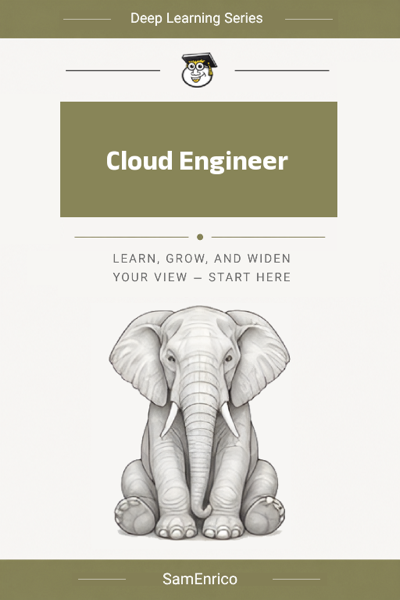
Non-FictionInformativeEducational
Cloud Engineer eBook
A Coursebook on Cloud Engineer
A Coursebook on Cloud Engineer
Formats
Free sample
Chapter 1: The $150K Question--–- Maria stared at her screen. The ticket read: “Migrate 200 on-premise servers to AWS by Q3.” She was a Sys Admin with fourteen years of experience. She knew how to rack servers, patch kernels, and replace failed hard drives in a RAID array blindfolded. But this? The cloud felt like a different universe.
She didn’t know where to start. She was terrified she’d become obsolete.Six months later, Maria accepted a cloud engineer role with a base salary of $140,000 plus equity. Her old job? It had been eliminated in a round of “infrastructure optimization.” The company didn’t need someone to rack servers anymore. They needed someone to write infrastructure as code.
Maria wasn’t smarter than her peers. She wasn’t a prodigy. She simply learned one thing that this chapter will teach you: cloud engineering isn’t about knowing every service—it’s about adopting a different mindset.This chapter establishes the conceptual and professional foundation for your entire journey. It answers the question every aspiring cloud engineer asks silently: “Is this worth it? Can I really do this?” By the end, you will understand why cloud engineers command six-figure salaries, how the role differs from traditional IT, and the mental model that separates the overwhelmed from the employable.The Great Divide: Cloud Engineer vs.
Sys Admin vs. Dev Ops Let’s clear up a massive point of confusion immediately. Job titles in this industry are messy. Companies post “Cloud Engineer” roles that are actually Sys Admin jobs with “cloud” tacked on for recruiting. Others post “Dev Ops Engineer” when they really want a cloud architect.
You need to know the difference—not for semantic purity, but because your career trajectory and salary depend on it.The Traditional Sys Admin The Sys Admin works with physical or virtualized servers as discrete pets. Each server has a name, a personality, and a manual configuration. You SSH into server A to fix a problem. You run updates by hand. You document configurations in a wiki.
When a server dies, you feel genuine loss—like a pet hamster passing away. The Sys Admin mindset is craft-oriented. It values deep knowledge of a specific operating system, manual troubleshooting skills, and the ability to keep fragile systems alive through sheer will.The Sys Admin asks: “What is wrong with this server, and how do I fix it right now?”This role isn’t going away entirely, but it is shrinking. According to the 2024 Stack Overflow Developer Survey, pure Sys Admin roles declined by 18% year-over-year while cloud-focused roles grew by 34%. The reason is simple: when your infrastructure runs on AWS, Azure, or GCP, you don’t care about the individual server.
You care about the auto-scaling group.The Cloud Engineer The Cloud Engineer treats infrastructure as disposable cattle. Servers have numbers, not names. If one dies, the auto-scaling group launches another. Configuration is defined in code, stored in Git, and applied automatically. You never SSH into a production server to “fix” something—you fix the code and redeploy.
The Cloud Engineer mindset is engineering-oriented. It values automation, repeatability, and designing for failure.The Cloud Engineer asks: “How do I define this infrastructure so it never needs manual intervention?”This shift is not trivial. It requires unlearning habits that served you well as a Sys Admin. The command line is still important—you learned that in Chapter 2 of this book—but it’s used to write scripts and run automation, not to poke at ailing servers.The Dev Ops Engineer Dev Ops is a culture, not a role, but companies hire for it anyway. The Dev Ops engineer focuses on the software development lifecycle (SDLC): continuous integration, continuous delivery, monitoring, and feedback loops.
They build the pipelines that take code from a developer’s laptop to production. A Cloud Engineer might provision the infrastructure (VPCs, subnets, load balancers) while a Dev Ops engineer builds the CI/CD pipeline that deploys the application onto that infrastructure. In practice, these roles overlap heavily. Most job postings use them interchangeably.The key takeaway for you: focus on the Cloud Engineer skillset first. It is the broadest foundation.
From there, you can specialize into Dev Ops, Security (Cloud Security Engineer), or Data (Cloud Data Engineer).Why Cloud Engineers Get Paid More Let’s talk about money directly. The 2024 Robert Half Technology Salary Guide reports the following median salaries in the United States:Sys Admin (5+ years experience): $85,000 – $115,000Cloud Engineer (3+ years experience): $130,000 – $175,000Senior Cloud Engineer (5+ years experience): $160,000 – $220,000Why the gap? It’s not because cloud engineers work harder or are smarter. It’s leverage.A Sys Admin can manage perhaps 50 to 200 servers manually, depending on tooling. A Cloud Engineer using Infrastructure as Code (which you will master in Chapter 7) can manage 5,000 servers with the same effort.
The cloud engineer’s work scales. When you write a Terraform configuration that launches 1,000 servers across three Availability Zones, your labor is multiplied by the cloud’s automation capabilities. Companies pay for leverage.Second, cloud engineers directly control costs. A Sys Admin’s value is often invisible—servers are just “working.” But a Cloud Engineer who optimizes a workload from $50,000 per month to $30,000 per month (Chapter 11 will show you exactly how) has just saved the company $240,000 annually. That’s measurable.
That’s valuable.Third, supply and demand. Cloud adoption is still accelerating. AWS alone generated $90 billion in revenue in 2023, growing 13% year-over-year. Azure and GCP are growing even faster. Every company is becoming a software company, and every software company is (or will be) in the cloud.
There aren’t enough skilled cloud engineers to fill the roles.The Shared Responsibility Model: What You Own vs. What the Cloud Owns One of the most misunderstood concepts in cloud computing is the Shared Responsibility Model. Misunderstanding it has cost companies millions of dollars and engineers their jobs. You need to internalize this.Imagine you rent an apartment. The landlord is responsible for the building’s structure: the roof, the foundation, the plumbing in the walls, the electrical wiring.
You are responsible for what’s inside your apartment: locking your door, not leaving the stove on, keeping your valuables safe. If a pipe bursts in the wall, call the landlord. If you leave your laptop on the subway, that’s on you.The Shared Responsibility Model works exactly the same way.The Cloud Provider (AWS, Azure, GCP) is responsible for:Physical security of data centers (guards, fences, biometric access)Hardware (servers, storage devices, network cables)Virtualization layer (the hypervisor that runs your VMs)Network infrastructure (routers, switches, power distribution)The Customer (you and your company) is responsible for:Customer data (encrypting it, backing it up, not leaking it)Identity and Access Management (who has which permissions)Operating system configuration (patching, user accounts, firewall rules inside the VM)Application security (code vulnerabilities, API security)Network traffic encryption (using HTTPS, TLS, VPNs)Where the line gets fuzzy is with managed services. For example, Amazon RDS (Relational Database Service) is a managed database. AWS handles the operating system patching, the database software installation, and the underlying hardware.
You are still responsible for the data inside the database, who has access to it, and how it’s encrypted.The Capital…
This is the end of the free sample. Get the eBook to keep going. Buy now
About this book
Details
- Author
- Connolly Charlyn
- Publisher
- SamEnrico
- Language
- English
- Genre
- Non-Fiction, Informative, Educational
- Released
- 2026-06-03
- Pages (approx.)
- 160
- Available as
- eBook, Audiobook

Read better in the ZLOADR app
Your eBooks on your phone or tablet. Sign in with your SamEnrico account and start reading.
More by Connolly Charlyn
 Bipolar Cognitive SymptomsConnolly Charlyn$11.99
 Alcohol Detox Pancreatitis RiskConnolly Charlyn$11.99
 Blanking Out Recovery ProtocolConnolly Charlyn$11.99
 Dan Mask Wisdom TeachingsConnolly Charlyn$11.99
 The Comparison Trap at WorkConnolly Charlyn$11.99
 The Silent Sky Warriors: Asia's First Wingsuit Revolution (1999-2008)Connolly Charlyn$11.99
 Understanding Post-traumatic EpilepsyConnolly Charlyn$17.99
 GA4 Events Tracking HandbookConnolly Charlyn$12.99
 Casual Dining GuideConnolly Charlyn$12.99
 How to Become a Lathe OperatorConnolly Charlyn$11.99
You may also like
 Hong Kong Handover 1997Dunn Johnnie$11.99
 Zumba For Postnatal Recovery CourseNeal Christian$11.99
 Zumba for BeginnersLadner Nikia$11.99
 YouTube Comment Mining GuideHumes Pandora$12.99
 Worry Box MeditationCarlin Rudy$11.99
 Workplace Stress MeditationNguyen Lynn$11.99
 Workplace Stress and Sleep RepairHawley Ivory$11.99
 Workplace Perfectionism CureDelaney Jeffry$11.99
 Workplace Injustice Anger GuideWallen Isabelle$11.99
 Work Addiction and Burnout LinkGreenwood Ester$11.99
 Women in Yoga and WellnessBeattie Galina$11.99
 Women in Stand Up ComedyChun Evangeline$11.99