
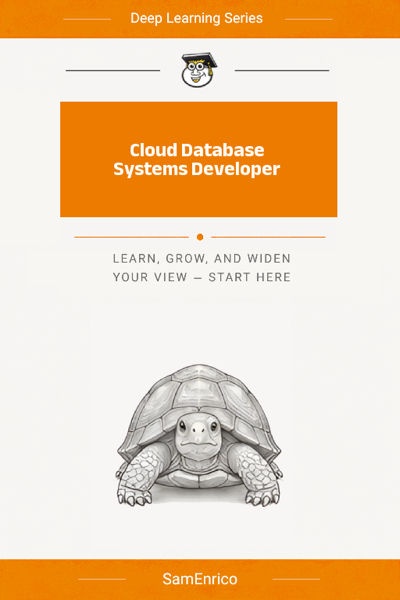
Non-FictionInformativeEducational
Cloud Database Systems Developer eBook
A Coursebook on Cloud Database Systems Developer
A Coursebook on Cloud Database Systems Developer
Formats
Free sample
Chapter 1: The Million-Dollar Mistake...--The pager went off at 2:47 AM on Cyber Monday. Sarah, the lead database engineer for a mid-sized e-commerce company, groggily reached for her phone. By 2:49 AM, she was fully awake. By 2:52 AM, she was watching her company’s revenue projection drop by 50,000perminute.By3:15AM,thenumberwas50,000 per minute. By 3:15 AM, the number was 50,000perminute.By3:15AM,thenumberwas1.2 million—gone. Not stolen. Not missing. Simply evaporated because the database couldn’t keep up.The post-mortem revealed the culprit: a senior developer had moved the company’s Postgre SQL database from an on-premise server to AWS RDS six months earlier. He had done everything “right.” He launched an instance, pointed the application at the new endpoint, and celebrated a successful migration. But he had treated the cloud like a rented data center. The application’s connection pool was configured for a static number of users. The retry logic assumed the database would never disappear. The queries assumed network latency was zero. On the busiest shopping day of the year, under legitimate peak load—not a DDo S attack, not a configuration error, just more customers than usual—the database fell over and refused to get back up.This chapter exists because Sarah’s story repeats itself thousands of times every year. Cloud databases are not magically better versions of on-premise databases. They are fundamentally different systems that require different thinking, different coding patterns, and a different understanding of what “reliable” even means.1.1 What This Book Is (And What It Is Not)Before we write a single line of SQL or provision a single instance, we need to establish a shared mental model. This is not a reference manual. You will not find exhaustive lists of every AWS RDS instance type or every Azure SQL pricing tier. Those documents exist already, they are well-written, and they change too fast for any book to keep up.This book is a practitioner’s guide to thinking like a cloud database developer. It teaches patterns, principles, and decision frameworks that survive vendor hype cycles. When you finish this chapter, you will understand why Sarah’s migration failed. When you finish Part I, you will be able to design data models that scale. By Part III, you will sleep through Cyber Monday because your database will handle the load. And by Part IV, you will build systems that not only survive but thrive—feeding data into AI models, controlling costs automatically, and maybe even letting you take a vacation.But first, we need to understand the fundamental mistake that kills cloud database projects: treating the cloud like a server in someone else’s data center.1.2 The Illusion of “Just a Server”When you provision a cloud database, the console shows you something familiar: an IP address, a port number, a connection string. You can ping it. You can telnet to it. You can run SELECT 1 and get back 1. It feels like a server. That feeling is a lie.A traditional on-premise database runs on hardware you can touch. The CPU, RAM, and disk are physically inside a server rack in a building you control. When you send a query, it travels over your local network (latency: 0.1-0.5 milliseconds) to a specific machine. That machine processes the query and returns the result. If the network cable gets unplugged, you know immediately. If the disk fills up, you can drive to the data center and replace it.A cloud database, by contrast, is a distributed system masquerading as a single server. Behind that IP address lies not one machine but dozens, sometimes hundreds, spread across multiple physical locations. Your “database” might have its storage on three different servers in three different availability zones. Your query might be processed by one CPU while your transaction log is written by another. When you run UPDATE users SET last_login = NOW() WHERE id = 123, that single statement might trigger writes to six different storage nodes, two replication logs, and three backup systems—all before the COMMIT returns success.Here is the critical insight that separates cloud-native developers from those who get paged at 2 AM: In the cloud, failure is not exceptional. Failure is the normal state, and success is what happens when your system works around it.On-premise databases are designed for a world where hardware fails rarely (once every few years) and catastrophically (the whole server dies). Cloud databases are designed for a world where components fail constantly (network packets drop, storage nodes lag, CPUs get preempted) but never all at once. The difference in philosophy changes everything about how you write code.1.3 The Shared Responsibility Model Explained (With Blame)Cloud vendors love to talk about the “shared responsibility model.” The concept is simple: the vendor is responsible for some things, and you are responsible for everything else. But what does that actually mean for a database developer?Let us draw the line. The cloud provider promises to:Keep the physical hardware running (power, cooling, network)Patch the underlying operating system Maintain the database server software (within limits)Provide backup infrastructure (snapshots, replication)Ensure the control plane (the API you use to provision instances) stays available You are responsible for:Every single line of SQL you write Your data model (tables, indexes, constraints)Query performance and tuning Connection management (pools, timeouts, retries)Application-level retry logic Disaster recovery planning (when you delete data by accident)Cost governance (more on this in Chapter 11)Security (who can connect, from where, with which permissions)Here is where developers get into trouble: the vendor’s responsibilities stop exactly where most developers think the vendor’s responsibilities begin. “But AWS said they handle high availability!” Yes, they handle hardware failures. They do not handle your DELETE FROM orders without a WHERE clause. “But Azure said they handle backups!” Yes, they back up the database files. They do not protect you from a migration script that corrupts your schema.The shared responsibility model means: When something breaks, the first question is always “Whose fault is this?” And the answer is almost always “yours.” Hardware fails so rarely that you can blame the vendor once a decade. Bad queries fail every day, and those are 100% on you.1.4 Lift and Shift: The Most Dangerous Phrase in Cloud Computing Sarah’s company fell victim to the most common anti-pattern in cloud migration: “Lift and Shift.” The phrase sounds safe. You lift your existing database from its on-premise server and shift it to a cloud VM. Same database software. Same configuration. Same application code. What could go wrong?Everything.Lift and Shift preserves the software but breaks the environment. Your on-premise database assumed:Low, predictable latency (0.5ms to the application server)No connection limits (you controlled every client)Static IP addresses (the database never moved)Infinite bandwidth (within the data center)Single-tenant hardware (no noisy neighbors)Manual failover (you would drive to the data center)Your cloud database runs in a world where:Network latency varies from 1ms to 100ms depending on region and load Connection limits are strict (max connections = f(instance size))IP addresses can change (after failover or maintenance)Bandwidth costs money (cross-AZ traffic adds up)Noisy neighbors exist (shared infrastructure)Automatic failover happens (whether you are ready or not)When you Lift and Shift, you import all the assumptions of on-premise computing into an environment that violates every single one. The result is not a “migration.” It is a time bomb. The bomb explodes under peak load, exactly when you can least afford it.Here…
This is the end of the free sample. Get the eBook to keep going. Buy now
About this book
Details
- Author
- Ridgeway Jerri
- Publisher
- SamEnrico
- Language
- English
- Genre
- Non-Fiction, Informative, Educational
- Released
- 2026-05-09
- Pages (approx.)
- 147
- Available as
- eBook, Audiobook

Read better in the ZLOADR app
Your eBooks on your phone or tablet. Sign in with your SamEnrico account and start reading.
More by Ridgeway Jerri
 The Walton Philosophy BookRidgeway Jerri$11.99
 Metta for Law EnforcementRidgeway Jerri$11.99
 Slave Auction Block RitualsRidgeway Jerri$11.99
 Al Anon Twelve Steps ExplainedRidgeway Jerri$11.99
 The Lost Expedition: Ibn Battuta's African OdysseyRidgeway Jerri$11.99
 Franchise Partner Exit StrategyRidgeway Jerri$12.99
 How to Produce a Bowl FeederRidgeway Jerri$11.99
 How to Become a Meal-grinder TenderRidgeway Jerri$11.99
You may also like
 Hong Kong Handover 1997Dunn Johnnie$11.99
 Zumba For Postnatal Recovery CourseNeal Christian$11.99
 Zumba for BeginnersLadner Nikia$11.99
 YouTube Comment Mining GuideHumes Pandora$12.99
 Worry Box MeditationCarlin Rudy$11.99
 Workplace Stress MeditationNguyen Lynn$11.99
 Workplace Stress and Sleep RepairHawley Ivory$11.99
 Workplace Perfectionism CureDelaney Jeffry$11.99
 Workplace Injustice Anger GuideWallen Isabelle$11.99
 Work Addiction and Burnout LinkGreenwood Ester$11.99
 Women in Yoga and WellnessBeattie Galina$11.99
 Women in Stand Up ComedyChun Evangeline$11.99