
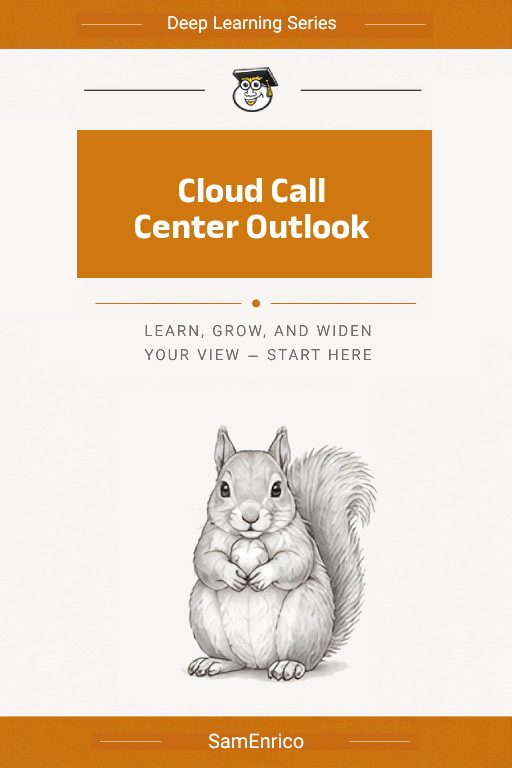
Non-FictionForecast & OutlookCCaaS
Cloud Call Center Outlook eBook
Project CCaaS adoption, AI voice agents, omnichann
by Soliz Ja
Project CCaaS adoption, AI voice agents, omnichannel routing, and workforce management cloud migration through 2030.
Formats
Free sample
Chapter 1: The $11.4 Billion Graveyard–- The pager went off at 3:17 AM on the Friday after Thanksgiving. Not a phone buzz. Not a Slack notification. A pager. The kind of device most people under thirty have only seen in movies about the 1990s.Mark Henderson, the Vice President of Customer Experience at a mid-sized retail chain called Omni Home Goods, stared at the glowing screen in the darkness of his hotel room.
He was supposed to be asleep. He had traveled to his in-laws’ house in suburban Ohio for the holiday, eaten too much turkey, and fallen into the kind of deep, food-induced slumber that only comes after three glasses of wine and a contentious game of Scrabble. Now his heart was pounding like he had just run a sprint.The pager read: “PBX CRITICAL FAILURE – QUEUE DOWN – 4,200 CALLS DROPPED.”Mark sat up so fast he nearly fell out of bed. His wife, Claire, stirred beside him. “What is it?” she mumbled.“I have to take this,” he whispered, already reaching for his laptop.He padded barefoot into the kitchen, the cold tile shocking his feet awake.
He opened his computer, connected to the corporate VPN, and stared at the dashboard of his company’s contact center. What he saw made his stomach drop. The on-premise PBX system—the physical telephone switch that routed every single customer call to every single agent—had frozen at 2:58 AM. For nineteen minutes, customers trying to reach Omni Home Goods for post-Thanksgiving support had heard nothing but dead air. Then a dial tone.
Then nothing again.The system had not merely crashed. It had died.By the time Mark got a bridge line going with the IT team at 4:30 AM, the damage was already calculated. Omni Home Goods had lost an estimated $2.3 million in potential sales from customers who gave up and called competitors. Worse, the company’s Net Promoter Score, which they had spent two years painstakingly building, would take a hit that no amount of apology coupons could fix. And the worst part?
The PBX system was only six years old. It had been the “state-of-the-art” upgrade when Mark had approved it back in 2020.“Six years,” Mark said to the silent IT director on the call. “We paid two million dollars for a system that lasts six years?”The IT director, a tired man named Jerome who had been woken up at 3:00 AM more times than he could count, sighed. “Mark, it’s not the age. It’s the architecture.
We’ve got sixteen different integrations holding this thing together. The CRM connector failed first, then the IVR tried to failover, then the whole stack collapsed. We’re not built for this much traffic. Black Friday was too much.”Mark closed his laptop at 6:15 AM as the sun began to rise over Ohio. He did not go back to sleep.
He sat in the dark kitchen, drinking cold coffee, and thought about a meeting he had attended six months earlier. A salesperson from a cloud contact center company had tried to pitch him on moving to their platform. Mark had said no. He had said, “We just invested in our on-premise system. We’re not ready to rip and replace.”Now he realized the truth: the system was going to rip and replace itself.
It was just going to take the company down with it.The $11.4 Billion Question Mark’s story is not unique. It is playing out in thousands of companies around the world, from regional banks to global airlines, from healthcare providers to e-commerce startups. The contact center—the nerve center of customer experience—is undergoing a transformation more profound than anything since the invention of the toll-free number in 1967. And at the heart of that transformation is a simple, terrifying question:How much longer can your legacy infrastructure survive?The numbers tell a stark story. In 2023, the global Contact Center as a Service (CCaa S) market was valued at approximately 3.6billion.By2030,thatnumberisprojectedtoreach3.6 billion.
By 2030, that number is projected to reach 3.6billion.By2030,thatnumberisprojectedtoreach11.4 billion, growing at a compound annual rate of 17.8%. To put that in perspective, the broader enterprise software market grows at about 8-10% annually. CCaa S is growing nearly twice as fast. Capital is pouring into the space. Venture capitalists, private equity firms, and the world’s largest technology companies are betting billions that the era of the on-premise call center is ending.Why?
Because the forces arrayed against legacy systems are not merely technological. They are demographic, economic, and psychological.The Three Forces Killing On-Premise Hardware Force One: The Remote Work Revolution Before 2020, most contact centers were physical buildings filled with cubicles. Agents commuted, clocked in, sat at a desk with a proprietary headset connected to a proprietary phone system, and went home at the end of their shift. The pandemic shattered that model virtually overnight. Companies that had insisted for years that agents could not work from home—citing security concerns, technology limitations, and management fears—were forced to send everyone home with laptops and hope for the best.Some companies succeeded.
Many did not.The ones that failed were almost universally running on-premise PBX systems that were never designed for distributed work. These systems assumed that every agent was physically connected to the same switch in the same building. When agents scattered to their living rooms and kitchen tables, the systems broke. Call quality degraded. Security holes opened.
IT teams spent countless hours trying to jury-rig solutions that would never be stable.The companies that succeeded? They were already in the cloud, or they moved there fast. Cloud-based CCaa S platforms are built for distributed work. Agents can log in from anywhere with an internet connection and a laptop. The system handles security, encryption, and quality automatically.
No VPN tricks. No proprietary hardware. No 3 AM pages because a switch in a closet overheated.Today, fewer than 40% of contact center agents work exclusively on-site. By 2030, that number will drop below 15%. The old architecture cannot survive that reality.Force Two: The Omnichannel Imperative Here is a simple test.
Think about the last time you had a problem with a company. How many different ways did you try to contact them?Maybe you started on their website chat. When that didn’t work, you sent a direct message on Twitter. Then you called their phone number. Then you sent an email.
And at every single step, you had to repeat yourself. “My name is John. My account number is 12345. My problem is…” Each time, you started over. Each time, your blood pressure rose.That experience is called the reset problem, and it is the single greatest source of customer frustration in the modern economy.
Studies show that 75% of customers expect consistent service across channels, but only 35% say they actually receive it. The gap between expectation and reality is a chasm, and companies are falling into it every day.Legacy on-premise systems cannot solve the reset problem because they were built for a single channel: voice. Everything else—email, chat, SMS, social media—is a bolt-on, a hack, a half-solution. The systems were never designed to share context across channels because the channels didn’t exist when the systems were…
This is the end of the free sample. Get the eBook to keep going. Buy now
About this book
Details
- Author
- Soliz Ja
- Publisher
- SamEnrico
- Language
- English
- Genre
- Non-Fiction, Forecast & Outlook, CCaaS
- Released
- 2026-06-01
- Pages (approx.)
- 151
- Available as
- eBook, Audiobook

Read better in the ZLOADR app
Your eBooks on your phone or tablet. Sign in with your SamEnrico account and start reading.
More by Soliz Ja
 Alcohol And Trauma DreamsSoliz Ja$11.99
 Parenting Stress And Digital OverloadSoliz Ja$11.99
 Energy Management AssessmentSoliz Ja$11.99
 Comparison Trap Couples GuideSoliz Ja$11.99
 Whispers of the Marid: The Djinn King’s Forgotten OathSoliz Ja$11.99
 The Bone Setter of Babylon: Imhotep’s Forgotten LegacySoliz Ja$11.99
 Understanding Hereditary Non-spherocytic Hemolytic AnemiaSoliz Ja$17.99
 CalligraphySoliz Ja$11.99
 Messaging Sales Funnel WorkbookSoliz Ja$12.99
 How to Start a Cask Assembly Machines Business (Beginners Guide)Soliz Ja$11.99
You may also like
 Hong Kong Handover 1997Dunn Johnnie$11.99
 Zumba For Postnatal Recovery CourseNeal Christian$11.99
 Zumba for BeginnersLadner Nikia$11.99
 YouTube Comment Mining GuideHumes Pandora$12.99
 Worry Box MeditationCarlin Rudy$11.99
 Workplace Stress MeditationNguyen Lynn$11.99
 Workplace Stress and Sleep RepairHawley Ivory$11.99
 Workplace Perfectionism CureDelaney Jeffry$11.99
 Workplace Injustice Anger GuideWallen Isabelle$11.99
 Work Addiction and Burnout LinkGreenwood Ester$11.99
 Women in Yoga and WellnessBeattie Galina$11.99
 Women in Stand Up ComedyChun Evangeline$11.99