
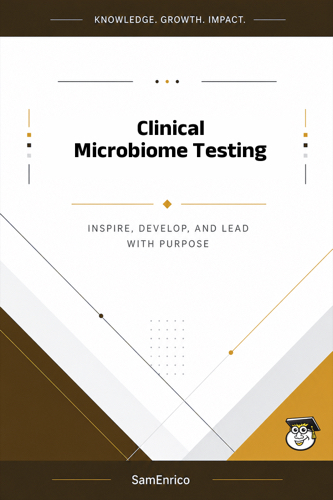
Clinical Microbiome Testing
Orders and interprets physician-only stool panels.
Orders and interprets physician-only stool panels.
Formats
About this book
Free sample
Chapter 1: Beyond the Petri Dish...--–- The sixty-seven-year-old gastroenterologist stared at the screen, his index finger hovering over the order button. For thirty years, he had managed irritable bowel syndrome with a predictable script: ruling out celiac disease, checking inflammatory markers, and prescribing antispasmodics or low-dose antidepressants. When diarrhea persisted, he sent stool for culture and C. difficile toxin. When constipation dominated, he recommended fiber and osmotic laxatives.
His success rate was modest at best, and he had long accepted that most patients would simply learn to live with their symptoms. But the report on his screen was not a standard stool culture. It was a physician-only comprehensive stool panel ordered by a young nurse practitioner in his own practice—a test he had initially dismissed as “expensive, unproven, and dangerous.” The patient, a forty-two-year-old woman with twenty years of post-infectious IBS, had paid $499 out of pocket. The results were unlike anything he had ever seen in residency or fellowship. There was no single pathogen.
Instead, the report showed a landscape: low Faecalibacterium prausnitzii at 0.02 percent relative abundance, undetectable secretory Ig A, elevated calprotectin at 128 mcg/g, and a Firmicutes-to-Bacteroidetes ratio of 8.5—more than triple the upper reference limit. For the first time in his career, he had a mechanistic explanation for her bloating, fatigue, and joint pain. But he also had a problem: he did not know how to interpret a single one of these numbers.This dilemma defines the central tension of modern gastroenterology and functional medicine. The tools have advanced faster than the training. Comprehensive stool testing using quantitative PCR (q PCR) and metagenomic sequencing can now map the intestinal ecosystem at a resolution that was unimaginable a decade ago.
Yet most clinicians were taught that the only clinically actionable findings in stool are enteric pathogens, C. difficile toxin, and perhaps fecal calprotectin for inflammatory bowel disease. The rest—commensal bacteria, archaea, fungi, viruses, and their metabolic byproducts—were considered biological noise, a black box of no diagnostic or therapeutic relevance. That paradigm is not merely outdated; it is actively harmful to patients with chronic gastrointestinal symptoms who…
This is the end of the free sample. Get the eBook to keep going. Buy now
Contents
- Chapter 1
- Chapter 2
- Chapter 3
- Chapter 4
- Chapter 5
- Chapter 6
- Chapter 7
- Chapter 8
- Chapter 9
- Chapter 10
- Chapter 11
- Chapter 12
Details
- Author
- Honeycutt Waltraud
- Publisher
- SamEnrico
- Language
- English
- Genre
- Non-Fiction, Health & Wellness, Clinical Diagnostics
- Released
- 2026-06-10
- Pages (approx.)
- 142
- Available as
- eBook, Audiobook

Read better in the ZLOADR app
Your eBooks on your phone or tablet. Sign in with your SamEnrico account and start reading.
More by Honeycutt Waltraud
 Active Listening Validation GuideHoneycutt Waltraud$11.99
 Therapy Hesitant Partner GuideHoneycutt Waltraud$11.99
 Chemotherapy Sleep SupportHoneycutt Waltraud$11.99
 Sleep Apnea Fatigue GuideHoneycutt Waltraud$11.99
 Pomodoro For Exam PrepHoneycutt Waltraud$11.99
 TM for Decision FatigueHoneycutt Waltraud$11.99
 Egypt Remote Tax GuideHoneycutt Waltraud$11.99
 Fincher Se7enHoneycutt Waltraud$11.99
 The Last Dance of the Blue Angels: How One Ceremony Redefined CourageHoneycutt Waltraud$11.99
 The Jade Phoenix’s Last Flight: A Dragon Sage’s WisdomHoneycutt Waltraud$11.99
 Spears and Silver: The Battle of Marathon and the Birth of DemocracyHoneycutt Waltraud$11.99
 How to Start a Moleskin Finishing Business (Beginners Guide)Honeycutt Waltraud$11.99