
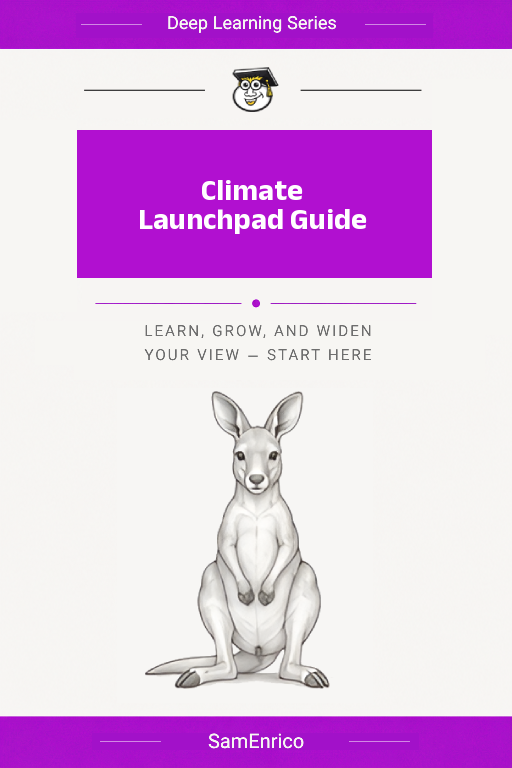
Non-FictionStartup GuideNon-Dilutive Grants
Climate Launchpad Guide eBook
Compete in Climate Launchpad. Green tech startup c
by Dean Ann
Compete in Climate Launchpad. Green tech startup competition with training and prizes.
Formats
Free sample
Chapter 1: The Unspoken Gatekeeper--–- Every year, five thousand hopefuls from ninety-seven countries submit their climate tech ideas to Climate Launchpad. Most of them believe the competition is about having the best technology or the most brilliant scientific breakthrough. They are wrong. The real gatekeeper is not the novelty of your invention, nor the depth of your patent portfolio, nor even the passion in your voice. The gatekeeper is something far more subtle and far more unforgiving: the difference between a green business idea and a climate solution.This chapter is not about how to fill out an application form.
You can find those instructions on the competition’s website in ten minutes. This chapter is about rewiring your entire understanding of what Climate Launchpad actually judges, why the competition exists within the European Union’s most sophisticated climate innovation network, and how the alumni network—collectively valued at over half a billion euros—operates as the real prize. By the end of this chapter, you will know whether your idea belongs in this arena or whether you should spend another six months in the lab before applying. More importantly, you will understand why the difference between “green” and “climate solution” determines not only your chances of winning but your startup’s entire trajectory.The Birth of a Climate Giant Climate Launchpad did not emerge from a corporate boardroom or a Silicon Valley accelerator. It was founded in 2014 under the umbrella of EIT Climate-KIC, which stands for the European Institute of Innovation and Technology’s Climate Knowledge and Innovation Community.
If that sounds like a mouthful of bureaucratic European jargon, you are not wrong. But beneath that clunky name lies one of the most ambitious and well-funded climate innovation engines on the planet.EIT Climate-KIC was established by the European Union to solve a single, maddening problem: Europe was producing world-class climate science in its universities and research labs, but those breakthroughs were dying in what entrepreneurs call the “valley of death.” A professor in Delft would discover a more efficient electrolyzer membrane. A Ph D candidate in Barcelona would develop a novel carbon capture catalyst. A research group in Helsinki would model a revolutionary grid-balancing algorithm. And then nothing would happen.
The science would be published. The grants would run out. The researchers would move to the next project. The technology would gather digital dust on a university server.Climate Launchpad was designed as a scalpel to cut through that valley of death. The competition’s founding insight was brutally simple: researchers and early-stage founders did not need more money.
They needed a structured pathway from “interesting lab result” to “investable business proposition.” They needed to learn how to speak the language of customers, markets, and unit economics without losing their scientific rigor. They needed a jury of experts who had built and exited climate companies, not just published papers. And they needed a community of peers going through the same brutal transition from scientist to founder.In its first year, the competition operated in a handful of European countries and received a few hundred applications. By 2024, it had expanded to ninety-seven countries across six continents. It has trained more than fifteen thousand teams.
Its alumni have gone on to raise over five hundred million euros in follow-on funding—a figure that the competition’s organizers are careful to note is cumulative across a decade, not a per-startup average. The typical alumnus raises between one hundred fifty thousand and two million euros within twelve to twenty-four months post-competition. A handful have reached unicorn status. Many more have built sustainable, profitable businesses that actually reduce emissions.The Three Stages of War Climate Launchpad operates in three distinct stages, each designed to filter for a different quality. Understanding these stages is not merely useful; it is essential.
Many first-time applicants assume that the competition is a single event where you show up, pitch, and win or lose. The reality is a marathon with three very different checkpoints.Stage one is the Online Submission. This is where approximately seventy percent of applicants are eliminated. The online submission is not a detailed business plan. It is a short form—typically five to seven questions—asking for your problem statement, proposed solution, target market, and expected climate impact.
The judges reviewing these submissions are not reading every word with the care of a literary editor. They are scanning. They are looking for one thing: a clear, specific, and quantified articulation of a problem that actually exists.Most submissions die here because they commit the sin of vagueness. “Climate change is a serious threat” is not a problem statement. It is a truism.
“The cement industry produces eight percent of global CO2 emissions, and current carbon capture retrofits cost over one hundred dollars per ton, which is too expensive for ninety percent of plants in Southeast Asia” is a problem statement. The first example could be written by a high school student. The second example could only come from someone who has done their homework. The online submission stage filters for curiosity, specificity, and evidence. It has no patience for generalities.Stage two is the Regional Final.
If you survive the online submission, you are invited to a boot camp—typically two to three days of intensive training, mentoring, and rehearsal, culminating in a live pitch competition. Regional finals take place in approximately thirty locations worldwide, from Bogotá to Bangalore to Berlin. This stage filters for coachability. Climate Launchpad is not looking for founders who have everything figured out. It is looking for founders who can absorb feedback, pivot gracefully, and improve their pitch in real time.The boot camp is brutal by design.
You will pitch to mentors. They will tear your assumptions apart. They will ask you questions you cannot answer. They will point out flaws in your unit economics and gaps in your customer discovery. How you respond in those moments—with defensiveness or curiosity, with collapse or adaptation—determines whether you advance to the final.
The judges are watching not just your pitch but your demeanor during the breaks, your questions to other teams, your willingness to stay late and work on your slides.Stage three is the Global Final. Historically held in locations like Singapore, Edinburgh, or online during pandemic years, the Global Final brings together the top teams from every regional final. This stage filters for polish, presence, and scalability. By this point, every team has a credible problem statement, a defensible solution, and a coachable attitude. The differentiating factor at the Global Final is the ability to deliver a flawless three-to-five-minute pitch under extreme pressure, answer any question with poise, and demonstrate that the solution can scale beyond a single market.The Global Final is also where the alumni network becomes visible.
Investors attend not as judges but as observers. Corporate partners scout for acquisition targets or licensing deals. The conversations in the hallways matter as much as the pitches on stage. Many winners of the Global Final have gone on to raise their first institutional rounds not from the prize money but from connections made during those two days.The Real Prize Is Not the Check Here is…
This is the end of the free sample. Get the eBook to keep going. Buy now
About this book
Details
- Author
- Dean Ann
- Publisher
- SamEnrico
- Language
- English
- Genre
- Non-Fiction, Startup Guide, Non-Dilutive Grants
- Released
- 2026-05-29
- Pages (approx.)
- 127
- Available as
- eBook, Audiobook

Read better in the ZLOADR app
Your eBooks on your phone or tablet. Sign in with your SamEnrico account and start reading.
More by Dean Ann
 Lonely Medical ResidentDean Ann$11.99
 Testosterone And Male Brain AgingDean Ann$11.99
 Remote Mental Health TimeDean Ann$11.99
 Siberian Winter CrossingDean Ann$11.99
 The Adrenal Fatigue Recovery GuideDean Ann$11.99
 The Persian Wheel: Zoroaster’s Forgotten Cycling LegacyDean Ann$11.99
 Learn to Play the ChalumeauDean Ann$11.99
 Backend Software DeveloperDean Ann$11.99
 EE Employment Letter GuideDean Ann$12.99
 How to Start a Dental Equipment and Supplies Manufacturing BusinessDean Ann$11.99
You may also like
 Hong Kong Handover 1997Dunn Johnnie$11.99
 Zumba For Postnatal Recovery CourseNeal Christian$11.99
 Zumba for BeginnersLadner Nikia$11.99
 YouTube Comment Mining GuideHumes Pandora$12.99
 Worry Box MeditationCarlin Rudy$11.99
 Workplace Stress MeditationNguyen Lynn$11.99
 Workplace Stress and Sleep RepairHawley Ivory$11.99
 Workplace Perfectionism CureDelaney Jeffry$11.99
 Workplace Injustice Anger GuideWallen Isabelle$11.99
 Work Addiction and Burnout LinkGreenwood Ester$11.99
 Women in Yoga and WellnessBeattie Galina$11.99
 Women in Stand Up ComedyChun Evangeline$11.99