
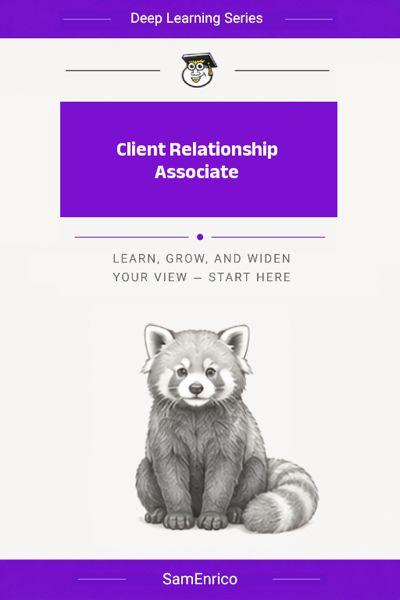
Client Relationship Associate eBook
A Coursebook on Client Relationship Associate
A Coursebook on Client Relationship Associate
Formats
Free sample
Chapter 1: Beyond the Clipboard--–- Maria Vasquez had been a Client Relationship Associate for exactly eleven months when she learned the lesson that no training manual had ever taught her. A $4.2 million account was quietly walking out the door, and the reason had nothing to do with product quality, delivery times, or pricing. The client was leaving because no one had noticed that their primary contact had been replaced three months earlier. The new person had never been properly onboarded, felt ignored, and had already signed with a competitor. Maria’s predecessor had logged every transaction correctly, responded to every email within two hours, and never missed a deadline.
By every operational metric, the account was perfectly managed. And it was failing.That afternoon, Maria’s manager sat her down and said something she would never forget: “You can execute every task on your job description flawlessly and still lose every client you have. Because this job is not on the clipboard. It never was.”The Great Misunderstanding For decades, the role now known as the Client Relationship Associate (CRA) has been tragically misunderstood. Search any job board today, and you will find postings seeking “customer service representatives,” “account coordinators,” or “client support specialists” who can “handle inquiries,” “process orders,” and “resolve issues.” These descriptions reduce a profoundly strategic role to a series of administrative tasks.
They treat the CRA as a human switchboard—someone who routes problems from one department to another while smiling pleasantly.This book exists to dismantle that fiction.The modern Client Relationship Associate is not an order-taker, a complaint-screener, or a human FAQ page. The modern CRA is the single most important guardian of the organization’s most valuable asset: the client relationship. In industries ranging from professional services and technology to manufacturing and financial services, the CRA sits at the precise intersection of operations, sales, and client psychology. No one else in the organization has the same panoramic view. Sales sees the client at the beginning of the relationship.
Delivery sees the client during project execution. Finance sees the client when invoices are due. Only the CRA sees the entire arc—from the first handshake to the renewal negotiation to the exit interview that should never have happened.This chapter will establish the foundational shift every aspiring CRA must make: moving from a transactional mindset to a relational one, from reactive service to proactive stewardship, and from task completion to value creation. By the end of this chapter, you will understand not just what the CRA does, but who the CRA must become.Three Roles, One Career Path Before we can build a new understanding of the CRA, we must first dismantle three common confusions. The business world has created a fog of overlapping titles: Customer Service, Customer Success, and Client Relationship Management.
Many organizations use these terms interchangeably. They are not interchangeable. Understanding the differences is the first step toward mastering your own career trajectory.Customer Service: The Reactive Foundation Customer Service is the oldest of the three functions. It emerged from call centers and help desks, and its defining characteristic is reactivity. A customer service representative waits for the phone to ring, the email to arrive, or the ticket to be opened.
The customer has a problem. The representative solves it. The interaction ends.The metrics of customer service are efficiency-based: average handle time, first-response resolution, number of tickets closed per hour. These metrics are valuable. They ensure that basic problems do not fester.
But they are also limited. Customer service, by its very design, cannot prevent problems—because it only exists after problems have already occurred.A customer service representative who closes one hundred tickets in a day has done excellent work according to the metrics. But what if fifty of those tickets were for the same recurring issue? What if the product team never learns about the root cause because the representative is too busy closing tickets to escalate patterns? What if the client is silently churning not because their ticket was unresolved, but because they are exhausted by having to open tickets at all?This is not a criticism of customer service professionals, many of whom perform heroic work under impossible conditions.
It is a boundary clarification. Customer service is essential. But it is not sufficient for the modern CRA.Customer Success: The Proactive Evolution Customer Success emerged in the software-as-a-service (Saa S) industry, where subscription models changed the economics of client relationships. In a traditional product sale, the transaction ends when the customer pays. In a subscription model, the transaction never ends.
The customer pays every month or every year, which means the customer can also stop paying at any time. This created a new imperative: actively ensure that customers achieve their desired outcomes, or they will leave.Customer Success is proactive by design. A Customer Success Manager (CSM) does not wait for the phone to ring. The CSM monitors product usage data, reaches out when a customer’s activity declines, schedules training sessions before the customer gets confused, and celebrates milestones when the customer achieves a goal.The metrics of Customer Success are outcome-based: product adoption rate, time-to-value, net revenue retention, and churn rate. These metrics are powerful.
They align the organization with the customer’s definition of success.Here is where many books and training programs stop. They tell the aspiring CRA that Customer Success is the destination. It is not. It is a waypoint.Client Relationship Management: The Strategic Summit Client Relationship Management (used here as a role, not just a software category) is the strategic layer above Customer Success. Where Customer Success asks, “Is the client achieving their desired outcomes?” Client Relationship Management asks, “Are we building a partnership that outlasts any single product, project, or person?”A Customer Success Manager ensures that the client uses the software correctly.
A Client Relationship Associate (operating at the strategic level) ensures that the client views the software provider as an indispensable business partner. The CSM focuses on adoption. The CRA focuses on advocacy. The CSM reduces churn risk. The CRA expands the total relationship value.Consider the difference through a concrete example.
A CSM notices that a client has stopped using the reporting feature. The CSM schedules a training call to re-engage the client. That is proactive and valuable. A strategic CRA, however, would have noticed that the client stopped using the reporting feature because their internal reporting analyst quit three weeks ago—and the CRA knows this because they maintain relationships with multiple people at the client, not just the named contact. The CRA would have already recommended a temporary workaround and connected the client with a contract resource to fill the gap.
The CSM solves the usage problem. The CRA solves the business problem behind the usage problem.The Career Arc: From Tactical to Strategic This book introduces a critical clarification that most resources omit. The CRA role is not a single destination. It is a career arc with two distinct levels.Tactical CRA (Chapters 1 through 8 of this book): At this level, the CRA operates primarily in the Customer Success domain. The focus is on proactive problem identification, clear communication, process execution, and preventing…
This is the end of the free sample. Get the eBook to keep going. Buy now
About this book
Details
- Author
- Mccormack Karyl
- Publisher
- SamEnrico
- Language
- English
- Genre
- Non-Fiction, Informative, Educational
- Released
- 2026-06-02
- Pages (approx.)
- 137
- Available as
- eBook, Audiobook

Read better in the ZLOADR app
Your eBooks on your phone or tablet. Sign in with your SamEnrico account and start reading.
More by Mccormack Karyl
 Mindfulness for New Parents GuideMccormack Karyl$11.99
 The Empty Collar HandbookMccormack Karyl$11.99
 Complicated Grief After HomicideMccormack Karyl$11.99
 Civil Engineer Creativity GuideMccormack Karyl$11.99
 The Validating Trauma Responses GuideMccormack Karyl$11.99
 The Last Broadcast: How a 1996 Radio Signal Predicted the InternetMccormack Karyl$11.99
 Understanding Stimulant PsychosisMccormack Karyl$17.99
 How to Become a Sheepskin PicklerMccormack Karyl$11.99
 Voice Activated AccountingMccormack Karyl$12.99
 Procurement Compliance AuditMccormack Karyl$12.99