
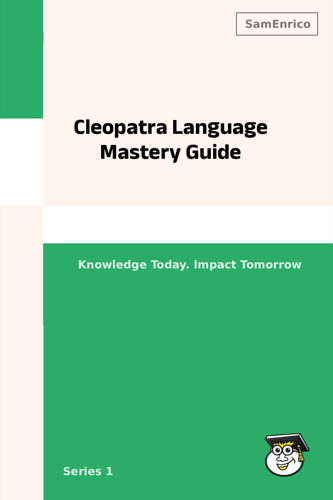
Cleopatra Language Mastery Guide eBook
Learn multiple languages for diplomatic advantage
by Herron Sona
Learn multiple languages for diplomatic advantage using the polyglot queen's communication tactics.
Formats
Free sample
Chapter 1: The Voice Arsenal...--The first time I heard a diplomat negotiate in a language she had learned only six months prior, I nearly didn't notice the switch. She had been speaking flawless English for forty-five minutes—her third language, but the one she used for legal precision. Then the opposing counsel, a man from Cairo, made a comment about "cultural misunderstandings" that was clearly a veiled insult. Without missing a beat, she shifted into Egyptian Arabic. Not just the words.
The rhythm. The posture. The slight lowering of her chin. The way she made her voice softer rather than harder, which in that dialect signals absolute authority rather than aggression.The Cairo lawyer went pale. His interpreter sat frozen.
For the next thirty seconds, she spoke directly to him—no translator, no buffer, no escape—and in that half-minute, she undid three hours of his posturing. She didn't threaten him. She didn't even correct him. She simply told a story about her grandmother's village near Alexandria, using a specific grammatical construction that only someone raised in Egypt's Delta region would know. She was not Egyptian.
She was American. But she had learned the secret that Cleopatra discovered two thousand years ago: language is not about vocabulary. It is about belonging.The meeting ended fifteen minutes later with the Cairo firm conceding on every point. When I asked the American diplomat how she had done it, she said something I have never forgotten: "I didn't learn Arabic to speak to them. I learned Arabic so they couldn't hide from me."This book is about that distinction.
It is not a language learning guide in the traditional sense. There will be no vocabulary lists for ordering coffee or asking where the bathroom is. There will be no conjugation tables or grammar drills disguised as "exercises." Those books already exist, and they have failed you not because you lack discipline but because they misunderstand the entire purpose of language in human affairs.You do not need fluency to have power. You need strategic functional fluency. You need the ability to enter a room, identify who holds the real authority, and speak directly to that person's identity—not their language, but their sense of self.
That is what Cleopatra understood. That is what the American diplomat executed. And that is what you will learn in this book.The Myth You Have Been Sold Let us begin with a confession: I have wasted years of my life learning languages the wrong way. I have sat in classrooms memorizing declensions. I have used flashcard apps until my thumbs ached.
I have watched foreign films with subtitles, listened to podcasts while jogging, and repeated useless phrases like "the pen is on the table" until I wanted to throw the pen through the table. And after all of that, I still could not negotiate a contract extension in Spanish, apologize effectively in Mandarin, or tell a joke in French that made anyone laugh.The problem was not me. The problem was the industry. The language learning industry sells you a fantasy: that fluency is a destination, that you can "arrive" at some magical threshold where words flow effortlessly, and that this arrival requires thousands of hours of vocabulary acquisition. This is a lie.
It is a lie designed to keep you buying apps, enrolling in courses, and never feeling adequate enough to actually use the language in high-stakes situations.Consider the evidence. The average educated native speaker knows between fifteen thousand and twenty thousand words. If you learn ten new words per day—a heroic pace that almost no adult maintains—you would need nearly six years to reach that level. Six years before you feel "ready" to negotiate a raise, argue with a contractor, or charm a future client. No one has that time.
And no one needs that many words.Plutarch, the Greek historian who wrote about Cleopatra a century after her death, described her voice as an "instrument of many strings." He meant this literally. In an age before amplification, Cleopatra could fill a throne room with sound. She could shift from a whisper to a command without changing her volume, simply by altering her resonance and pace. But there is a deeper meaning to Plutarch's metaphor that most readers miss. An instrument does not produce music by having more strings.
It produces music by having the right strings tuned precisely and played with intention.Cleopatra did not speak nine languages because she was a superhuman memorizer. She spoke nine languages because she understood that each language opened a specific door. Egyptian was the language of her subjects' hearts—she used it to legitimize her rule and to rally troops. Greek was the language of law and commerce—she used it to manage her court and negotiate with Rome. Aramaic was the language of her eastern trading partners—she used it to monitor the Parthian Empire, Rome's greatest rival.
And the others? They were strategic investments, learned just enough to perform the specific diplomatic function required.She did not learn Ethiopian to read their poetry. She learned Ethiopian so that when their ambassadors arrived, she could greet them in their mother tongue before switching to Greek for the substance of the negotiation. That greeting—thirty seconds, perhaps fifty words—was more valuable than fluency. It said: I see you.
I respect you. And because I respect you, I will now speak to you in a language where neither of us has the advantage.Tourist Fluency vs. Diplomatic Agility Throughout this book, we will return to a central distinction: Tourist Fluency versus Diplomatic Agility. Understanding this difference is the single most important concept you will learn, because it will determine every decision about which languages to learn, how to learn them, and when to deploy them.Tourist Fluency is what most language courses teach. It is the ability to order food, ask for directions, book a hotel room, and exchange pleasantries about the weather.
It is passive, transactional, and ultimately forgettable. A tourist who speaks perfect restaurant French has not gained power; they have simply become a more efficient consumer. There is nothing wrong with this if your goal is to vacation comfortably. But if your goal is diplomatic advantage—to shift the balance of power in a negotiation, to gather intelligence that others cannot access, to build relationships that transcend transactions—then tourist fluency is worse than useless. It creates the illusion of competence without the substance.Diplomatic Agility, by contrast, is the ability to use language as a weapon of asymmetrical advantage.
It requires far fewer words—sometimes as few as fifty—but those words must be chosen with surgical precision and deployed with flawless timing. Diplomatic agility means knowing that in Japanese, the silence between sentences is often more meaningful than the words themselves. It means knowing that in Russian, switching from the formal "you" (vy) to the informal "you" (ty) at the wrong moment can end a business relationship permanently. It means knowing that in Egyptian Arabic, mentioning a shared hometown is worth more than a hundred compliments.The American diplomat I described earlier did not have fluent Arabic. I checked with her afterwards.…
This is the end of the free sample. Get the eBook to keep going. Buy now
About this book
Details
- Author
- Herron Sona
- Publisher
- SamEnrico
- Language
- English
- Genre
- Non-Fiction, History, Linguistics
- Released
- 2026-06-11
- Pages (approx.)
- 143
- Available as
- eBook, Audiobook

Read better in the ZLOADR app
Your eBooks on your phone or tablet. Sign in with your SamEnrico account and start reading.
More by Herron Sona
 The Authority BiasHerron Sona$11.99
 Financial Stress and InflationHerron Sona$11.99
 Mindfulness Meditation for KidsHerron Sona$11.99
 Fenrir's Fetters: The Architect of Asgard's DoomHerron Sona$11.99
 How to Start a Boxing Promoter Business (Beginners Guide)Herron Sona$11.99
 Utility Function Solver WorkbookHerron Sona$12.99
 How to Produce Audio Recording EquipmentHerron Sona$11.99
You may also like
 Hong Kong Handover 1997Dunn Johnnie$11.99
 Zumba For Postnatal Recovery CourseNeal Christian$11.99
 Zumba for BeginnersLadner Nikia$11.99
 YouTube Comment Mining GuideHumes Pandora$12.99
 Worry Box MeditationCarlin Rudy$11.99
 Workplace Stress MeditationNguyen Lynn$11.99
 Workplace Stress and Sleep RepairHawley Ivory$11.99
 Workplace Perfectionism CureDelaney Jeffry$11.99
 Workplace Injustice Anger GuideWallen Isabelle$11.99
 Work Addiction and Burnout LinkGreenwood Ester$11.99
 Women in Yoga and WellnessBeattie Galina$11.99
 Women in Stand Up ComedyChun Evangeline$11.99