
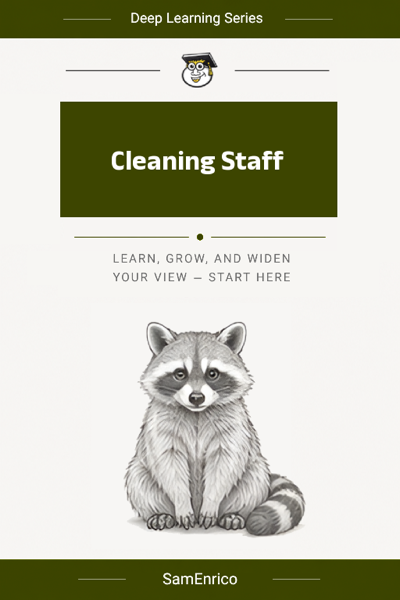
Non-FictionInformativeEducational
Cleaning Staff eBook
A Coursebook on Cleaning Staff
A Coursebook on Cleaning Staff
Formats
Free sample
Chapter 1: The Slob Virus--–- Every human being is born with a neurological defect. It has no cure, no vaccine, and no diagnostic code that insurance will recognize. The medical establishment ignores it because everyone has it. The cleaning industry survives because of it. It is called Slob Vision, and you have it right now.Open your phone’s camera.
Point it at the room you are sitting in. Look at the screen. Do you see what the camera sees? The camera has no emotional attachment to the clutter on your counter. The camera does not filter out the dust on your baseboards because you have looked at them a thousand times.
The camera sees the truth. You see a version of the truth that your brain has edited for your own comfort.This editing is not laziness. It is not a moral failing. It is how the human brain survives. Your brain receives approximately eleven million bits of sensory information every second.
It can consciously process only about forty of those bits. Everything else must be filtered, summarized, and in many cases, deleted. Your brain deletes the mess because the mess is not a threat. A tiger in the room would not be deleted. A smoke alarm would not be filtered out.
But a dusty ceiling fan that has been dusty for three years? That information is archived as “unchanging background” and your brain stops showing it to you.This is Slob Vision. It is the neurological default setting of every human being who has not been trained otherwise. And the first step to becoming a professional cleaner is not learning how to wipe a surface. The first step is learning how to see.The $87,000 Question In the introduction to this book, you read about Angela, the cleaner who grossed eighty-seven thousand dollars last year.
Here is what you did not read: Angela started her career as the messiest person in her own home. She was not born with a gift for cleanliness. She was not raised by a mother who taught her to make beds with hospital corners. Her childhood bedroom was a disaster zone. Her first apartment looked like a burglary had occurred and the burglars had decided to live there.What changed was not a sudden love of tidiness.
What changed was a customer who fired her.Angela was twenty-six years old. She had been cleaning houses for a local company for eighteen months. She thought she was good at her job. Her supervisors never complained. Her checklists were always signed off.
Then one Tuesday afternoon, a client named Mrs. Chen walked through her own kitchen while Angela was packing up her caddy. Mrs. Chen looked at the refrigerator door. She ran her finger along the top edge of the door frame.
She held up her finger, which now carried a gray stripe of dust, and said nothing. She simply looked at Angela. Then she called the cleaning company’s office and requested that Angela never return to her home.That dust had been there for weeks. Angela had cleaned that kitchen at least six times during those weeks. She had never seen the dust.
Her brain had filtered it out. The dust was on the top edge of the door frame, which was above her natural eye level. She never looked up there because she never had a reason to look up there. Her checklist said “wipe kitchen surfaces.” Her brain interpreted “surfaces” as the countertops, the stovetop, the sink, and the refrigerator handles. The top edge of the door frame was not a “surface” in her mental model.
It was background. It was invisible.Mrs. Chen’s finger made it visible. That finger was the most expensive piece of training Angela ever received.The Science of Selective Attention What happened to Angela has a name in cognitive psychology: inattentional blindness. The most famous experiment on this phenomenon was conducted in 1999 by Daniel Simons and Christopher Chabris.
Participants watched a video of people in white shirts and black shirts passing basketballs. They were asked to count the number of passes made by the white-shirt team. Halfway through the video, a person in a gorilla suit walked into the middle of the game, faced the camera, thumped their chest, and walked off. Forty-six percent of the participants did not see the gorilla.They were looking right at it. They did not see it.If half of all people can miss a dancing gorilla when they are focused on counting basketball passes, how much more will a cleaner miss when they are focused on finishing a checklist before a client comes home?
The answer is: almost everything. The gorilla is always there. The gorilla is the dust on the top of the refrigerator. The gorilla is the greasy film on the range hood that has been accumulating for months. The gorilla is the mildew creeping up the corner of the shower wall.
You do not see the gorilla because you are not looking for the gorilla. You are looking for the things on your checklist.This is why the Reality-Based Checklist, introduced later in this chapter, is not a list of tasks. It is a tool for overriding your brain’s filtering system. A good checklist forces you to look at places your brain would rather ignore. It forces you to touch surfaces your eyes have learned to skip.
It is a prosthetic for attention.But before you can use the checklist, you must accept a difficult truth: you are not naturally good at seeing mess. No one is. The idea that some people are “born neat” and others are “born messy” is a myth that serves no one. The neat person is simply someone who has trained their attention differently, usually starting in childhood. The messy person is someone who has never been given that training.
Both have the same neurology. Both have Slob Vision. One has learned to compensate. The other has not.Project-Based vs. Maintenance-Based Thinking Slob Vision does not only affect what you see.
It affects how you plan your work. There are two fundamentally different ways to think about cleaning, and most people default to the wrong one.Project-based thinking is the natural output of Slob Vision. It works like this: you ignore a mess until it becomes impossible to ignore. The dishes pile up until there are no clean plates. The laundry accumulates until you are wearing your second-least-favorite pair of socks.
The dust becomes thick enough to write your name in. Then, in a burst of energy and self-loathing, you spend an entire Saturday “cleaning.” You are exhausted. You swear you will never let it get this bad again. And then, slowly, inevitably, you do.Project-based cleaning is driven by shame. It is inefficient.
It is physically exhausting. And it does not produce a clean environment; it produces a temporarily less-disgusting environment that will degrade again within days.Maintenance-based thinking is the professional alternative. It operates on a simple principle: small, consistent actions prevent large, overwhelming ones. You wipe the counter after every meal, not once a week. You vacuum on the same day every week, not when the carpet changes…
This is the end of the free sample. Get the eBook to keep going. Buy now
About this book
Details
- Author
- Ransom Tessie
- Publisher
- SamEnrico
- Language
- English
- Genre
- Non-Fiction, Informative, Educational
- Released
- 2026-06-03
- Pages (approx.)
- 129
- Available as
- eBook, Audiobook

Read better in the ZLOADR app
Your eBooks on your phone or tablet. Sign in with your SamEnrico account and start reading.
More by Ransom Tessie
 Assertive Communication for DoctorsRansom Tessie$11.99
 Mental Health PovertyRansom Tessie$11.99
 Imposter Syndrome Perfectionism LinkRansom Tessie$11.99
 Dynamic Flexibility Warm Up PrimerRansom Tessie$11.99
 The Beginner Meditation Trauma GuideRansom Tessie$11.99
 Understanding Myopathy, Mcardle TypeRansom Tessie$17.99
 How to Become a Documentation-billing ClerkRansom Tessie$11.99
 Spotify SWOT GuideRansom Tessie$12.99
 Citation Style Cheat SheetRansom Tessie$12.99
You may also like
 Hong Kong Handover 1997Dunn Johnnie$11.99
 Zumba For Postnatal Recovery CourseNeal Christian$11.99
 Zumba for BeginnersLadner Nikia$11.99
 YouTube Comment Mining GuideHumes Pandora$12.99
 Worry Box MeditationCarlin Rudy$11.99
 Workplace Stress MeditationNguyen Lynn$11.99
 Workplace Stress and Sleep RepairHawley Ivory$11.99
 Workplace Perfectionism CureDelaney Jeffry$11.99
 Workplace Injustice Anger GuideWallen Isabelle$11.99
 Work Addiction and Burnout LinkGreenwood Ester$11.99
 Women in Yoga and WellnessBeattie Galina$11.99
 Women in Stand Up ComedyChun Evangeline$11.99