
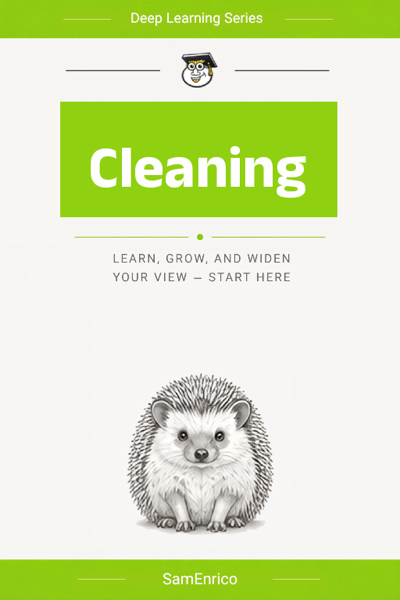
Non-FictionInformativeEducational
Cleaning eBook
A Coursebook on Cleaning
A Coursebook on Cleaning
Formats
Free sample
Chapter 1: The Shame Cycle Ends Here--–- Let me tell you something no cleaning book has ever admitted: your house is not a reflection of your worth as a human being. And yet, almost everyone who picks up a book about cleaning believes, somewhere deep down, that it is. You believe that a clean home means you are a competent adult, and a messy home means you are failing. This belief is not only wrong—it is the single biggest obstacle between you and a consistently clean home.I have interviewed hundreds of people about their cleaning struggles, and the same pattern emerges every time. A woman named Sarah told me she once spent four hours scrubbing her baseboards the day before a party.
No one looked at her baseboards. Not one guest. But Sarah was so exhausted and resentful by the time people arrived that she couldn’t enjoy her own gathering. Another person, a man named David, confessed that he hides in his car when friends ring the doorbell unannounced. Not because his house is filthy—but because the breakfast dishes are still in the sink and there is a basket of unfolded laundry on the couch.
He believes these small imperfections mean he has failed as an adult.This is the shame cycle, and it is destroying your ability to clean effectively.The shame cycle works like this: you look around your home and see mess. Instead of seeing a neutral condition that can be changed with simple actions, you see a moral indictment. You think, “I am lazy,” or “I am disorganized,” or “I am not a real adult.” That shame triggers a stress response in your body. Your cortisol rises. Your brain perceives a threat—because shame is neurologically processed in the same regions as physical pain.
And what does a threatened brain do? It avoids. It postpones. It seeks distraction. So you scroll on your phone instead of washing the dishes.
Then the mess gets worse. And the shame grows. And the cycle continues.The only way out is to break the link between cleanliness and self-worth. This chapter will show you exactly how to do that.The Lie You Were Told About Cleanliness Where did this belief come from? For most of us, it started in childhood.
You heard a parent say, “This house is a disaster,” or “What will the neighbors think?” You learned that a clean house was something you did for approval, not for yourself. You learned that mess was embarrassing, even shameful. And you learned that if you couldn’t keep your room clean, something was wrong with you.These messages are so pervasive that we absorb them without question. But let me ask you something: would you say that a person who cannot cook a gourmet meal is a moral failure? Of course not.
Cooking is a skill. Some people are taught; others are not. Some people practice; others do not. The same is true for cleaning. It is a set of observable, learnable techniques, not a virtue you are either born with or without.The bestselling books in this space have danced around this truth but never stated it plainly.
Marie Kondo talks about joy, but if you don’t feel joy while folding socks, you might still feel like you’re doing it wrong. Cheryl Mendelson, in Home Comforts, treats cleaning as a science, which is helpful but can feel intimidating. Rachel Hoffman, in Unf*ck Your Habitat, gets closest to the truth with her no-shame, twenty-minutes-at-a-time approach. But even that book doesn’t fully dismantle the moral framework that keeps you stuck.So let me say it clearly: a clean house does not make you a good person. A messy house does not make you a bad person.
Your home is a physical space that you inhabit. It serves you. You do not serve it. Once you truly believe this, cleaning becomes a practical task rather than an emotional ordeal.The Psychology of Shame and Avoidance Let me walk you through the neuroscience, because understanding why shame fails is the key to overcoming it.When you feel shame, your brain activates the same neural circuits that process physical pain. Researchers at UCLA used functional MRI scans to study this phenomenon.
They asked participants to recall a time they felt deeply ashamed—being rejected, being humiliated, being judged. The scans showed activity in the dorsal anterior cingulate cortex and the anterior insula, which are the same regions that light up when you experience physical pain. Your brain literally cannot tell the difference between being ashamed of your messy kitchen and stubbing your toe.Here is what happens next. When your brain registers pain, it seeks escape. This is an ancient survival mechanism.
If you touch a hot stove, your hand pulls away before you even think about it. The same reflex applies to emotional pain. When you feel shame about your home, your brain tries to escape—not by cleaning, but by avoiding the source of the shame. You close the door to the messy room. You scroll social media.
You tell yourself you will clean tomorrow. The avoidance provides temporary relief, which reinforces the behavior. So you avoid again. And again. And the mess grows.This is why shame does not motivate action.
It motivates the opposite of action. It paralyzes you.Guilt is slightly different, but equally unhelpful. Guilt focuses on specific behaviors: “I should have done the dishes last night.” Guilt can sometimes spur action, but it comes with a cost. Guilt-ridden cleaning feels like punishment. You scrub the toilet while muttering about how you should have done it sooner.
You resent the task. You resent yourself. And because the experience is unpleasant, you are less likely to repeat it voluntarily. Guilt might get you to clean once, but it will not build a sustainable habit.What actually works? Small, consistent wins.
Behavioral psychology research, particularly the work of B.J. Fogg at Stanford, shows that habits form when behaviors are easy, feel good, and happen in response to a reliable trigger. Notice what is missing from that list: shame. Guilt. Punishment.
None of those are effective habit-builders.The most successful cleaning habits come from a place of neutrality or even positivity. You clean because you want a clear counter to make breakfast on. You clean because you enjoy the feeling of a made bed. You clean because five minutes of tidying means you wake up to a calm space. Notice that none of these motivations require you to feel bad about yourself first.Defining Your “Clean Enough” Standard If shame is the problem, then the solution is a new definition of success.
I call this your “Clean Enough” standard.Here is what Clean Enough is not. It is not a pristine, magazine-cover home where every pillow is fluffed and every surface gleams. That standard is not only unrealistic for real people living real lives—it is actively harmful. When you compare your home to a styled photo shoot, you are comparing your daily reality to someone else’s curated best moment, often captured under professional lighting with a team of stylists. That comparison is designed…
This is the end of the free sample. Get the eBook to keep going. Buy now
About this book
Details
- Author
- Garmon Kerrie
- Publisher
- SamEnrico
- Language
- English
- Genre
- Non-Fiction, Informative, Educational
- Released
- 2026-05-04
- Pages (approx.)
- 145
- Available as
- eBook, Audiobook

Read better in the ZLOADR app
Your eBooks on your phone or tablet. Sign in with your SamEnrico account and start reading.
More by Garmon Kerrie
 Trauma Dream Metaphors GuideGarmon Kerrie$11.99
 Parenting Stress And Climate AnxietyGarmon Kerrie$11.99
 Hydration Energy GuideGarmon Kerrie$11.99
 Body Image Relationship Self EsteemGarmon Kerrie$11.99
 The Babylonian Star Catalog: The Ancient Quest to Map the HeavensGarmon Kerrie$11.99
 The Troll’s Bridge: A Nordic Folklore Engineering MarvelGarmon Kerrie$11.99
 Understanding Hereditary Sensory Neuropathy Type IGarmon Kerrie$17.99
 Fiverr Gig Ranking PrimerGarmon Kerrie$12.99
 Cloud Manufacturing OutlookGarmon Kerrie$12.99
 How to Start a Shutes Made of Canvas Business (Beginners Guide)Garmon Kerrie$11.99
You may also like
 Hong Kong Handover 1997Dunn Johnnie$11.99
 Zumba For Postnatal Recovery CourseNeal Christian$11.99
 Zumba for BeginnersLadner Nikia$11.99
 YouTube Comment Mining GuideHumes Pandora$12.99
 Worry Box MeditationCarlin Rudy$11.99
 Workplace Stress MeditationNguyen Lynn$11.99
 Workplace Stress and Sleep RepairHawley Ivory$11.99
 Workplace Perfectionism CureDelaney Jeffry$11.99
 Workplace Injustice Anger GuideWallen Isabelle$11.99
 Work Addiction and Burnout LinkGreenwood Ester$11.99
 Women in Yoga and WellnessBeattie Galina$11.99
 Women in Stand Up ComedyChun Evangeline$11.99