
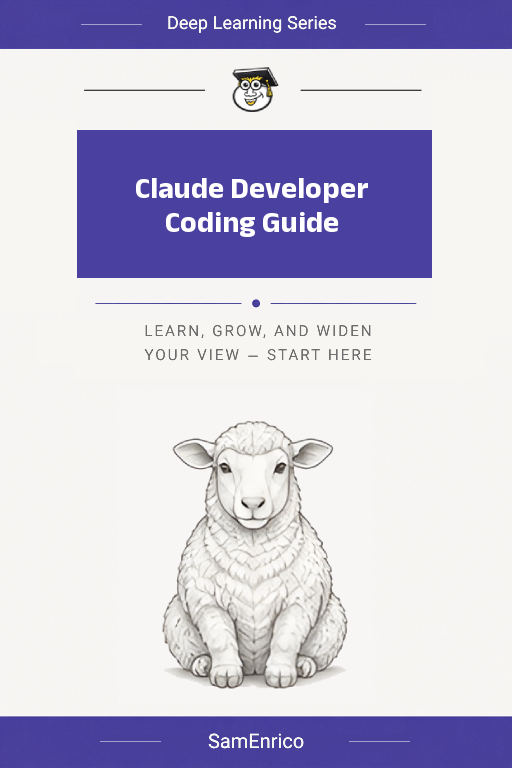
Claude Developer Coding Guide eBook
Use Anthropic's Claude for large-scale code genera
Use Anthropic's Claude for large-scale code generation and reasoning about architecture.
Formats
Free sample
Chapter 1: The Harness Moment--–- The first time your AI breaks production, you will feel something between betrayal and awe. Betrayal, because the code looked perfect—clean abstractions, thoughtful error handling, tests that passed with flying colors. Awe, because you will realize the truth: the AI didn't make a mistake. It did exactly what you asked. The problem was never the AI.
The problem was you thought you were prompting when you should have been engineering.This is the Harness Moment. It comes for every developer who moves beyond toy examples and tries to use Claude for real work. It came for me on a Tuesday in March, at 2:17 AM, when a payment processing endpoint double-charged 847 customers because Claude had refactored a shared utility function I never asked it to touch. The code was beautiful. The bug was invisible.
The refund liability was $486,000.This book is what I learned in the months that followed. It is not a collection of prompt tips. It is a complete engineering discipline for building reliable, production-grade systems around Anthropic's Claude. By the time you finish this chapter, you will understand why "vibe coding" fails at scale, what the five critical failure modes of agentic systems are, and how to assess whether your team is ready to move beyond experimentation.Let us begin with the mistake almost everyone makes.The Vibe Coding Illusion A new wave of hype has swept through development communities. Social media influencers post videos of themselves typing casual sentences like "build a social media app" and watching Claude generate thousands of lines of working code.
They call this "vibe coding"—the art of describing what you want in conversational language and letting the AI figure out the rest.It feels magical. It feels productive. It is a trap.The problem with vibe coding is not that it fails. The problem is that it succeeds often enough to be seductive. You will have dozens of conversations where Claude understands your intent perfectly, generates elegant solutions, and saves you hours of work.
You will feel like a wizard. And then, in the 80th or 800th or 8,000th interaction, it will do something catastrophic.Here is what actually happens inside a vibe coding session. You type a loosely specified request. Claude, eager to please, fills in the gaps with its best guesses. Those guesses are statistically likely to be correct based on its training data.
But "statistically likely" is not the same as "correct for your specific codebase, with its unique constraints, undocumented assumptions, and subtle architectural decisions made by humans who are no longer on your team."The result is the 80% Problem. Claude solves 80% of a problem brilliantly. The remaining 20%—edge cases, integration details, state management, security boundaries, performance characteristics—requires disciplined harness design. Without that harness, the 80% solution does not simply fail to work. It actively harms your codebase by introducing code that almost works, written by an agent that has no memory of why it made certain choices and no ability to explain its trade-offs.Sarah, the lead engineer at the fintech company where that $486,000 bug occurred, had been vibe coding for three weeks.
She was thrilled. "It's like having ten junior engineers who never sleep," she told me. But junior engineers, even tireless ones, need supervision. They need constraints. They need a harness.Sarah's harness was her own attention.
And her attention, like yours, is finite.The Agentic Loop To understand why vibe coding fails, you must understand how Claude actually works. Claude is not an autocomplete engine on steroids. It is an agent—a system that runs a continuous decision-making loop.Traditional coding assistants like Git Hub Copilot suggest one line at a time. You type, they predict the next few characters. This is autocomplete.
It is powerful but fundamentally reactive.Claude Code, by contrast, runs what engineers call the query Loop. Here is what happens in each iteration:First, Claude builds a system prompt and conversation history—everything you have said, everything it has said, every file it has read, every command it has run. This context can grow to hundreds of thousands of tokens.Second, Claude calls the underlying language model, sending that context and waiting for a response. The model does not just generate text. It generates a structured decision: either "continue the conversation" or "call a tool."Third, if the decision is to call a tool, Claude parses the tool call—which tool, with what arguments.
Tools include reading files, writing files, running bash commands, searching the web, querying databases, and any custom tools you have added via the Model Context Protocol (MCP, covered in depth in Chapter 6).Fourth, Claude executes the tool. This might mean actually writing to your file system or running a command that changes your production environment.Fifth, Claude appends the tool's result to the conversation history.Sixth, the loop repeats. Claude sees the result, decides what to do next, calls another tool, sees that result, and continues until it either reaches a stopping condition or exhausts its token limit.This is fundamentally different from autocomplete. Claude can execute multi-step transformations autonomously. It can read five files, write three new ones, run your test suite, see that two tests failed, debug the failures, fix them, and run the tests again—all without you typing another word.This power is precisely what makes the Harness Moment inevitable.
Because the agent does not stop to ask permission at every step. It acts, observes, and replans. And when its initial plan contains a flaw—a flawed assumption, an ambiguous requirement, a missing constraint—that flaw propagates through subsequent actions, compounding into failures that bear no resemblance to the original request.The Five Critical Failure Modes Through analyzing hundreds of production failures across dozens of teams, a clear pattern emerges. Agentic systems fail in predictable ways. These are the five critical failure modes.
They will appear throughout this book as a framework for diagnosis and prevention.Failure Mode One: The Loop Stuck The agent repeats the same action indefinitely. It tries to read a file, fails, tries again, fails again, never changing its approach. Sometimes this manifests as a visible infinite loop; other times it appears as a "thinking" state that never resolves. The root cause is usually missing context—the agent lacks information it needs to make progress, but its training pushes it to keep trying rather than asking for help.In one memorable incident, a developer asked Claude to "refactor the authentication module." Claude attempted to read a configuration file that had been renamed six months earlier. It tried 147 times before the developer noticed the API bill.Failure Mode Two: Context Collapse The agent loses access to critical information as the conversation grows.
This is the "lost in the middle" problem we will explore in Chapter 3. LLMs attend more strongly to the beginning and end of their context windows. Information in the middle becomes effectively invisible. When context collapse occurs, Claude starts ignoring earlier instructions, forgetting constraints you established, and hallucinating facts that contradict information it once had.The symptom is a gradual degradation in response quality. What was once a precise, constraint-aware agent becomes vague, forgetful, and prone to repeating itself.Failure Mode…
This is the end of the free sample. Get the eBook to keep going. Buy now
About this book
Details
- Author
- Wilde Celestine
- Publisher
- SamEnrico
- Language
- English
- Genre
- Non-Fiction, AI Operator
- Released
- 2026-06-01
- Pages (approx.)
- 130
- Available as
- eBook, Audiobook

Read better in the ZLOADR app
Your eBooks on your phone or tablet. Sign in with your SamEnrico account and start reading.
More by Wilde Celestine
 Contract Abstraction Prompt Testing GuideWilde Celestine$11.99
 Imposter Depression ConnectionWilde Celestine$11.99
 Nonforfeiture Benefit LTC GuideWilde Celestine$11.99
 Energizing Breath Awareness PracticeWilde Celestine$11.99
 Self Talk For Creative BlockWilde Celestine$11.99
 Russia FCPA Enforcement LogWilde Celestine$11.99
 Memory Keeping for ParentsWilde Celestine$11.99
 Indigenous Spiritual Mentoring CourseWilde Celestine$11.99
 Bosnian Ethnic CleansingWilde Celestine$11.99
 The Outback Telescope: Australia’s Quest for the StarsWilde Celestine$11.99
 The Manchurian Algorithm: How AI Almost Triggered a Cold War AI Arms RaceWilde Celestine$11.99
 The Lost Tomb of the Red Sea: Unlocking Ancient DNA in the Indian OceanWilde Celestine$11.99
You may also like
 AI Presentation WorkbookSommers Tonda$11.99
 PowerPoint Copilot MasteryConway Lanita$11.99
 Branded AI DecksWindham Loni$11.99
 AI Presentation CourseGrooms Olin$11.99
 AI Presentation CertificationBlank Dolly$11.99
 AI Deck Version ControlMedley Lorina$11.99
 AI Deck Update AutomationFraser Tresa$11.99
 AI Deck Myths DebunkedCrittenden Romelia$11.99
 AI Deck Customization GuideDove Hannelore$11.99
 AI Bullet to Slide ConverterKohn Eloisa$11.99
 AI Deck Notes CreatorBarela Sunday$11.99
 AI Deck Outline GeneratorAshmore Morgan$11.99