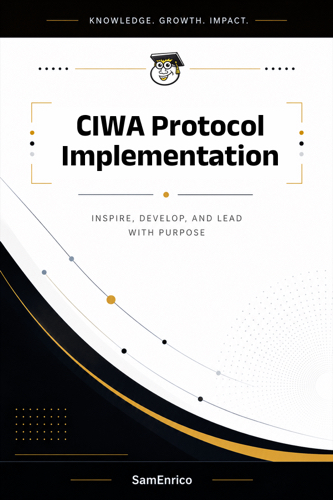
CIWA Protocol Implementation eBook
Teaches nurses and doctors to use Clinical Institu
by Tapia Elvia
Teaches nurses and doctors to use Clinical Institute Withdrawal Assessment for alcohol.
Formats
Free sample
Chapter 1: The Kindling Fire...-- Alcohol withdrawal is not a moral failing. It is a neurological fire that, once sparked, burns hotter with every relapse. This is the single most important concept that no one taught you in nursing school or medical residency—and it is the reason your hospital is failing patients with Alcohol Use Disorder (AUD) every single night.The 2 AM Page No One Wants to Answer It is 2:17 AM on a Tuesday. You are the night shift nurse on a 32-bed medical-surgical unit. Your assignment includes six patients.
One is post-operative day one from a hip replacement. One is here for cellulitis of the lower leg. One is an elderly woman with pneumonia. And then there is Mr. Henderson in Room 204.Mr.
Henderson is 47 years old. He was admitted eighteen hours ago with what the emergency department documented as "abdominal pain, possible pancreatitis." His labs showed an amylase of 480, lipase of 900, and an AST of 112 with an ALT of 68—a classic pattern for alcoholic pancreatitis. The admitting hospitalist wrote orders for IV fluids, pain control, nothing by mouth, and a CIWA-Ar protocol "for alcohol withdrawal screening."At 10:00 PM, the previous shift nurse documented a CIWA score of 6. Mild. The patient was anxious but cooperative, with a fine tremor noted only when his arms were extended.
No medication was given. The note said, "Patient sleeping comfortably at shift change."Now, at 2:17 AM, you walk past Room 204 and hear a thud.You push open the door. Mr. Henderson is on the floor between the bed and the window. His hospital gown is twisted around his waist.
His IV line has been pulled from his arm and is dripping saline onto the linoleum. He is shaking—not a fine tremor now, but a whole-body tremor that makes his teeth click together. His eyes are wide open, darting around the room, and he is speaking rapidly in a language you do not recognize. It sounds like words, but they do not connect. When you kneel beside him and say his name, he turns his head toward you but does not seem to see you.
His pupils are dilated. His skin is hot and soaked with sweat. You reach for his wrist to check a pulse and find it racing—you count 142 beats per minute.You call out for help. Another nurse arrives. Together, you get Mr.
Henderson back into bed. He resists. He grabs the bed rail and tries to climb over it. He says, "They're in the walls. Get them out.
Get them out of the walls."You grab the CIWA flowsheet from the front of his chart. You quickly run through the ten items. Nausea? He vomited on the floor. Tremor?
Continuous, even at rest. Sweats? Drenching. Anxiety? He is beyond anxious—he is terrified.
Agitation? He tried to climb over the bed rail. Tactile disturbances? He is brushing something off his arms that is not there. Auditory disturbances?
He is responding to voices you cannot hear. Visual disturbances? He is watching things move along the wall. Headache? He cannot tell you.
Orientation? He does not know where he is or why he is here.You calculate the score. It is 24.You look back at the flowsheet. The last documented score was 6 at 10:00 PM. Over four hours, while the night shift attended to five other patients, Mr.
Henderson's withdrawal escalated from mild to very severe. He is now in full alcohol withdrawal delirium—what old textbooks called delirium tremens, or the DTs. He is at imminent risk of a seizure. His heart rate of 142 could tip into a fatal arrhythmia at any moment. His temperature is 38.9°C (102°F).
He is dangerously close to cardiovascular collapse.You reach for the phone to call the covering hospitalist. You know what is coming. The hospitalist will ask you a series of questions—questions you could have answered thirty minutes ago, or two hours ago, or four hours ago, if anyone had checked his CIWA score. The hospitalist will order benzodiazepines. You will give them.
But it will take time for the medication to reach his brain, and in that time, his heart rate could climb to 160, or he could seize, or he could stop breathing from the very medication meant to save him.You are now in a rescue scenario. And it did not have to be this way.This is the hidden epidemic of general hospital medicine. Mr. Henderson is not an outlier. He is one of the 15 to 25 percent of patients occupying general medical-surgical beds at this very moment who have Alcohol Use Disorder.
He is the patient with pneumonia who starts hallucinating on day two. He is the patient with a broken ankle from a fall who becomes agitated and unmanageable. He is the patient with pancreatitis who was supposed to be "stable" but is now in the intensive care unit on a benzodiazepine drip, costing the hospital an additional $15,000 and occupying a bed that could have gone to someone else.The problem is not that hospitals lack protocols for alcohol withdrawal. The problem is that most clinicians have never been properly trained to use them. And the deeper problem—the one this entire book exists to solve—is that most clinicians do not understand the fundamental neurobiology of alcohol withdrawal.
They do not understand the kindling effect. And because they do not understand kindling, they underestimate their patients. They assume that mild withdrawal today means mild withdrawal tomorrow. They assume that a patient who scores a 6 at 10:00 PM will still be a 6 at 2:00 AM. They are catastrophically wrong.This chapter will teach you why alcohol withdrawal is fundamentally different from almost every other withdrawal syndrome in medicine.
It will teach you why each subsequent detoxification is more dangerous than the last. It will teach you to recognize the prodrome of delirium tremens before your patient hits the floor. And it will make the case—clinical, financial, and legal—that a properly implemented symptom-triggered CIWA protocol is not a luxury. It is the standard of care.The Neurobiology of Dependence: What Happens Inside the Brain To understand why alcohol withdrawal is so dangerous—and why the CIWA protocol is so essential—you must first understand what alcohol does to the brain during chronic heavy use. This section will use simplified neurobiology, but the clinical implications are anything but simple.Alcohol is a central nervous system depressant.
It works primarily by enhancing the activity of the brain's main inhibitory neurotransmitter, gamma-aminobutyric acid, or GABA. When you drink alcohol, it binds to GABA-A receptors in your brain, making them more responsive to the GABA that is already there. The result is sedation, reduced anxiety, muscle relaxation, and, at higher doses, respiratory depression and loss of consciousness.But the human brain is a homeostatic organ. It does not like being pushed out of balance. When you chronically flood your brain with an exogenous depressant (alcohol), your brain adapts by reducing its own GABA production and downregulating GABA receptors.
At the same time, your brain upregulates the opposing system: the excitatory neurotransmitter system, primarily glutamate. Glutamate is the gas pedal of the brain. It makes neurons fire. It promotes alertness, anxiety, and seizure…
This is the end of the free sample. Get the eBook to keep going. Buy now
About this book
Details
- Author
- Tapia Elvia
- Publisher
- SamEnrico
- Language
- English
- Genre
- Non-Fiction, Health & Wellness, Clinical Protocols
- Released
- 2026-06-07
- Pages (approx.)
- 146
- Available as
- eBook, Audiobook

Read better in the ZLOADR app
Your eBooks on your phone or tablet. Sign in with your SamEnrico account and start reading.
More by Tapia Elvia
 Self Esteem In Job InterviewsTapia Elvia$11.99
 Omega 3s for Depression GuideTapia Elvia$11.99
 Paleo Vs KetoTapia Elvia$11.99
 Birthday Party Planning ShortcutTapia Elvia$11.99
 Round Robin Idea SharingTapia Elvia$11.99
 Blue Zone Water Drinking GuideTapia Elvia$11.99
 Anger Cognitive Restructuring For TeensTapia Elvia$11.99
 The Shadow Code: Berlin’s Ransomware Heist and the Birth of Cyber ExtortionTapia Elvia$11.99
 The Ashes of Glory: England's First Cricket Champions and the Birth of a Rivalry (1882)Tapia Elvia$11.99
 How to Produce Hunting Blinds and ScreensTapia Elvia$11.99
 A Collector's Handbook to the Gsm DeltaTapia Elvia$11.99
 Bluevine International BankingTapia Elvia$12.99