
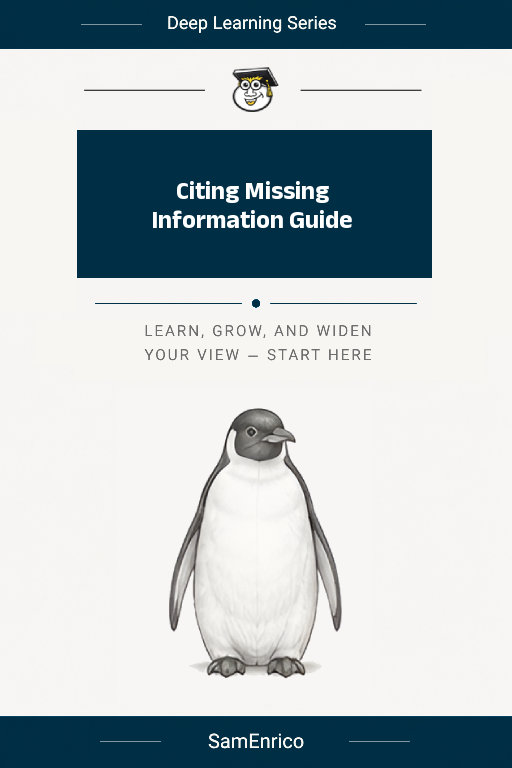
Non-FictionStudent's ShortcutMissing Info
Citing Missing Information Guide eBook
Cite sources with no author, no date, or no page n
Cite sources with no author, no date, or no page number in all citation styles.
Formats
Free sample
Chapter 1: The Navigation Principle...--–- You have just found the perfect source for your research paper. It says exactly what you need, contains compelling data, and supports your argument flawlessly. There is only one problem. The source has no author. No publication date.
No page numbers. And your professor expects a perfect citation by tomorrow morning. What do you do?This moment of panic is the most common experience in academic writing, yet almost no one talks about it. Writing centers assume you have complete sources. Citation generators break when fields are empty.
And style manuals—those dense, intimidating doorstops of rules—tell you what to do when information exists, not what to do when it has disappeared.This book exists because that moment of panic is not your fault. It is a structural failure in how citation is taught.Every day, millions of students, researchers, and professionals encounter sources that are missing critical information. A government report with no listed author. A webpage with no publication date. A PDF that has been stripped of its original page numbers.
An ancient text that uses a numbering system you have never seen. A social media post from an account with no bio. A deleted tweet that you desperately need to cite.These are not edge cases or rare anomalies. They are the reality of modern research.The old rules of citation were designed for a world of print books, journal issues with consecutive pagination, and clearly labeled authors on title pages. That world no longer exists.
We now live in a world of digital ephemera, anonymous web content, constantly updated pages, and sources that seem designed to frustrate the very concept of attribution.Yet the expectation to cite perfectly remains.This book bridges that gap. It does not assume you have complete information. It assumes you do not. It does not punish you for missing data. It teaches you how to work with what you have.
And it does not force you to memorize hundreds of style-specific exceptions. It gives you a framework—a way of thinking about citations—that works across MLA, APA, and Chicago, the three major styles used in academic writing.Before we dive into specific techniques for specific missing elements, we must establish the single most important idea in this entire book. Everything else builds from this foundation. If you understand this one principle, you will never again feel lost when facing a citation with missing information. If you ignore it, you will remain confused no matter how many rules you memorize.The principle is this: a citation is not a punishment, a bureaucratic requirement, or a set of arbitrary hoops to jump through.
A citation is a recovery map.Let us explain what that means.The Recovery Map Philosophy When you write a research paper, you are making an implicit promise to your reader. That promise is simple: everything I have borrowed from others can be found by you if you want to verify it, explore it, or understand my argument better. The citation is the tool that fulfills that promise.Think of a citation exactly like a GPS coordinate or a library call number. Its only job is to lead someone directly to the source you used. If a reader cannot locate your source using the information you provided, the citation has failed—regardless of whether you followed every formatting rule perfectly.This shifts the entire purpose of citation from rule-following to reader recovery.Here is what that means in practice.
When you encounter a source with missing information, your first question should not be "What does the style manual say about this exact scenario?" Your first question should be "What information do I have that would allow a reader to find this source?"This question changes everything.Because once you understand that citation is about recovery rather than rules, you stop panicking about what is missing and start working confidently with what you have. You realize that a stable identifier like a DOI can replace an author, a date, and a publisher all at once. You understand that a descriptive title in quotation marks can serve as an effective stand-in for a missing byline. You see that a section heading and a paragraph count can do the work of a missing page number.The recovery map philosophy also saves you from the most common mistake in citation writing: inventing information.When students panic about missing data, they often guess. They invent an author name based on the website domain.
They estimate a publication date based on the copyright notice at the bottom of the page. They assume a publisher based on the URL. Every one of these inventions is a violation of academic integrity, and they are completely unnecessary.The "Fill What You Have, Skip What You Don't" rule is the practical expression of the recovery map philosophy. This rule is simple: include every piece of information you can reliably identify, and omit every piece you cannot. Never invent.
Never guess. Never assume.If a source has no author, you do not invent one. You move the title to the front. If a source has no date, you do not guess based on the URL. You use n.d.
in APA or omit the date entirely in MLA. If a source has no publisher, you do not assume based on the book's topic. You skip the field or mark it as unknown.This rule is not a concession to laziness or a lowering of standards. It is the official guidance of every major style manual. APA says so explicitly.
MLA says so explicitly. Chicago says so explicitly. They all agree: include what you have, omit what you do not, and never invent.The rest of this chapter builds on this foundation by introducing the three core frameworks you will use throughout this book: the hierarchy of reliability, the anatomy of a citation, and the style landscape.The Hierarchy of Reliability: What to Trust When Nothing Is Complete Not all information in a source is equally reliable or equally useful for recovery. Some pieces of information are almost impossible to fake or lose. Others are helpful but secondary.
And some are better than nothing but should be your last resort.The hierarchy of reliability organizes citation information from most reliable to least reliable. You will use this hierarchy constantly when diagnosing missing-information problems and deciding how to structure your citations.First Level: Stable Identifiers At the top of the hierarchy are stable identifiers. These are permanent, unique codes assigned to specific works by publishers, libraries, or international standards organizations. The most important stable identifiers for citation work are the DOI, the ISBN, and the PMID.A DOI, or Digital Object Identifier, is the gold standard of citation recovery. It is a permanent alphanumeric string assigned to journal articles, book chapters, research reports, and other scholarly works.
DOIs never change. They are not tied to specific websites or publishers. If you have a DOI, you can find the source regardless of whether the original URL has broken, the publisher has gone out of business, or the author has deleted their personal website.Here is what a…
This is the end of the free sample. Get the eBook to keep going. Buy now
About this book
Details
- Author
- Curtis Richard
- Publisher
- SamEnrico
- Language
- English
- Genre
- Non-Fiction, Student's Shortcut, Missing Info
- Released
- 2026-05-30
- Pages (approx.)
- 157
- Available as
- eBook, Audiobook

Read better in the ZLOADR app
Your eBooks on your phone or tablet. Sign in with your SamEnrico account and start reading.
More by Curtis Richard
 Concentrating Mental ObjectsCurtis Richard$11.99
 Check The Facts GuideCurtis Richard$11.99
 Emotion Regulation For Financial StressCurtis Richard$11.99
 The Weekly Priority ReviewCurtis Richard$11.99
 Pelvic Floor and Diastasis RectiCurtis Richard$11.99
 Workaholism Self Assessment ToolCurtis Richard$11.99
 CVD Risk Master GuideCurtis Richard$11.99
 Antwerp Heist VictimsCurtis Richard$11.99
 The Golden Voices: Black Operatic Legends Who Conquered the World StageCurtis Richard$11.99
 The Copycat Killer of Canada: How Cold Case Squads Tracked a Decade of ImitationsCurtis Richard$11.99
 How to Produce Storage and Entryway BenchesCurtis Richard$11.99
 A Collector's Handbook to the Dutton B-seriesCurtis Richard$11.99
You may also like
 Hong Kong Handover 1997Dunn Johnnie$11.99
 Zumba For Postnatal Recovery CourseNeal Christian$11.99
 Zumba for BeginnersLadner Nikia$11.99
 YouTube Comment Mining GuideHumes Pandora$12.99
 Worry Box MeditationCarlin Rudy$11.99
 Workplace Stress MeditationNguyen Lynn$11.99
 Workplace Stress and Sleep RepairHawley Ivory$11.99
 Workplace Perfectionism CureDelaney Jeffry$11.99
 Workplace Injustice Anger GuideWallen Isabelle$11.99
 Work Addiction and Burnout LinkGreenwood Ester$11.99
 Women in Yoga and WellnessBeattie Galina$11.99
 Women in Stand Up ComedyChun Evangeline$11.99