
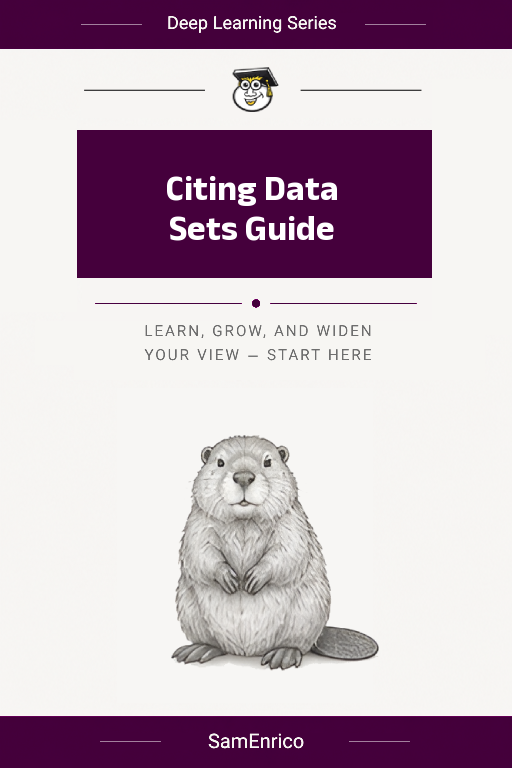
Non-FictionStudent's ShortcutData
Citing Data Sets Guide eBook
Cite raw data, statistics, and datasets from repos
Cite raw data, statistics, and datasets from repositories like ICPSR and Data.gov.
Formats
Free sample
Chapter 1: The Invisible Backbone--Every scientific conclusion you have ever trusted rests upon a silent foundation. When a journalist reports that “unemployment fell by 0.3%,” when a pharmaceutical company announces a new drug reduces symptoms by 40%, or when a policy maker claims that a specific intervention improved student test scores, you are not witnessing the result of a single genius insight. You are seeing the final, polished output of an invisible machine—one built entirely from raw data, statistics, and datasets that someone, somewhere, had to collect, clean, verify, and ultimately cite.Yet for centuries, academic culture has celebrated the interpreter while ignoring the evidence itself. A Nobel Prize is awarded to the economist who discovers a relationship between education and economic growth, but rarely to the government statisticians who spent decades tracking thousands of individuals. A groundbreaking medical study makes front-page news, but the patient-level data collected over ten years from fifty hospitals receives no byline.
This chapter argues that this imbalance is not merely unfair—it is dangerous for science, destructive for reproducibility, and ultimately unsustainable. Citing data properly is not a bureaucratic chore. It is the single most important act of intellectual honesty you can perform as a researcher.The Argument vs. The Evidence To understand why data citation matters, you must first recognize a distinction that most researchers overlook: the difference between citing an argument and citing evidence.When you cite a traditional book or journal article, you are citing an argument. The author has taken raw observations—whether from experiments, historical documents, or surveys—and has interpreted them into a narrative, a theory, or a conclusion.
You are citing the author’s thinking. This is valuable, but it is one step removed from the empirical world.When you cite a dataset, by contrast, you are citing evidence itself. You are pointing directly to the measurements, the counts, the responses, and the observations that anyone can reanalyze. A dataset does not argue. It does not persuade.
It simply exists as a collection of facts waiting to be interrogated.Consider a concrete example. Imagine you are writing a paper on voter turnout in the United States. You might cite a book by a political scientist who argues that weather suppresses turnout. That is an argument citation. But you might also cite the raw data from the Cooperative Election Study, which contains the actual responses of 50,000 voters, including whether they voted and what the weather was in their precinct.
That is an evidence citation.The difference is profound. Arguments can be wrong. Interpretations can be biased. But evidence—properly collected and accurately cited—remains true to itself. When you cite the dataset, you are inviting your reader to bypass your interpretation entirely and test the evidence themselves.
That is the essence of science.Yet the current system discourages this. Most citation style guides were designed in an era when the only citable objects were printed books and journals. Datasets were afterthoughts—mentioned in footnotes, buried in appendices, or omitted entirely. As a result, researchers learned to cite the paper that used the data rather than the data itself. A vicious cycle emerged: data creators received no academic credit, so they had little incentive to curate and share their data; without curated data, researchers continued citing papers instead of data; and without proper citations, data remained invisible.This chapter begins the work of breaking that cycle.Scholarly Credit: Why Data Creators Deserve Recognition The concept of “scholarly credit” is not merely about ego or career advancement.
It is the primary mechanism by which academia allocates resources, rewards effort, and incentivizes quality work. Tenure decisions, grant funding, journal editorships, and even Nobel Prizes all depend on a simple question: Who has contributed meaningful, citable work to the field?Today, the answer systematically excludes data creators.A research assistant who spends six months cleaning a messy dataset receives no citable credit. A government agency that collects and validates a longitudinal survey over thirty years is listed as a “source” rather than an author. A data curator who ensures that historical weather records are preserved, documented, and accessible receives a thank-you in the acknowledgments—if they are lucky.This is not a minor oversight. It is a structural failure with measurable consequences.
Economists have estimated that the lack of formal data citations reduces the academic reward for data sharing by as much as 80% compared to publishing traditional papers. In fields like genomics and astronomy, where data collection is enormously expensive, this disincentive actively harms scientific progress. Why would a senior investigator spend millions of dollars to collect a unique dataset when they could instead spend a fraction of that to analyze someone else’s data and publish five papers?The solution, championed by the FORCE11 working group on data citation (which we will explore later in this chapter), is simple in concept but radical in practice: treat datasets as first-class citable objects. This means that datasets should have persistent identifiers (like DOIs), metadata that describes their provenance and methodology, and citation formats that parallel those for journal articles. It also means that universities, funding agencies, and promotion committees must count data citations alongside traditional citations when evaluating researchers.Some institutions have already begun.
The National Institutes of Health (NIH) and the National Science Foundation (NSF) now require data management and sharing plans for all grant applications. A growing number of journals, including Nature, Science, and PLOS ONE, mandate that authors include a data availability statement that cites the datasets used. And organizations like ORCID (Open Researcher and Contributor ID) now allow researchers to link their profile to the datasets they have created, ensuring that data contributions appear alongside their publications.But policy changes alone are insufficient. The real transformation happens when individual researchers—readers like you—internalize the principle that citing data is not optional. It is a professional obligation.Reproducibility: The Crisis That Demands Data Citation If scholarly credit is the incentive, reproducibility is the imperative.The reproducibility crisis is now well-documented across multiple disciplines.
In psychology, an ambitious project attempted to replicate 100 studies from top journals and succeeded in only 39% of cases. In cancer biology, researchers could reproduce the results of only 6 out of 53 landmark studies. In economics, fewer than half of the replication attempts in a major project yielded consistent findings.Many factors contribute to this crisis: small sample sizes, flexible analysis choices, publication bias. But one factor stands out as both pervasive and preventable: the inability to access and verify the original data.Consider what happens when a paper does not cite its data clearly. A reader who wants to reproduce the analysis must:Hunt through the text, footnotes, and supplementary materials for clues about where the data came from.Guess whether the authors used a specific version of a public dataset (e.g., the 2015 release of the American Community Survey vs.
the 2018 release).Search for contact information and email the corresponding author, who may or may not respond.Wait weeks or months for the author to locate the exact files used.Discover that the author has since lost the files, upgraded their software, or cannot remember which cleaning steps they applied.Even when goodwill exists, the lack of precise citation creates enormous…
This is the end of the free sample. Get the eBook to keep going. Buy now
About this book
Details
- Author
- Patino Bennie
- Publisher
- SamEnrico
- Language
- English
- Genre
- Non-Fiction, Student's Shortcut, Data
- Released
- 2026-06-01
- Pages (approx.)
- 151
- Available as
- eBook, Audiobook

Read better in the ZLOADR app
Your eBooks on your phone or tablet. Sign in with your SamEnrico account and start reading.
More by Patino Bennie
 Nurse Who Never Gave UpPatino Bennie$11.99
 Emotion Exposure HierarchyPatino Bennie$11.99
 Breath Awareness For Chronic PainPatino Bennie$11.99
 Alcohol Recovery Finance PlanPatino Bennie$11.99
 Delegation for New ManagersPatino Bennie$11.99
 Antwerp Heist PhotographyPatino Bennie$11.99
 Pomodoro For Writers BlockPatino Bennie$11.99
 Graham Hancock OdysseyPatino Bennie$11.99
 The Troll King’s Riddle: A Saga of Excalibur and FrostPatino Bennie$11.99
 The Phantom of the Fur Trade: The Ghosts of the Hudson's Bay CompanyPatino Bennie$11.99
 10 Ways to Use Sweet Sherry (Recipe Book)Patino Bennie$11.99
 Seasonal Student Job GuidePatino Bennie$12.99
You may also like
 Hong Kong Handover 1997Dunn Johnnie$11.99
 Zumba For Postnatal Recovery CourseNeal Christian$11.99
 Zumba for BeginnersLadner Nikia$11.99
 YouTube Comment Mining GuideHumes Pandora$12.99
 Worry Box MeditationCarlin Rudy$11.99
 Workplace Stress MeditationNguyen Lynn$11.99
 Workplace Stress and Sleep RepairHawley Ivory$11.99
 Workplace Perfectionism CureDelaney Jeffry$11.99
 Workplace Injustice Anger GuideWallen Isabelle$11.99
 Work Addiction and Burnout LinkGreenwood Ester$11.99
 Women in Yoga and WellnessBeattie Galina$11.99
 Women in Stand Up ComedyChun Evangeline$11.99