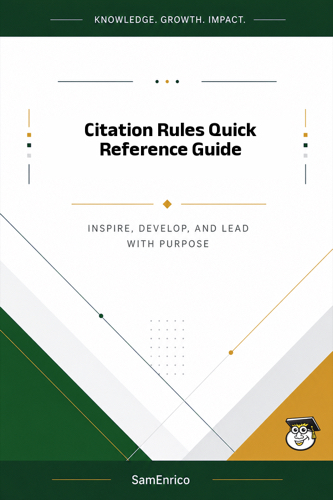
Citation Rules Quick Reference Guide eBook
Master APA MLA and Chicago citations in under twen
by Biddle Lauri
Master APA MLA and Chicago citations in under twenty minutes with this streamlined tutorial.
Formats
Free sample
Chapter 1: The Honesty Shortcut...--You are not afraid of citations. Let me say that again, because every student who picks up this book thinks the opposite is true. You are not afraid of citations. What you are actually afraid of is the consequence of getting them wrong – the point deduction, the plagiarism accusation, the late-night panic when your professor writes "incomplete citation" in red ink and you have no idea what that means.Here is the uncomfortable truth that bestselling citation guides like Charles Lipson's Cite Right have quietly understood for years: citation is not a punishment. It is not a bureaucratic hoop designed to make your life harder.
It is, in fact, the exact opposite. Proper citation is the single fastest way to demonstrate that you belong in the academic conversation – that you have done the reading, understood the arguments, and can position your own ideas alongside the work of established scholars.This chapter rewires how you think about citation. By the time you finish reading – in about three minutes – you will understand why citation exists, when you actually need to use it, and why "accuracy over volume" will save you more points than memorizing every comma rule in the style guide.The Real Problem (It Is Not What You Think)Walk into any college library during finals week, and you will find students doing the same thing: frantically flipping through style guides, cross-referencing citation generators, and praying that their professor does not notice the misplaced period on page twelve of their reference list. This is the citation anxiety cycle, and it is entirely self-inflicted.The root cause of citation anxiety is not complexity. The root cause is a fundamental misunderstanding of what citations are for.
Most students believe citations exist to satisfy an arbitrary rule set. "My professor said to use APA, so I am using APA." This is like saying "my doctor told me to exercise, so I am moving my arms while sitting on the couch." You are performing the motion without understanding the purpose, and the result is a mess.Citations exist to solve three problems that have existed since the very first university was founded in Bologna in 1088. First, they give credit where credit is due – the ethical problem of intellectual theft. Second, they allow readers to verify your sources – the practical problem of evidence. Third, they locate your argument within an existing conversation – the intellectual problem of originality.When you cite a source, you are not bowing to an arbitrary rule.
You are saying to your reader: "I found this idea here, and you can find it too. Now let me build on it." That is an act of intellectual confidence, not submission.The Three Rules of Academic Honesty (A 30-Second Decision Tree)Here is the entire citation rulebook distilled to its absolute essence. Everything else in this guide – every comma, every italic, every parentheses placement – is just a formatting detail that serves these three rules. Memorize these rules, and you will never commit accidental plagiarism again.Rule One: Cite if you quote directly.Any time you take a string of words from another source and place them inside your paper, you need quotation marks and a citation. The length does not matter.
A single distinctive word – if it is unique to that author's vocabulary – requires quotation marks. A full paragraph requires quotation marks. A sentence requires quotation marks. If the words are not yours, mark them as borrowed.The only exception to quotation marks is when you are quoting a source that is already inside a block quote format – but even then, you still cite the source. The quotation marks disappear because the block formatting signals the borrowing, but the citation remains.Rule Two: Cite if you paraphrase a unique idea.This is where most students stumble, because the definition of "paraphrase" is widely misunderstood.
Paraphrasing is not changing a few words. Paraphrasing is not swapping synonyms. Paraphrasing is a complete restructuring of the original idea in your own voice and sentence structure – and even then, you still need to cite the source.Why? Because the idea itself is borrowed. You did not discover the relationship between carbon emissions and ocean acidification.
You did not invent the concept of cognitive dissonance. You did not uncover the historical significance of the Emancipation Proclamation. You read those ideas in someone else's work, and then you rephrased them. That rephrased version still belongs – intellectually – to the original author.Here is the test: if the idea would not exist in your paper without having read that specific source, you need to cite it. This remains true even if you have completely rewritten every sentence.Rule Three: Do not cite common knowledge or your own analysis.Common knowledge is the safety valve that prevents citation from becoming absurd.
You do not need to cite that water freezes at zero degrees Celsius. You do not need to cite that Barack Obama was the 44th president of the United States. You do not need to cite that the sun rises in the east.But here is where common knowledge gets tricky. What counts as common knowledge depends entirely on your audience. In a first-year composition class, the fact that "Shakespeare wrote sonnets" is common knowledge.
In a graduate-level Shakespeare seminar, the fact that "Sonnet 18 follows the English sonnet rhyme scheme of ABAB CDCD EFEF GG" is also common knowledge – but just barely. In a biology paper, that same fact about sonnet rhyme schemes would require a citation, because biologists cannot be expected to know the structure of English poetry.The "Man on the Street" test offers a practical boundary. Imagine you stop five random people on the street. If all five would know the fact without having specialized training, it is common knowledge. If even one would look confused, you are in citation territory.Your own analysis – the conclusions you draw, the arguments you construct, the original connections you make between sources – never requires a citation.
That is your intellectual contribution. Do not dilute it by over-citing. A paper that cites every sentence reads like a patchwork of borrowed ideas. A paper that cites strategically reads like a confident scholar entering a conversation.The "Cite Right" Ethos: Why Accuracy Outranks Volume Charles Lipson, whose work anchors the most respected citation guides in academic publishing, offers a counterintuitive insight: a few correctly formatted citations carry more weight than a long, error-filled reference list. This is the "Cite Right" ethos, and it changes everything.Consider two students.
Student A submits a paper with twenty sources in the reference list, but five of them have missing DOIs, two have incorrect author names, and three have formatting errors that make the publication dates illegible. Student B submits a paper with eight sources in the reference list, every single one formatted perfectly. Which student makes a better impression on the professor?Student B, without question. The professor looks at Student B's reference list and thinks: "This student pays attention to details. This student respects the academic process.
This student can be trusted to handle primary sources correctly." The professor looks at Student A's reference list and thinks: "This student rushed. This student used a…
This is the end of the free sample. Get the eBook to keep going. Buy now
About this book
Details
- Author
- Biddle Lauri
- Publisher
- SamEnrico
- Language
- English
- Genre
- Non-Fiction, Student's Shortcut, Academic Writing
- Released
- 2026-06-07
- Pages (approx.)
- 136
- Available as
- eBook, Audiobook

Read better in the ZLOADR app
Your eBooks on your phone or tablet. Sign in with your SamEnrico account and start reading.
More by Biddle Lauri
 Model Child Star ExploitationBiddle Lauri$11.99Model Child Star ExploitationBiddle Lauri$11.99
 Assertive Communication for ManagersBiddle Lauri$11.99
 Fiverr Seller Level StrategyBiddle Lauri$11.99
 Walmart Neighborhood MarketBiddle Lauri$11.99
 Scott Peterson Appeal ArgumentsBiddle Lauri$11.99
 Permissive ScriptingBiddle Lauri$11.99
 Indian GST Input Tax Credit First Claim GuideBiddle Lauri$11.99
 Cicero's Six Part SpeechBiddle Lauri$11.99
 The Iron Phalanx: The Birth of Armored Warfare in Ancient ChinaBiddle Lauri$11.99
 The Ghosts of Operation Cyclone: How the CIA Armed the MujahideenBiddle Lauri$11.99
 UN Secondment And Loans GuideBiddle Lauri$12.99