
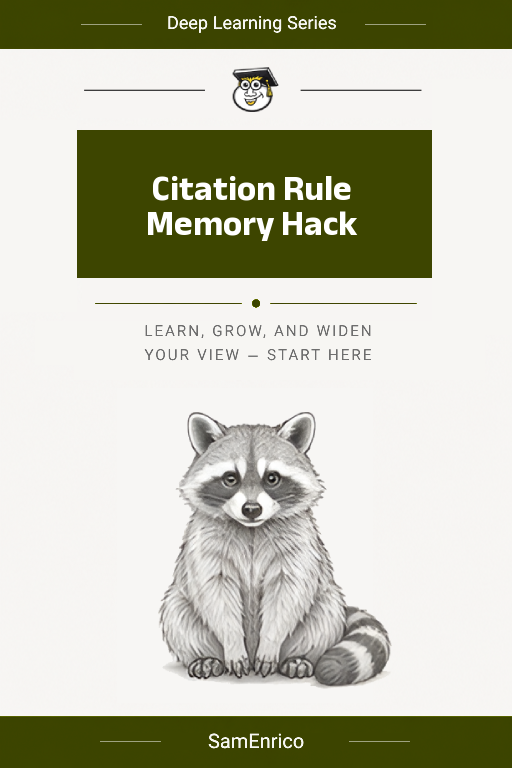
Non-FictionMemory AidStudy Guide
Citation Rule Memory Hack eBook
Use simple memory tricks to recall citation format
Use simple memory tricks to recall citation formats instantly. No more flipping through style guides during exams.
Formats
Free sample
Chapter 1: The Forgetting Paradox--–- You have never had a bad memory. You have only ever had an untrained one.This is not a motivational slogan. It is a neurological fact. The difference between a student who panics during an exam, flipping frantically through a style guide to find whether a comma belongs inside or outside a quotation mark, and a student who writes the citation from memory without breaking stride is not a difference in innate ability. It is a difference in encoding strategy.
One student has been taught to memorize through repetition and hope. The other has been taught to memorize through pictures, stories, and deliberate weirdness. This chapter is about why the second method works, why the first method fails, and how you are going to retrain your brain in the next fifteen minutes.Let us begin with a question. Think back to the last time you forgot something important during a test. Not something difficult—something you had reviewed the night before.
A formula. A date. A citation rule. You knew it at 10 p.m. At 10 a.m., it was gone.
Now think back to something you remember effortlessly from five years ago. A childhood birthday. An embarrassing moment in high school. The layout of your grandparents' living room. Why does one memory stick while the other evaporates?
The answer lies in how your brain decides what to keep and what to throw away.Your brain is not a computer. It does not store information like files on a hard drive, faithfully preserved until deleted. Your brain is a survival organ. It evolved over hundreds of thousands of years to solve one problem: keeping you alive long enough to reproduce. Every cognitive system—attention, memory, decision-making—was shaped by this single pressure.
Your brain remembers what matters for survival. It forgets what does not.Think about the environment in which your brain evolved. There were no citation style guides. There were no exams. There were no commas inside or outside quotation marks.
There were, however, predators that could eat you, cliffs you could fall from, and social alliances you needed to maintain. Your brain became exceptionally good at remembering three specific categories of information: threats (the tall grass where a lion might hide), locations (the path to the safe water source), and social stories (who helped you and who betrayed you). These categories share a common feature. They are visual. They are emotional.
They are often bizarre or surprising.Now consider a citation rule. "In APA style, when a source has three or more authors, you use the first author's last name followed by 'et al.' in every in-text citation after the first." That sentence contains no threat. It contains no location. It contains no social story. It contains no image.
It contains no emotion. It contains no surprise. It is pure abstract symbol manipulation. Your brain looks at that sentence and asks its ancient, survival-oriented question: "Will remembering this help me avoid being eaten?" The answer is no. So your brain discards it.This is the Forgetting Paradox.
The rules you most need to remember for academic success are precisely the rules your brain is evolutionarily designed to forget. You are fighting millions of years of selective pressure every time you try to memorize a citation format through sheer repetition. And you are losing that fight. Not because you are lazy or unintelligent, but because you are using the wrong tool.The good news is that you can trick your brain. You can take that abstract, meaningless citation rule and dress it up in the clothes your brain actually pays attention to.
You can attach it to a bizarre image, a ridiculous story, an unexpected emotion. When you do this, the rule stops being a piece of arbitrary punctuation and starts being a mental event. Your brain, which would normally delete the rule within hours, now files it away as potentially relevant. Not because the rule matters to survival, but because the image attached to it triggers your brain's ancient pattern-recognition systems.Let me demonstrate the difference between rote repetition and strategic encoding.Here is a rule. In American English, commas and periods always go inside quotation marks.
Always. No exceptions. This is one of the most frequently tested and most frequently forgotten rules in academic writing. Most students try to memorize it by repeating it: "Commas inside quotes. Commas inside quotes.
Commas inside quotes." They say it ten times. They write it on a flashcard. They feel confident. Twenty-four hours later, they are staring at an exam question—"Does the comma go before or after the closing quotation mark in this sentence?"—and their mind is blank. The repetition did not fail because they did not repeat it enough.
The repetition failed because repetition is the weakest form of memory encoding.Now try something different. Close your eyes for five seconds. Imagine a tiny comma. Give it a shy personality. It is small.
It is nervous. It is afraid of being alone. It is standing outside a pair of quotation marks. The quotation marks look like two tall doors. It begins to rain.
Hard. The comma, seeing the rain, panics. It squeezes through the doors of the quotation marks and hides inside. The rain stops. The comma stays inside, feeling safe.
That is why the comma goes inside the quotation marks in American English. It is hiding from the rain.You will not forget that image. It is bizarre. It is slightly childish. It has a tiny story.
Your brain, which would have deleted the abstract rule within a day, will retain that image for weeks or months. When you see an exam question about commas and quotation marks, you will not think about the rule. You will think about the shy comma hiding from the rain. And the answer will appear instantly.This is not magic. This is cognitive science.The Bizarre Image Principle The effect you just experienced is called the Bizarre Image Principle.
It was first systematically studied by memory researchers in the 1970s and has been replicated dozens of times since. The principle states that unusual, surprising, or emotionally charged mental images are recalled significantly better than ordinary or abstract information. In one landmark study, participants who created bizarre mental images for a list of word pairs remembered nearly twice as many pairs as participants who simply repeated the words to themselves. The more unusual the image, the stronger the memory.Why does bizarreness work? Your brain is constantly bombarded with sensory information.
Most of it is predictable and ordinary. Your brain filters out the ordinary because it does not need to be remembered. But when something bizarre happens—a comma hiding from rain, two authors tied together with a twisted ribbon inside a tiny box, a heavy book sinking in italicized water—your brain pauses. It asks: "Is this a threat? Is this a potential resource?
Is this relevant to a social story?" Even when the answer is no, the fact that the brain asked the question at all means the memory has been flagged for potential retention. The bizarre image acts as a cognitive hook. Without the…
This is the end of the free sample. Get the eBook to keep going. Buy now
About this book
Details
- Author
- Zaragoza Harlan
- Publisher
- SamEnrico
- Language
- English
- Genre
- Non-Fiction, Memory Aid, Study Guide
- Released
- 2026-05-30
- Pages (approx.)
- 153
- Available as
- eBook, Audiobook

Read better in the ZLOADR app
Your eBooks on your phone or tablet. Sign in with your SamEnrico account and start reading.
More by Zaragoza Harlan
 Imposter Syndrome In InterviewsZaragoza Harlan$11.99
 Critical Parent Internal Voice WorkbookZaragoza Harlan$11.99
 Hamstring Flexibility Stretch GuideZaragoza Harlan$11.99
 Assertive Email CommunicationZaragoza Harlan$11.99
 Instagram vs Reality Comparison GuideZaragoza Harlan$11.99
 The Spy of the Labyrinth: Daedalus and Icarus’ Secret MissionZaragoza Harlan$11.99
 Understanding MyopiaZaragoza Harlan$17.99
 How to Start a Overhead Transparency Projectors Business (Beginners Guide)Zaragoza Harlan$11.99
 Roku SWOT Library GuideZaragoza Harlan$12.99
 Coach Technique En Architecture LogicielleZaragoza Harlan$11.99
You may also like
 Hong Kong Handover 1997Dunn Johnnie$11.99
 Zumba For Postnatal Recovery CourseNeal Christian$11.99
 Zumba for BeginnersLadner Nikia$11.99
 YouTube Comment Mining GuideHumes Pandora$12.99
 Worry Box MeditationCarlin Rudy$11.99
 Workplace Stress MeditationNguyen Lynn$11.99
 Workplace Stress and Sleep RepairHawley Ivory$11.99
 Workplace Perfectionism CureDelaney Jeffry$11.99
 Workplace Injustice Anger GuideWallen Isabelle$11.99
 Work Addiction and Burnout LinkGreenwood Ester$11.99
 Women in Yoga and WellnessBeattie Galina$11.99
 Women in Stand Up ComedyChun Evangeline$11.99