
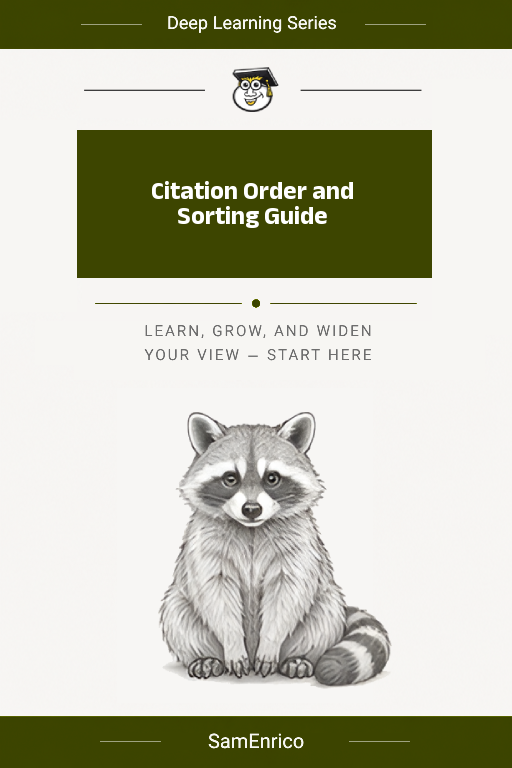
Citation Order and Sorting Guide
Arrange citations alphabetically, chronologically,
Arrange citations alphabetically, chronologically, or by appearance depending on style requirements.
Formats
About this book
Free sample
Chapter 1: The Reader's Map--–- Every scholarly argument, no matter how revolutionary, lives or dies by a single, unglamorous mechanic: the reader's ability to find what you promised them. A brilliant thesis supported by impeccable data will be dismissed as sloppy if the person examining your work cannot, within a few seconds, match an in-text citation like (Chen, 2021) to its corresponding full entry in your reference list. This is not an exaggeration. Journal editors report that sorting errors are among the top five reasons for desk-rejection—not because the research is flawed, but because incorrect ordering signals a lack of attention to detail that makes editors doubt everything else. Similarly, professors consistently deduct points from student papers not for weak arguments, but for reference lists where Smith appears after Snyder despite the alphabet clearly demanding otherwise.
This chapter establishes the foundational purpose behind every sorting rule you will learn in this book. You will discover why a bibliography is not the same as a reference list, how the three core sorting philosophies serve different intellectual goals, and why the concept of locator logic transforms a tedious formatting chore into a strategic tool for scholarly credibility.The Silent Contract Between Writer and Reader Before examining any rule about where to place a comma or how to alphabetize a Dutch surname, we must first understand the unspoken agreement that underlies all academic writing. When you cite a source, you are making a promise. That promise has two parts. First, you promise that the idea you just presented is not original to you—that it came from another thinker whose work you are acknowledging.
Second, and more importantly for this book, you promise that your reader can independently locate that source with reasonable effort. The reference list or bibliography is the tool that fulfills the second promise. But a list of sources is useless if it is not organized in a predictable way. Predictability is the heart of locator logic.Imagine walking into a library where books are shelved randomly. The librarian tells you, "We have the book you want, but you will have…
This is the end of the free sample. Get the eBook to keep going. Buy now
Contents
- Chapter 1
- Chapter 2
- Chapter 3
- Chapter 4
- Chapter 5
- Chapter 6
- Chapter 7
- Chapter 8
- Chapter 9
- Chapter 10
- Chapter 11
- Chapter 12
Details
- Author
- Self Kemberly
- Publisher
- SamEnrico
- Language
- English
- Genre
- Non-Fiction, Student's Shortcut, Citation Order
- Released
- 2026-05-29
- Pages (approx.)
- 158
- Available as
- eBook, Audiobook

Read better in the ZLOADR app
Your eBooks on your phone or tablet. Sign in with your SamEnrico account and start reading.
More by Self Kemberly
 SMART History GuideSelf Kemberly$11.99
 Teamster Boss Hoffa Biography Complete ManualSelf Kemberly$11.99
 Post Cheating Guilt RecoverySelf Kemberly$11.99
 Burnout Recovery For Flight AttendantsSelf Kemberly$11.99
 Remote Work BoundariesSelf Kemberly$11.99
 Sleep Restriction GuideSelf Kemberly$11.99
 Atomic Habits For ParentingSelf Kemberly$11.99
 The Lampkeeper's Bargain: A Djinn's Last WishSelf Kemberly$11.99
 Headspace Meditation Minute RivalrySelf Kemberly$11.99
 The Last Stand of 'Iron Mike': Tyson’s Unbreakable ComebackSelf Kemberly$11.99
 How to Start a Coach Hire With Driver Business (Beginners Guide)Self Kemberly$11.99
 How to Produce a Music CentreSelf Kemberly$11.99