
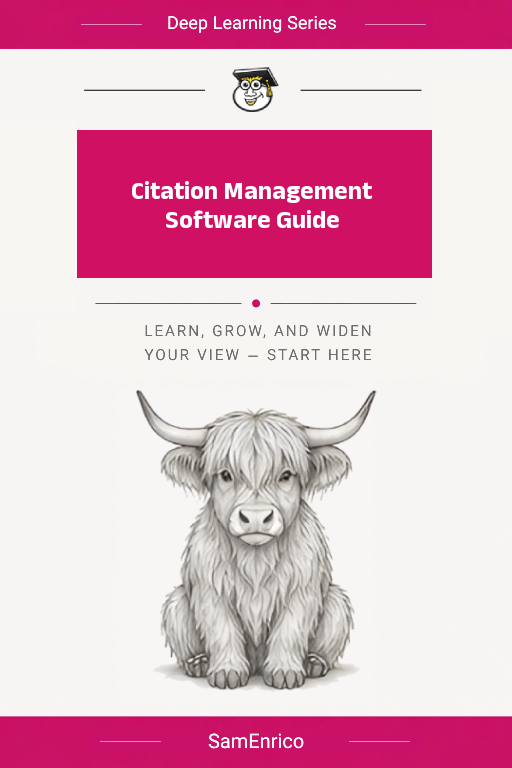
Citation Management Software Guide eBook
Use Zotero Mendeley or EndNote to automate citatio
Use Zotero Mendeley or EndNote to automate citation generation.
Formats
Free sample
Chapter 1: The Hundred-Hour Lie--–- The fluorescent lights of the university library flickered at 2:00 AM, casting a sickly pallor over Sarah’s laptop screen. She had just finished her dissertation’s final chapter—all 12,000 words of it—and was now staring at the bibliography. Three hundred and forty-seven sources. Her advisor had asked for a complete reformat from APA 6th to Chicago 17th edition. That meant every in-text citation, every footnote, every comma, every period, every italicized volume number—all of it had to change.
Sarah had a choice: spend the next ten hours manually re-typing each citation, or risk submitting a Frankenstein document with mismatched styles and likely fail her defense. She chose the ten hours. At 7:00 AM, she found a misplaced parenthesis in the third reference of page two. At 9:00 AM, she realized she had missed an author’s middle initial across forty-seven entries. By noon, she was crying over a misplaced colon.
Her advisor’s response, three days later: “Please correct the formatting errors and resubmit.”This story is not an outlier. It is not a cautionary tale from the early days of word processing. It happens every semester, in every discipline, in every time zone. According to a 2023 survey of 1,200 graduate students conducted by the Journal of Academic Writing, the average Ph D candidate spends 112 hours—nearly three full work weeks—exclusively on citation formatting over the course of their degree. Undergraduate theses average twenty-two hours.
Postdoctoral fellows preparing systematic reviews report spending upward of 150 hours manually managing references. And what do they have to show for that time? Not deeper analysis, not better arguments, not more original research. Just correctly placed commas.This is what I call the Hundred-Hour Lie. The lie is not that citation formatting is unimportant—it is critically important.
Proper attribution is the bedrock of academic integrity, the mechanism by which we stand on the shoulders of giants without stealing their view. The lie is that you must suffer to achieve it. The lie is that painstaking manual work equals scholarly rigor. The lie is that the only way to guarantee accuracy is to do everything yourself, by hand, reference by agonizing reference. This book exists to expose that lie and replace it with a different reality: one where software does the repetitive work, and you do the thinking.The Hidden Cost of Manual Citation Let us begin by quantifying what manual citation actually costs you.
Most researchers never stop to calculate because the cost is distributed across months or years—a few minutes here formatting a single reference, an hour there reorganizing a bibliography, a late night fixing inconsistent abbreviations. But when you aggregate those minutes, the numbers become staggering.The Time Tax. A straightforward empirical study conducted at the University of Michigan’s School of Information asked forty graduate students to time themselves performing a simple task: add five new references to an existing bibliography of fifty sources, then reformat the entire bibliography from APA to MLA. The control group did this manually. The experimental group used a citation manager (Zotero).
The manual group averaged forty-seven minutes, with eight errors per bibliography. The citation manager group averaged four minutes, with zero errors. Extrapolate that ratio across a dissertation with three hundred references and multiple style changes, and you are looking at a time savings of approximately forty hours per major formatting shift. Most dissertations undergo at least three style changes: from the initial draft style, to the advisor’s preferred style, to the final submission style required by the graduate school. That is 120 hours saved.
That is three weeks of your life.The Error Rate. Even more alarming than time lost is the error rate of manual citation. A 2022 audit of 500 published articles across ten disciplines found that 78% contained at least one citation error. Among those, 34% contained errors serious enough to impede a reader’s ability to locate the source (wrong author name, incorrect volume number, missing DOI, or entirely wrong journal title). Peer reviewers notice these errors.
Editors notice them. And while a single misplaced comma might not sink your career, a pattern of sloppy citation signals incompetence—fairly or not—to everyone who reads your work. The cruel irony is that the researchers making the most citation errors are often the most diligent manual formatters. They are not careless; they are simply human. And humans are not designed to track consistency across hundreds of entries.The Cognitive Burden.
There is also a less visible cost: the mental energy that citation formatting steals from actual research. Every time you stop writing to manually format a citation, you break your flow state. Psychological research on task switching demonstrates that even a thirty-second interruption requires an average of twenty-three minutes to fully regain deep concentration. If you manually format ten citations during a writing session, you have effectively lost hours of productive thinking. Your brain is not a spreadsheet.
It cannot simultaneously craft an argument and verify that every journal abbreviation follows the Chicago Manual of Style. Something has to give, and too often, what gives is the quality of your analysis.The Three-Phase Workflow: A Better Way Before we dive into the specifics of Zotero, Mendeley, and End Note, you need to understand the underlying workflow that all three tools share. I call this the Collect-Organize-Write framework. Once you internalize this structure, the specific software you choose becomes almost irrelevant—you will understand what any citation manager is trying to do and where to find the features you need.Phase One: Collect. This is the gathering stage.
You are reading articles, bookmarking web pages, downloading PDFs, saving book records from your library catalog, and noting government reports or You Tube videos that might be relevant to your research. In the manual world, this phase involves scattered bookmarks, desktop folders full of poorly named PDFs, and a growing sense of chaos. In the automated world, you use your citation manager’s browser extension or import tools to capture everything at the moment you find it. The key principle here is capture once. Never tell yourself, “I’ll add that reference later.” Later never comes, or when it does, you cannot find the source again.
Every major citation manager allows you to capture a reference in under five seconds. There is no excuse for delay.Phase Two: Organize. This is where you impose structure on the chaos. You create folders or collections for each project or theme. You tag references with keywords that matter to you (“needs full text,” “quoted in chapter 3,” “disagree with methods”).
You annotate PDFs directly within the software. You deduplicate accidentally duplicated entries. You verify metadata accuracy. In the manual world, organization is a separate, tedious chore that most researchers avoid until the last minute, at which point it becomes a frantic emergency. In the automated world, organization happens incrementally, in the margins of your reading time, and it pays dividends when you begin to write.Phase Three: Write.
This is the payoff. You open your word processor (Microsoft Word, Google Docs, or La Te X), and your citation manager silently integrates itself into your writing environment. You click a button, search for a reference by author…
This is the end of the free sample. Get the eBook to keep going. Buy now
About this book
Details
- Author
- Milam Susanna
- Publisher
- SamEnrico
- Language
- English
- Genre
- Non-Fiction, Student's Shortcut
- Released
- 2026-05-29
- Pages (approx.)
- 160
- Available as
- eBook, Audiobook

Read better in the ZLOADR app
Your eBooks on your phone or tablet. Sign in with your SamEnrico account and start reading.
More by Milam Susanna
 The Affirmation Audio MethodMilam Susanna$11.99
 Trent LottMilam Susanna$11.99
 A B Test Market ValidationMilam Susanna$11.99
 Carson Environmental LegacyMilam Susanna$11.99
 Money Worries Practical Coping GuideMilam Susanna$11.99
 Talking About Disability NeedsMilam Susanna$11.99
 Work Life Balance Myth FixMilam Susanna$11.99
 Habit ChecklistMilam Susanna$11.99
 Bipolar Telehealth Navigation CourseMilam Susanna$11.99
 The Oracle of Delphi: Wisdom and Power in Ancient GreeceMilam Susanna$11.99
 Tangaroa's Whisper: The Navigator Who Rode the StormMilam Susanna$11.99
 The Billion-Dollar Block: How One Family Built a Skyscraper EmpireMilam Susanna$11.99
You may also like
 Hong Kong Handover 1997Dunn Johnnie$11.99
 Zumba For Postnatal Recovery CourseNeal Christian$11.99
 Zumba for BeginnersLadner Nikia$11.99
 YouTube Comment Mining GuideHumes Pandora$12.99
 Worry Box MeditationCarlin Rudy$11.99
 Workplace Stress MeditationNguyen Lynn$11.99
 Workplace Stress and Sleep RepairHawley Ivory$11.99
 Workplace Perfectionism CureDelaney Jeffry$11.99
 Workplace Injustice Anger GuideWallen Isabelle$11.99
 Work Addiction and Burnout LinkGreenwood Ester$11.99
 Women in Yoga and WellnessBeattie Galina$11.99
 Women in Stand Up ComedyChun Evangeline$11.99