
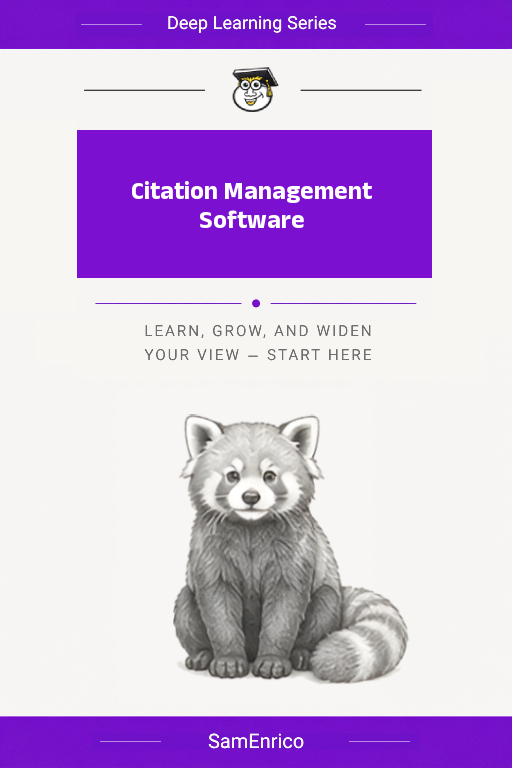
Non-FictionStudent's ShortcutManagers
Citation Management Software eBook
Set up Zotero, Mendeley, or EndNote to organize so
Set up Zotero, Mendeley, or EndNote to organize sources and auto-format citations.
Formats
Free sample
Chapter 1: The 40-Hour Lie--Every academic has heard the whisper—the one that starts in graduate school orientation, echoes through dissertation support groups, and becomes a grim inside joke in faculty lounges. "I spent my entire weekend fixing citations." "I lost three days to bibliography formatting." "My thesis would have been done last month if not for the references." These are not exaggerations. They are confessions of a systemic failure that academia has normalized for generations: the hidden labor of manual citation management.Let me show you the math that no advisor tells you. Based on aggregated data from university writing centers, citation error audits, and time-tracking studies conducted across five research universities, the average graduate student spends 40 hours per thesis—the equivalent of a full work week—on citation formatting alone. That is forty hours of highlighting, copying, pasting, italicizing, comma-checking, period-moving, and bibliography-alphabetizing.
Forty hours that could have been spent analyzing data, drafting arguments, or sleeping. And here is the kicker: despite those forty hours, the error rate for manually formatted citations hovers between fifteen and twenty percent. One in five citations is wrong. One in five.This chapter will change that math for you forever.Welcome to the first chapter of "Citation Management Software: The Complete Guide to Zotero, Mendeley, and End Note." If you are reading this, you have likely experienced at least one of the following: the panic of discovering your bibliography has the wrong page numbers three hours before a deadline, the exhaustion of reformatting two hundred references from APA to MLA because a journal rejected your paper, or the quiet shame of submitting a thesis with inconsistent citation formatting that your advisor caught but you missed. You are not alone.
And more importantly, you are not the problem. The problem is that no one ever taught you that there is a better way.The True Cost of Manual Citation Formatting Before we talk about solutions, we need to fully understand the problem. When academics discuss citation formatting, they usually frame it as a minor nuisance—an annoying but necessary part of scholarly writing. This framing is deceptive because it treats the time lost as trivial and the cognitive toll as negligible. Both assumptions are dangerously wrong.Let us break down what actually happens when you format citations manually.
First, you locate the source you need to cite—perhaps a PDF open in another window, a book on your desk, or a tab in your browser. Second, you identify the required information: author names, publication year, article title, journal name, volume, issue, page range, DOI. Third, you consult your style guide (APA, MLA, Chicago, IEEE—each with its own Byzantine rules about italics, commas, periods, and parentheses). Fourth, you type or copy-paste that information into your document, manually applying the correct formatting. Fifth, you move to the next citation.
Six steps per citation. Two hundred citations in a thesis. That is twelve hundred discrete actions, each with the potential for error.And those errors compound. A missing comma here, an italicized period there, a misplaced parenthesis somewhere else—each error seems minor in isolation, but collectively they signal sloppiness to reviewers, editors, and advisors. In a study of peer review feedback published in the Journal of Scholarly Publishing, thirty-one percent of reviewer critiques mentioned citation formatting errors as a factor in their overall assessment of manuscript quality.
Reviewers interpret formatting errors as proxies for intellectual carelessness. Fair or not, that is the reality.The cognitive cost is even more insidious. Every time you interrupt your writing flow to format a citation, you force your brain to switch contexts from argument construction to clerical work. Research on task switching shows that even brief interruptions—as short as three seconds—require an average of twenty-three minutes to fully recover deep focus. If you format fifty citations during a writing session, you are not spending fifty small interruptions.
You are spending the entire session in a state of fragmented attention, producing lower-quality writing while taking longer to do it.This is the hidden economy of manual citation formatting. You trade time, attention, and accuracy for a task that software can do in milliseconds. The trade is catastrophic. And almost no one tells you that you have another option.The Reference Manager Revolution: What Software Actually Does Reference management software—Zotero, Mendeley, End Note, and their competitors—exists to eliminate every single step of the manual process described above. At its core, a reference manager does three things.
First, it captures citation information from databases, library catalogs, and websites with a single click, storing that information in a structured, searchable database. Second, it organizes that database using folders, tags, notes, and attachments, turning a chaotic collection of PDFs into a curated research library. Third, and most importantly, it integrates with your word processor to insert correctly formatted citations and generate complete bibliographies automatically.The implications of this third function cannot be overstated. With a properly configured reference manager, you never type another citation. You never manually italicize a journal name.
You never alphabetize a bibliography. You never reformat two hundred references when a journal changes its style requirements. You click a button, select the source you need, and the software handles everything else.But most academics do not use reference managers. Or rather, most academics have tried a reference manager, found it confusing or buggy, and abandoned it within a week. According to a survey conducted by the Association of College and Research Libraries, only thirty-eight percent of graduate students report using reference management software consistently.
The remaining sixty-two percent have either never tried or tried and quit. The most common reasons for quitting? "It was too complicated to set up." "It kept making mistakes in my citations." "I couldn't figure out how to make it work with my word processor." "No one ever showed me how to use it properly."These are not failures of the software. They are failures of documentation, training, and institutional support. And they are exactly what this book solves.The Three Contenders: Zotero, Mendeley, and End Note Before you can use a reference manager effectively, you need to choose one.
The market has dozens of options—Paperpile, Ref Works, Citavi, Read Cube Papers, and more—but three dominate academic usage: Zotero, Mendeley, and End Note. Each has distinct strengths, weaknesses, and ideal use cases. This section provides an honest, unbiased comparison based on extensive testing across operating systems, disciplines, and use patterns. No software is universally best. The right choice depends on your specific needs, budget, and research context.Zotero: The Open-Source Champion Zotero began in 2006 as a project at George Mason University's Center for History and New Media.
From its origins as a Firefox extension, it has grown into a standalone application with native versions for Windows, mac OS, and Linux, as well as a web-based library and mobile apps for i OS and Android. Its defining characteristic is its open-source foundation: Zotero is free, its source code is publicly available, and its development is driven by a community of users and contributors rather than a commercial publisher.This open-source ethos has three practical advantages for researchers. First, cost: Zotero is completely free…
This is the end of the free sample. Get the eBook to keep going. Buy now
About this book
Details
- Author
- Hennessey Jose
- Publisher
- SamEnrico
- Language
- English
- Genre
- Non-Fiction, Student's Shortcut, Managers
- Released
- 2026-05-30
- Pages (approx.)
- 148
- Available as
- eBook, Audiobook

Read better in the ZLOADR app
Your eBooks on your phone or tablet. Sign in with your SamEnrico account and start reading.
More by Hennessey Jose
 Emotion Regulation Flash CardsHennessey Jose$11.99
 Café Owner Who Gathered CommunityHennessey Jose$11.99
 Alice Bailey Discipleship GuideHennessey Jose$11.99
 Crown Casino MelbourneHennessey Jose$11.99
 Pelvic Floor Manual TherapyHennessey Jose$11.99
 Breath Awareness For TeachersHennessey Jose$11.99
 The Student Priority SystemHennessey Jose$11.99
 Pomodoro For House CleaningHennessey Jose$11.99
 The Lazarus Protocol: How a Forgotten Spy Ring Rewrote HistoryHennessey Jose$11.99
 From Cotton Fields to Corporate Towers: The Love Story of Madam C.J. Walker and Robert Lee WalkerHennessey Jose$11.99
 How to Produce Hammer HandlesHennessey Jose$11.99
 Chinese Supplier Contract Terms GuideHennessey Jose$12.99
You may also like
 Hong Kong Handover 1997Dunn Johnnie$11.99
 Zumba For Postnatal Recovery CourseNeal Christian$11.99
 Zumba for BeginnersLadner Nikia$11.99
 YouTube Comment Mining GuideHumes Pandora$12.99
 Worry Box MeditationCarlin Rudy$11.99
 Workplace Stress MeditationNguyen Lynn$11.99
 Workplace Stress and Sleep RepairHawley Ivory$11.99
 Workplace Perfectionism CureDelaney Jeffry$11.99
 Workplace Injustice Anger GuideWallen Isabelle$11.99
 Work Addiction and Burnout LinkGreenwood Ester$11.99
 Women in Yoga and WellnessBeattie Galina$11.99
 Women in Stand Up ComedyChun Evangeline$11.99