
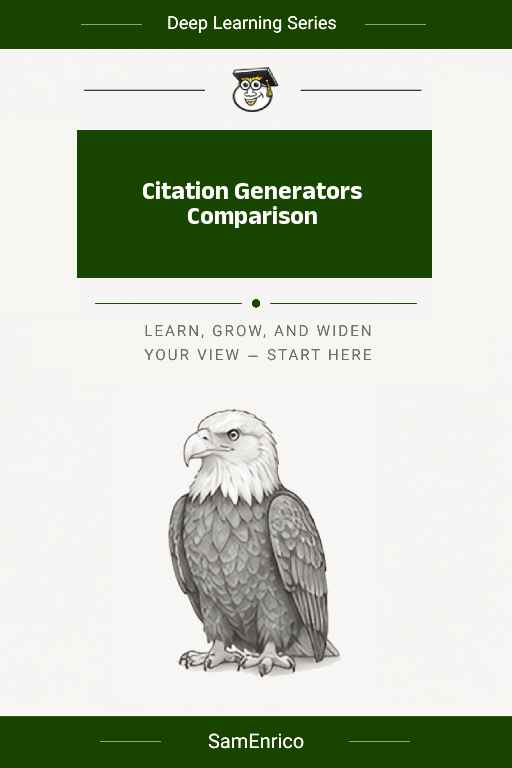
Non-FictionStudent's ShortcutTools
Citation Generators Comparison eBook
Use Zotero, Mendeley, or EasyBib effectively and w
Use Zotero, Mendeley, or EasyBib effectively and when to avoid automated errors.
Formats
Free sample
Chapter 1: The Metadata Graveyard--–- Every semester, thousands of students type a URL into Easy Bib, click “generate,” copy the result into their bibliography, and submit their paper without a second thought. And every semester, thousands of professors sigh, reach for their red pens, and start deducting points. The students are not lazy. They are not bad writers. They have simply fallen for the most dangerous illusion in academic writing: that citation generation is a push-button solution.The problem is not that citation generators are evil or useless.
The problem is that they are machines, and machines do exactly what you tell them to do—not what you wish they would do. When you feed a generator bad information, it cheerfully produces bad citations. When you ask it to guess missing data, it guesses wrong. When you assume it knows the difference between a book edition and a reprint, it does not. This is the Garbage In, Garbage Out principle, and it is the single most important concept in reference management.
Master it, and you will never lose another point on a bibliography. Ignore it, and you will spend the rest of your academic career wondering why your “perfectly generated” citations keep getting marked up in red.This chapter is not a software tutorial. You will find those in later chapters for Zotero, Mendeley, and Easy Bib respectively. Instead, this chapter is a fundamental re-education. It will teach you what a citation actually is, why citation styles exist, how metadata works (and fails), and why your own eyes are the most important citation tool you will ever own.
By the end, you will understand why professors can spot an Easy Bib citation from across the room and why the most expensive paid citation generator still cannot reliably capitalize a title correctly.The Two Halves of Every Citation Before you can understand why generators fail, you must understand what a citation is supposed to do. Every citation in every academic paper has exactly two jobs. The first job is obvious: it tells the reader where you found your information. The second job is subtler but more important: it proves that you did the work.When you cite a source correctly, you signal to your professor that you know how to navigate a library database, extract the relevant information, and present it according to professional standards. When you cite a source incorrectly, you signal the opposite.
A missing DOI suggests you did not look for it. An all-caps journal title suggests you copied without reading. A misplaced comma suggests you did not care enough to check. Fair or not, your bibliography is a reflection of your scholarly rigor. And citation generators, left to their own devices, make you look sloppy.Now let us break down the two structural components of every citation system.
The first is the bibliographic entry. This is the full citation that appears at the end of your paper in the bibliography, works cited page, or references section. It contains everything a reader would need to find your source: author names, publication year, title, journal or book title, volume and issue numbers, page range, DOI or URL, and sometimes access dates. Bibliographic entries are long, dense, and packed with punctuation that varies wildly between styles.The second component is the in-text citation. This is the shortened reference that appears within the body of your paper, usually in parentheses, immediately after you quote or paraphrase a source.
In-text citations are minimalist by design. They typically include just the author’s last name and either a publication year (APA) or a page number (MLA). Chicago style offers both footnote and author-date options. The in-text citation is like a key: it unlocks the door to the full bibliographic entry at the back of your paper.Here is where most students go wrong. They treat the in-text citation and the bibliographic entry as separate, independent things.
They are not. They are a matching pair. The in-text citation must point unambiguously to exactly one bibliographic entry. If your in-text citation says (Smith, 2020) but your bibliography has Smith (2019) and also Jones (2020), your reader cannot tell which source you actually used. This is a clarity failure, and it will cost you points.
Good reference management software ensures that every in-text citation has a matching bibliographic entry. Bad generators and manual copy-pasting are how these matches break.Why Citation Styles Are Not Arbitrary Every student has asked the question at least once: why does APA want the publication year right after the author’s name, while MLA buries it near the end? Why does Chicago use footnotes when everyone else uses parentheses? The answer is not cruelty. Citation styles encode disciplinary priorities.APA, the style of the American Psychological Association, is used primarily in the social sciences.
Social scientists care about the timeliness of research. A psychology study from 1985 might be completely obsolete, while a philosophy text from 1850 could still be foundational. APA puts the publication year immediately after the author’s name in both in-text citations and bibliographic entries because date matters most. When you read (Kahneman, 2011) in an APA paper, you know instantly that the research is recent enough to be relevant.MLA, the style of the Modern Language Association, is used primarily in the humanities. Humanists care about the location of ideas within a text.
When you quote a novel, your reader needs to find the exact page. MLA puts the page number in the in-text citation and moves the publication year to the end of the bibliographic entry because the specific passage matters more than the publication date of the edition.Chicago style, used in history, some social sciences, and publishing, offers two systems. The notes-bibliography system uses footnotes or endnotes for in-text citations, which allows for extensive commentary without cluttering the main text. The author-date system works like APA but with different punctuation conventions. Chicago is flexible because historians often need to cite archival sources, letters, and manuscripts that do not fit neatly into author-date frameworks.None of these styles is objectively correct.
They are conventions, agreed upon by communities of scholars, to make reading and writing more efficient. The important thing is consistency. A paper that mixes APA punctuation with MLA capitalization and Chicago footnote numbering is unreadable. Citation generators exist to enforce consistency. But they can only enforce the rules you tell them to follow.
If you tell Easy Bib to generate MLA but your professor requires APA, the generator will happily produce the wrong style. Garbage In, Garbage Out.The Invisible Problem of Metadata Let us talk about metadata. Metadata is data about data. For a journal article, the metadata includes the author names, article title, journal title, volume number, issue number, page range, DOI, publication date, and sometimes keywords or abstracts. When you search a library database, you are searching metadata.
When you export a citation, you are exporting metadata. When a citation generator creates a bibliography entry, it is reformatting metadata.Here is the problem: metadata is not objective reality. It is entered by humans, often under time pressure, and different databases store it differently. A study published in the journal Nature might appear in Pub Med as…
This is the end of the free sample. Get the eBook to keep going. Buy now
About this book
Details
- Author
- Kelly Roderick
- Publisher
- SamEnrico
- Language
- English
- Genre
- Non-Fiction, Student's Shortcut, Tools
- Released
- 2026-06-01
- Pages (approx.)
- 138
- Available as
- eBook, Audiobook

Read better in the ZLOADR app
Your eBooks on your phone or tablet. Sign in with your SamEnrico account and start reading.
More by Kelly Roderick
 Opposite Action WorkbookKelly Roderick$11.99
 A1C InterpretationKelly Roderick$11.99
 Pelvic Floor Relaxation SkillsKelly Roderick$11.99
 Eisenhower Matrix Productivity GuideKelly Roderick$11.99
 Joe Dispenza EvolveKelly Roderick$11.99
 Liberating Mental ObjectsKelly Roderick$11.99
 Outsourcing Social Media ManagementKelly Roderick$11.99
 Antwerp Heist in Pop CultureKelly Roderick$11.99
 Voltaire's Enlightenment: The Pen That Enlightened a ContinentKelly Roderick$11.99
 The Vanishing of Marcel Lefèvre: A Prohibition-Era Mystery in ParisKelly Roderick$11.99
 How to Produce Storage and OrganizationKelly Roderick$11.99
 How to Produce Hair Removal ProductsKelly Roderick$11.99
You may also like
 Hong Kong Handover 1997Dunn Johnnie$11.99
 Zumba For Postnatal Recovery CourseNeal Christian$11.99
 Zumba for BeginnersLadner Nikia$11.99
 YouTube Comment Mining GuideHumes Pandora$12.99
 Worry Box MeditationCarlin Rudy$11.99
 Workplace Stress MeditationNguyen Lynn$11.99
 Workplace Stress and Sleep RepairHawley Ivory$11.99
 Workplace Perfectionism CureDelaney Jeffry$11.99
 Workplace Injustice Anger GuideWallen Isabelle$11.99
 Work Addiction and Burnout LinkGreenwood Ester$11.99
 Women in Yoga and WellnessBeattie Galina$11.99
 Women in Stand Up ComedyChun Evangeline$11.99