
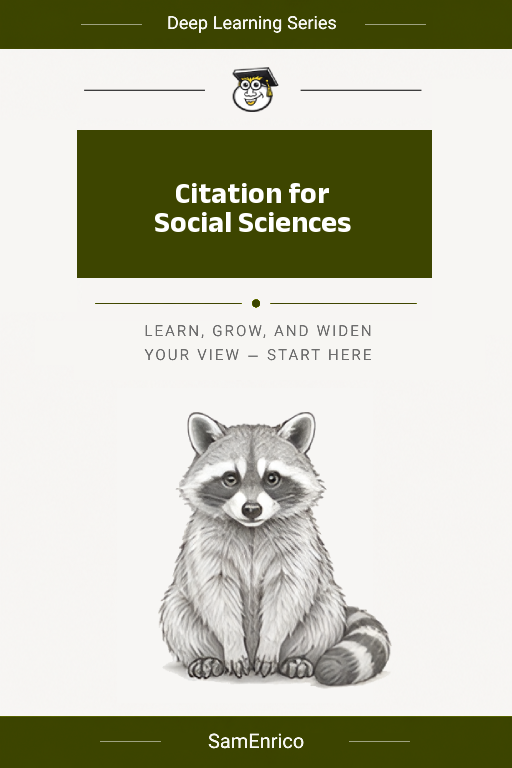
Non-FictionStudent's ShortcutSocial Sci
Citation for Social Sciences eBook
Apply APA rules for psychology, sociology, educati
Apply APA rules for psychology, sociology, education, and business papers.
Formats
Free sample
Chapter 1: Why Rules Matter...--–- Every semester, thousands of social science students lose points on otherwise excellent papers. Not because their research was flawed. Not because their arguments were weak. But because a comma was in the wrong place, a citation was missing a parentheses, or a reference list included the wrong italicized element. These are not minor technicalities.
They are the difference between a paper that communicates with authority and a paper that signals carelessness.This book exists because the official APA Publication Manual—the 427-page authoritative guide—is overwhelming. It is designed as a comprehensive reference, not as a teaching tool. Graduate students, undergraduates, and even seasoned researchers find themselves flipping endlessly between chapters, searching for one specific example that matches their source type. The manual tells you the rules. It rarely explains why those rules exist or how to apply them without frustration."Citation for Social Sciences" takes a different approach.
This book bridges the gap between the official manual and the practical needs of students and researchers in psychology, sociology, education, and business. It translates complex rules into clear, actionable guidance with discipline-specific examples drawn from actual papers. And unlike the official manual, this book acknowledges that you are not a professional copyeditor. You are a researcher, a student, a practitioner who needs to cite sources correctly so you can focus on what matters most: your ideas.Before diving into formatting mechanics, in-text citation rules, or reference list structures, this chapter answers a more fundamental question. Why does any of this matter?
Why do social scientists subject themselves to such detailed rules about commas, italics, and parentheses? The answer reveals something essential about how knowledge advances in psychology, sociology, education, and business—and why citation is far more than an academic ritual.The Scientific Value of Standardization Science progresses through replication. A single study, no matter how well designed, is never sufficient to establish a finding as true. Other researchers must be able to repeat the study, analyze the same data, or extend the findings to new populations. This is the self-correcting mechanism that separates science from opinion.APA style exists to enable this replication.
When every paper follows the same formatting rules, readers know exactly where to find the methodology section, how to interpret statistical abbreviations, and which sources support which claims. Consistency reduces cognitive load. When you read an APA-formatted paper, you are not wasting mental energy deciphering an idiosyncratic organization system. You are focusing on content.The American Psychological Association introduced its first style guide in 1929, publishing a seven-page article in the Psychological Bulletin. That article, "Instructions for Preparation of Manuscripts," established basic guidelines for typing, punctuation, and reference formatting.
The goal was simple: reduce publication costs and improve readability across psychology journals. A century later, APA style has expanded to seven editions and hundreds of pages, but the core purpose remains unchanged. Standardized formatting enables efficient communication of empirical research.What many students do not realize is that APA style is not arbitrary. Nearly every rule traces back to a practical problem. The requirement to include DOIs (Digital Object Identifiers) for journal articles emerged because articles moved online and became harder to locate.
The preference for active voice over passive voice emerged because readers found active voice clearer and more direct. The detailed rules for bias-free language emerged from recognition that careless language can perpetuate harmful stereotypes. Behind every rule is a rationale.Consider what happens when citation rules are ignored. A reader encounters a claim in a paper with no source attached. Is this the author's original idea?
Is it common knowledge? Did the author forget to cite someone else's work? The reader cannot know. Trust erodes. In a literature review, missing citations prevent readers from tracing the intellectual history of an idea.
In a methods section, vague citations make replication impossible. In a discussion section, incorrect citations undermine the credibility of every claim that follows.Citation is not a bureaucratic hurdle. It is a core scientific value: giving intellectual credit, avoiding plagiarism, and providing enough detail to enable replication of research. When you cite a source correctly, you are participating in a century-old conversation among researchers who have built upon each other's work. You are honoring that chain of intellectual contribution.The Consequences of Citation Errors The stakes of citation accuracy vary by context, but they are never zero.
For an undergraduate student, a citation error might cost a few points on a term paper. For a graduate student, the same error could delay thesis approval or trigger an academic integrity review. For a published researcher, a citation mistake in a journal article can lead to corrections, retractions, or damage to professional reputation.Real cases illustrate the range of consequences. A master's thesis in sociology was returned for revision solely because 34 percent of the in-text citations did not appear in the reference list. The student had added and removed sources during the writing process but failed to update the reference list accordingly.
The revision delayed graduation by six months. A doctoral dissertation in education received a "revise and resubmit" verdict from a journal because the author incorrectly formatted legal citations for court cases. The editor noted that such errors raised questions about the author's attention to detail across the entire manuscript. A business school faculty member received a formal warning after a student discovered that a published white paper cited a source that did not exist—a typo in the DOI had rendered the source unfindable.These are not isolated incidents. Studies of citation accuracy in published journals consistently find error rates between 20 and 40 percent.
One analysis of leading psychology journals found that nearly one in four reference list entries contained at least one error. Another study of sociology journals found that 18 percent of citations were inaccurate enough to impede source retrieval. These numbers are not evidence of laziness. They are evidence that citation is genuinely difficult, and that even experienced researchers struggle with APA rules.Plagiarism represents the most serious citation failure, and it exists on a spectrum. At one end is deliberate copying of another's work without attribution—clear academic dishonesty with severe consequences.
At the other end is improper paraphrasing, where a writer changes a few words but retains the original sentence structure and core phrasing. Between these extremes lies self-plagiarism: reusing significant portions of one's own previously published work without citation. Many early-career researchers do not realize that self-plagiarism violates ethical guidelines. The APA Publication Manual is explicit: "Just as researchers must cite the work of others, they must also cite their own previous work when republishing" (p. 256).This book addresses plagiarism in depth in Chapter 5, including strategies for proper paraphrasing, understanding when to quote directly versus summarize, and avoiding the common trap of patchwriting.
For now, the essential point is that citation rules exist to prevent all forms of attribution failure, from the minor to the severe.Why APA Dominates the Social Sciences APA style did not become the default for psychology, sociology, education, and business by accident. It spread because it solved real problems that researchers in these fields faced.Psychology adopted APA first because the discipline was growing rapidly in the early twentieth century.…
This is the end of the free sample. Get the eBook to keep going. Buy now
About this book
Details
- Author
- Ragland Suellen
- Publisher
- SamEnrico
- Language
- English
- Genre
- Non-Fiction, Student's Shortcut, Social Sci
- Released
- 2026-06-01
- Pages (approx.)
- 150
- Available as
- eBook, Audiobook

Read better in the ZLOADR app
Your eBooks on your phone or tablet. Sign in with your SamEnrico account and start reading.
More by Ragland Suellen
 The Mechanic Who Fixed More Than CarsRagland Suellen$11.99
 Mid Term Rental GuideRagland Suellen$11.99
 DBT For Jealousy GuideRagland Suellen$11.99
 Antwerp Heist Reddit ThreadsRagland Suellen$11.99
 Slot Machine InsiderRagland Suellen$11.99
 Pelvic Floor for CheerleadersRagland Suellen$11.99
 Pomodoro For Exercise RoutinesRagland Suellen$11.99
 Breath Meditation For Healthcare WorkersRagland Suellen$11.99
 The Lost Acrobats of Camelot: The Circus Performers Who Shaped Arthurian LegendRagland Suellen$11.99
 The Ale of the Tudors: Brewing Power in Medieval EnglandRagland Suellen$11.99
 How to Produce String Instrument Cleaning ClothsRagland Suellen$11.99
 How to Produce Hammer HeadsRagland Suellen$11.99
You may also like
 Hong Kong Handover 1997Dunn Johnnie$11.99
 Zumba For Postnatal Recovery CourseNeal Christian$11.99
 Zumba for BeginnersLadner Nikia$11.99
 YouTube Comment Mining GuideHumes Pandora$12.99
 Worry Box MeditationCarlin Rudy$11.99
 Workplace Stress MeditationNguyen Lynn$11.99
 Workplace Stress and Sleep RepairHawley Ivory$11.99
 Workplace Perfectionism CureDelaney Jeffry$11.99
 Workplace Injustice Anger GuideWallen Isabelle$11.99
 Work Addiction and Burnout LinkGreenwood Ester$11.99
 Women in Yoga and WellnessBeattie Galina$11.99
 Women in Stand Up ComedyChun Evangeline$11.99