
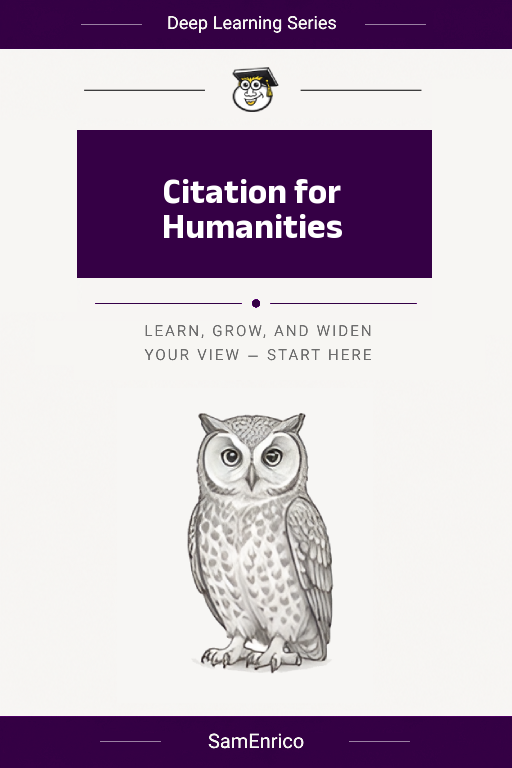
Non-FictionStudent's ShortcutHumanities
Citation for Humanities eBook
Apply MLA rules for literature, philosophy, art, a
by Weems Chloe
Apply MLA rules for literature, philosophy, art, and film studies papers.
Formats
Free sample
Chapter 1: Why Nobody Told You--–- The first time the author failed a paper, it was not because the argument was weak, the research was shallow, or the writing was sloppy. It was because of a period. One small, circular punctuation mark, misplaced by half an inch relative to a pair of parentheses. The professor’s comment, scrawled in red ink that seemed to pulse with barely suppressed rage, read simply: “MLA error. See me.” That meeting lasted twelve minutes, most of which consisted of the professor explaining that the entire academic community would dismiss the author’s ideas not because they were wrong, but because the author had failed to show where those ideas came from.
The period, it turned out, was not the problem. The problem was that nobody had ever explained what citation was actually for.This chapter reframes citation from a mechanical chore into a core intellectual practice. It opens by moving beyond simple plagiarism avoidance, arguing that citation is how scholars enter an ongoing conversation in the humanities. The chapter then breaks down how citation functions differently across four fields: literature, philosophy, art history, and film studies. It concludes with a high-level overview of the MLA Handbook 9th Edition’s nine core elements, setting the stage for the rest of the book.
By the end of this chapter, you will understand that citation is not punishment. It is hospitality. It is a map you draw for your reader so they can follow your thinking, verify your claims, and join you in the conversation.The Red Ink Trauma Every humanities student has a red ink story. Maybe it was a paper returned with “Works Cited?” scrawled at the bottom, even though you included a Works Cited page. Maybe it was a deduction for “incorrect use of et al.” when you had no idea what et al.
even meant. Maybe it was the professor who circled every single in-text citation and wrote “page number?” in the margin, as if the requirement had been obvious all along. These moments accumulate into a single, crushing belief: citation is a minefield of arbitrary rules designed by sadistic librarians to punish students for using other people’s ideas.That belief is wrong, but it is not unreasonable. The way citation is taught—when it is taught at all—reinforces this misunderstanding. Most students receive citation instruction as a thirty-minute library workshop sandwiched between midterms and finals, or as a single page in a writing center handout, or as a passive-aggressive comment on a returned paper.
The message students absorb is not “citation helps your reader” but “citation will save you from plagiarism charges.” The frame is defensive, not generous. The tone is threatening, not welcoming.This book operates on a different premise. Citation is not a shield against punishment. It is a gift you give your reader. When you cite a source correctly, you are saying: “Here is exactly where I found this idea.
You can go there yourself. You can check my work. You can build on it. You can disagree with it. You can find the original context and decide whether I have represented it fairly.” That is an act of intellectual hospitality.
It invites your reader into your process rather than hiding it behind a wall of unsubstantiated claims.Consider the difference between these two sentences:“The green light at the end of Daisy’s dock represents Gatsby’s impossible dream of recapturing the past.”“The green light at the end of Daisy’s dock represents Gatsby’s impossible dream of recapturing the past (Fitzgerald 21).”The first sentence asks the reader to trust the writer on faith alone. The second sentence provides a map. The reader can open any edition of The Great Gatsby, turn to page 21, and see the passage for themselves. They can decide whether the writer’s interpretation is faithful to the text or whether the writer has stretched the evidence. The citation does not prove the interpretation correct, but it makes the interpretation arguable.
Without the citation, the sentence is not wrong—it is simply unlocatable. It exists in a vacuum. And ideas that exist in vacuums cannot be debated, refined, or built upon.The Conversation Metaphor The most useful way to understand citation is to imagine an academic discipline as a long-running conversation. This conversation has been going on for decades, sometimes centuries. Scholars enter the conversation at different points, speak for a while, and then leave.
But the conversation continues. Every time you write a paper, you are not creating something from nothing. You are joining a conversation that was already in progress.Citation is how you show your reader where you entered the conversation and whom you have been listening to. When you cite a scholar, you are essentially saying: “I have been listening to this person, and here is what they said that matters to my point.” When you cite multiple scholars, you are showing the relationships between their contributions—who agrees with whom, who disagrees, who has been misunderstood, who has been ignored.This metaphor explains several otherwise confusing features of academic writing. It explains why your professors expect you to cite sources even when you are not directly quoting anyone.
Paraphrasing someone’s argument still requires a citation because you are still pointing to someone who spoke in the conversation before you. It explains why you cannot cite Wikipedia in most college papers. Wikipedia is not a participant in the conversation; it is a summary of the conversation written by anonymous people whose qualifications you cannot verify. It is like reading a recap of a baseball game written by someone who was not at the game, instead of watching the game yourself. It explains why older sources are not automatically worse than newer sources.
In philosophy, Plato is still in the conversation. In literature, Shakespeare is still in the conversation. In art history, Vasari is still in the conversation. The date of publication is not a score; it is just a timestamp.The conversation metaphor also explains why different disciplines have different citation practices. In the sciences, conversations move quickly, and recent sources often supersede older ones.
In the humanities, conversations move more slowly, and a book from 1950 might still be the definitive word on a subject. This book focuses on the humanities, but within the humanities, each discipline has its own rhythm, its own preferred source types, and its own citation quirks. The next four sections explain those differences.Literature: Citation as Anchored Interpretation In literary studies, citation serves one primary function: it anchors interpretation to the text. A literary argument is a claim about what a text means, how it creates that meaning, and why that meaning matters. Without citations, a literary argument floats free of the text, becoming a matter of opinion rather than a matter of evidence.
With citations, a literary argument becomes testable. Another reader can go to the same passage, read the same lines, and decide whether the interpretation holds up.This is why literature professors are obsessive about editions. If you cite The Great Gatsby from a random paperback you bought at an airport, your page 21 might be completely different from…
This is the end of the free sample. Get the eBook to keep going. Buy now
About this book
Details
- Author
- Weems Chloe
- Publisher
- SamEnrico
- Language
- English
- Genre
- Non-Fiction, Student's Shortcut, Humanities
- Released
- 2026-05-29
- Pages (approx.)
- 149
- Available as
- eBook, Audiobook

Read better in the ZLOADR app
Your eBooks on your phone or tablet. Sign in with your SamEnrico account and start reading.
More by Weems Chloe
 Pelvic Floor During ChemotherapyWeems Chloe$11.99
 DBT For DisappointmentWeems Chloe$11.99
 Breath Awareness For First RespondersWeems Chloe$11.99
 Delegation for Medical ProfessionalsWeems Chloe$11.99
 ABC Prioritization for ADHDWeems Chloe$11.99
 Pomodoro For Meditation PracticeWeems Chloe$11.99
 Dion Fortune Inner LightWeems Chloe$11.99
 Childhood Roots of Low WorthWeems Chloe$11.99
 The Last Supper: A Forgotten Masterpiece ResurrectedWeems Chloe$11.99
 The Cartographer’s Dream: Magellan’s Odyssey and the Birth of the Modern WorldWeems Chloe$11.99
 How to Produce HammersWeems Chloe$11.99
 Mastering The Art of Krabi-krabongWeems Chloe$11.99
You may also like
 Hong Kong Handover 1997Dunn Johnnie$11.99
 Zumba For Postnatal Recovery CourseNeal Christian$11.99
 Zumba for BeginnersLadner Nikia$11.99
 YouTube Comment Mining GuideHumes Pandora$12.99
 Worry Box MeditationCarlin Rudy$11.99
 Workplace Stress MeditationNguyen Lynn$11.99
 Workplace Stress and Sleep RepairHawley Ivory$11.99
 Workplace Perfectionism CureDelaney Jeffry$11.99
 Workplace Injustice Anger GuideWallen Isabelle$11.99
 Work Addiction and Burnout LinkGreenwood Ester$11.99
 Women in Yoga and WellnessBeattie Galina$11.99
 Women in Stand Up ComedyChun Evangeline$11.99