
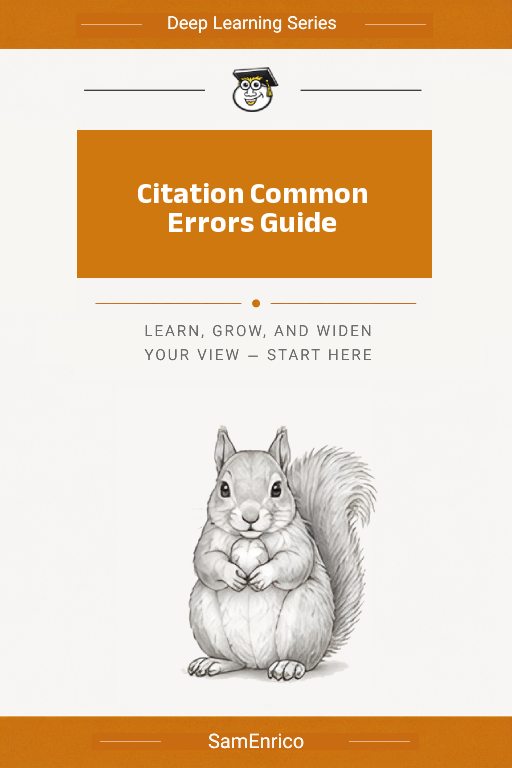
Citation Common Errors Guide eBook
Fix the top ten citation mistakes students make mo
Fix the top ten citation mistakes students make most often.
Formats
Free sample
Chapter 1: The Patchwriting Lie--It starts innocently enough. You have a source in front of you—a journal article, a textbook chapter, a well-written website. The author has said something perfectly. The sentence structure is elegant. The vocabulary is precise.
You think to yourself, "Why reinvent the wheel? I will just change a few words here and there, keep the good parts, and call it a day." You swap out "significant" for "important." You flip the order of two clauses. You replace "nevertheless" with "however." You add a citation at the end. And then you hit submit, confident that you have done everything right.Your professor disagrees. The paper comes back with a comment that makes your stomach drop: "This is patchwriting.
See me."You are confused. You did not copy and paste. You did not steal anyone's work. You changed words. You provided a citation.
How is this still a problem?This chapter is going to answer that question. And the answer might make you uncomfortable, because patchwriting is the most misunderstood form of plagiarism on college campuses today. Students do it constantly. Most do not even know they are doing it. And here is the cruel irony: patchwriting often takes more work than legitimate paraphrasing.
You are putting in effort to change words, but you are still getting it wrong because you are changing the wrong things.Let us fix that. By the end of this chapter, you will understand exactly what patchwriting is, why it matters, and—most importantly—how to stop doing it forever.What Patchwriting Actually Is (And What It Is Not)Patchwriting is a term that was coined by composition scholar Rebecca Moore Howard in the early 1990s. She noticed something strange when she studied student writing: students were not simply copying sources verbatim, and they were not properly paraphrasing either. They were doing something in between. They were taking sentences from sources and "patching" them together with small changes—a new word here, a rearranged clause there—while keeping the original sentence structure, syntax, and phrasing largely intact.Here is a formal definition:Patchwriting occurs when a writer changes a few words or rearranges the order of clauses in a source sentence while largely maintaining the original sentence structure, phrasing, and syntax.Notice what this definition does not say.
It does not say that patchwriting is copying without a citation. Most patchwriting includes a citation. That is what makes it so confusing for students. You see the citation at the end of the sentence and think you are safe. But you are not safe, because patchwriting is not about missing citations.
It is about the relationship between your words and the source's words.Let me show you what I mean.The Three-Way Comparison Consider this original passage from a fictional source:Original Source (Smith, 2022, p. 45):"Social media platforms have fundamentally altered the way young people form and maintain friendships. Unlike previous generations who relied on face-to-face interaction and telephone calls, today's adolescents can sustain dozens of relationships simultaneously through apps like Instagram, Snapchat, and Tik Tok. However, researchers disagree about whether this quantity of connections comes at the cost of genuine intimacy."Now look at three different student responses.Student A (Direct plagiarism):"Social media platforms have fundamentally altered the way young people form and maintain friendships. Unlike previous generations who relied on face-to-face interaction and telephone calls, today's adolescents can sustain dozens of relationships simultaneously."No citation.
No changes. This is straightforward plagiarism.Student B (Patchwriting with citation):Social media has basically changed how young people create and keep friendships. Unlike older generations who depended on in-person interaction and phone calls, current teens can maintain many relationships at once through apps like Instagram, Snapchat, and Tik Tok (Smith, 2022).Citation present. Words changed. But can you see the problem?
The sentence structure is identical to Smith's. The order of information is identical. The student has simply swapped synonyms—"basically" for "fundamentally," "create and keep" for "form and maintain," "older generations" for "previous generations," "in-person" for "face-to-face," "current teens" for "today's adolescents." This is patchwriting.Student C (Legitimate paraphrase with citation):According to Smith (2022), digital platforms have transformed adolescent friendship formation. While young people can now maintain far more social connections than previous generations could, researchers remain divided on whether this increased quantity reduces the depth of those relationships (p. 45).Citation present.
Sentence structure changed. The student has reorganized the information, changed the grammatical flow, and integrated the citation naturally. This is legitimate paraphrasing.The difference between Student B and Student C is not about vocabulary. Student B has better vocabulary than Student C in some places. The difference is about structure and independence.
Student B is leaning on Smith's sentence structure like a crutch. Student C has stood on their own two feet and said the same idea in a completely new way.Why Students Patchwrite (The Honest Truth)If patchwriting is so common, there must be reasons beyond simple laziness. And there are. Through years of teaching and researching student writing, I have identified three root causes. Understanding these causes is the first step to overcoming them.Cause 1: Vocabulary Insecurity This is the biggest one, and it is the one students are least likely to admit.
When you read a well-written source, the author's vocabulary can feel intimidating. The words seem precise. The phrasing seems elegant. You worry that if you try to say the same thing in your own words, you will sound clumsy or, worse, wrong.So you cling to the source's words like a life raft. You change a few synonyms—enough to feel like you are doing something—but you keep the underlying structure because you are afraid to let go.Here is the truth that no one tells you: your professor does not expect you to sound like a published academic.
You are a student. You are learning. Your professors want to hear your voice, even if it is less polished than the sources you are citing. In fact, they prefer it. A paper that is nothing but patchwritten sentences from sources is a paper with no original thinking.
A paper that paraphrases awkwardly but genuinely is a paper where a student is trying.Let go of the fear. Your words are enough.Cause 2: Time Pressure The second cause is simple and painful: deadlines. When you have three papers due in the same week, the pressure to produce text quickly is immense. Patchwriting feels faster than true paraphrasing. You can knock out a patchwritten paragraph in two minutes by swapping synonyms and flipping clauses.
Legitimate paraphrasing takes longer because you have to close the source, think about what it said, and then write from scratch.But here is the thing about time pressure: patchwriting is actually slower in the long run because you will have to rewrite it anyway. Every minute you spend patchwriting is a minute you will waste when your professor sends the paper back for revision. It is faster to learn how to paraphrase correctly now than to keep patching and patching and patching.Cause 3: Never Being Taught the Difference The third cause is the saddest and most systemic. Many students have never actually been taught…
This is the end of the free sample. Get the eBook to keep going. Buy now
About this book
Details
- Author
- Lister Lekisha
- Publisher
- SamEnrico
- Language
- English
- Genre
- Non-Fiction, Student's Shortcut
- Released
- 2026-06-01
- Pages (approx.)
- 146
- Available as
- eBook, Audiobook

Read better in the ZLOADR app
Your eBooks on your phone or tablet. Sign in with your SamEnrico account and start reading.
More by Lister Lekisha
 Cohort Analysis Validation MethodLister Lekisha$11.99
 Carson Marine Biology RootsLister Lekisha$11.99
 Bipolar Long Term Recovery GuideLister Lekisha$11.99
 TikTok Envy Recovery GuideLister Lekisha$11.99
 Addressing Racial InsensitivityLister Lekisha$11.99
 The Artistic Teen Self EsteemLister Lekisha$11.99
 Habit Tips GuideLister Lekisha$11.99
 Patrick MoynihanLister Lekisha$11.99
 Perfectionism Burnout LinkLister Lekisha$11.99
 The Last Broadcast of the Forgotten Pirate Radio StationLister Lekisha$11.99
 Sand and Steel: The Desert Storm Campaign That Redefined WarLister Lekisha$11.99
 Excalibur’s Shadow: The Forgotten Lady of the LakeLister Lekisha$11.99
You may also like
 LSE Online Program LengthAgee Letisha$11.99
 Harvard Extension School for Working AdultsRoush Yer$11.99
 LSE Online Reading ListAshford Ludivina$11.99
 LSE Online Language RequirementsWhitten Daphine$11.99
 LSE Online Class SizeHughey Garret$11.99
 LSE Online Alumni MentorshipWild Lyla$11.99
 London School of Economics Alumni NetworkDutton Chantal$11.99
 Harvard Extension School Student SupportCantrell Christene$11.99
 Harvard Extension School Library AccessSantana Adah$11.99
 Harvard Extension School Degree CompletionBray Wyatt$11.99
 Harvard Extension School Course AuditingAbbott Craig$11.99
 Harvard Extension School Extension DiplomaNew Joane$11.99