
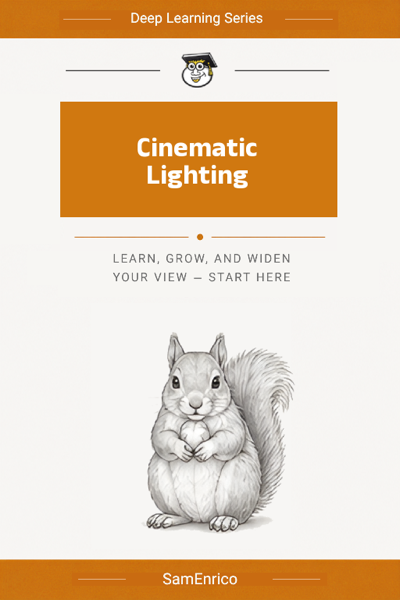
Non-FictionInformativeEducational
Cinematic Lighting eBook
A Coursebook on Cinematic Lighting
by Barbour Ozie
A Coursebook on Cinematic Lighting
Formats
Free sample
Chapter 1: Beyond the Bulb--–- The single most expensive mistake you will ever make as a filmmaker happens long before you turn on a single light. It happens in your mind, in the quiet moment when you decide what lighting is for. If you believe lighting exists to make things bright enough to see, you have already lost. You will spend thousands of dollars on equipment you do not need, hours of time you cannot afford, and the result will still look like a badly lit news broadcast.Here is the truth that separates cinema from home video: lighting is not about visibility. Lighting is about selective invisibility.
It is the art of deciding what the audience sees, what they almost see, and what remains hidden in shadow. The greatest cinematographers in history were not masters of light. They were masters of darkness.This chapter will rewire your understanding of cinematic lighting from the ground up. By the time you finish, you will see every film differently. You will understand why some images feel like art while others feel like security footage.
And you will have a framework for making lighting decisions that serve your story, not your gear budget.The Great Deception: Why More Light Is Almost Always Wrong Walk onto any low-budget film set and you will witness the same tragedy. The well-meaning director of photography has rented every light their budget allows. They have set them up in a careful ring around the actor. They have turned them all on. The actor is bathed in even, shadowless illumination.
Every wrinkle is softened. Every imperfection is blurred.The result is flat. Dead. Lifeless. It looks like a commercial for arthritis medication.Why does this happen?
Because we have been taught a lie. The lie is that light is good and darkness is bad. The lie is that the goal of lighting is to eliminate shadows. The lie is that more light equals more professional results.None of this is true. Not even a little.The truth is that the human eye is drawn to contrast.
When everything is evenly lit, nothing stands out. The audience has no idea where to look because everywhere looks the same. When you allow shadows to exist – deep, rich, velvety shadows – the areas of light become beacons. The eye goes exactly where you want it to go.Consider the most memorable images in cinema history. The silhouetted cowboys at the end of The Searchers.
The half-lit face of Michael Corleone in The Godfather. The shafts of light cutting through fog in Blade Runner. What do these images have in common? They are defined as much by what you cannot see as by what you can.The Physics of Attention: How Your Eyes Actually Work Before we can understand cinematic lighting, we need to understand human vision. Your eyes are not cameras.
They do not record reality. They construct reality in real time, constantly shifting focus, adjusting exposure, and ignoring vast amounts of information.Here is the crucial fact that most lighting tutorials ignore: your eyes are drawn to three things. Brightness, contrast, and movement. In a static frame, the brightest area will always win. In a frame with even brightness, the area of highest contrast will win.
In a frame with even brightness and even contrast, nothing wins. The audience gets bored and looks away.Cinematic lighting hijacks this biological programming. By controlling where the brightness lives and where the shadows fall, you control where the audience looks. This is not manipulation. It is grammar.
It is the visual equivalent of punctuation.A period is a hard cut. A comma is a subtle shift in focus. An exclamation point is a sudden burst of brightness. The audience reads these visual sentences whether they know it or not. Your job is to write clearly.The Pre-History: When Light Was Fire The story of cinematic lighting begins not with electricity but with fire.
The first film studios were glass-roofed buildings that relied entirely on sunlight. Cinematographers had no control over direction, quality, or color. They could only wait for the right time of day and pray for clouds that would diffuse the harsh sunlight.This was the era of what we might call passive lighting. The cinematographer was a documentarian, not an author. The light simply was.
You took what nature gave you and hoped for the best.Then came the carbon arc lamp. It was dangerous, unstable, and hot enough to melt steel. It required a dedicated technician to feed the carbon rods as they burned away, spitting sparks and toxic fumes. But it was bright. Unimaginably bright.
For the first time, filmmakers could shoot indoors at any hour.The carbon arc gave us hard light. Brutal, unforgiving, sharp-edged. The shadows it cast were not gentle gradients. They were razor blades. Look at the German Expressionist films of the 1920s – The Cabinet of Dr.
Caligari, Nosferatu, Metropolis. The faces are not softly modeled. They are geometric sculptures carved from light and shadow.Here is the lesson from this era: hard light is not a technical limitation. It is a psychological weapon. Sharp shadows create unease.
They suggest a fractured, dangerous world. When you choose a hard source today – a bare bulb, an unfiltered fresnel, the midday sun – you are evoking this century-old language of anxiety.The Tungsten Age: When Light Became Obedient The incandescent tungsten bulb domesticated light. Unlike the carbon arc, which was essentially a controlled explosion, tungsten was predictable. It ran on standard household electricity. It was dimmable.
It was small enough to hide just out of frame.This technical shift created an aesthetic revolution. For the first time, cinematographers could place lights exactly where they wanted them. They could create pools of light within darkness. They could motivate sources – making artificial light look like practical lamps, windows, or streetlights.The Hollywood studio system was built on tungsten. Every frame of every film from the 1930s through the 1960s was lit with tungsten fresnels.
The look of classic cinema – the glamorous close-ups, the dramatic shadows, the three-point grammar – is the look of tungsten.But tungsten had a dark secret. It was hot. Dangerously hot. A 10,000-watt lamp could ignite scenery, melt gels, and cook actors. It consumed massive amounts of electricity, requiring dedicated generators and thick cable.
Ninety percent of its energy became heat, not light.The tungsten era taught us that control comes at a cost. Every light you add creates heat, draws power, and demands space. The cinematographer's job is not to add as much light as possible. It is to add exactly enough and no more.Film Noir: When Shadow Became Character No discussion of lighting history is complete without dwelling in the shadows of Film Noir. This genre, born from post-war pessimism and German Expressionist refugees, elevated lighting from craft to art form.The classic Film Noir frame uses a single hard source as key light, placed extremely high and far to the side.
Fill light is minimal or nonexistent. Backgrounds fall into near-total darkness. The result is a world of moral ambiguity made visible – characters who are neither fully good nor fully evil, trapped between light…
This is the end of the free sample. Get the eBook to keep going. Buy now
About this book
Details
- Author
- Barbour Ozie
- Publisher
- SamEnrico
- Language
- English
- Genre
- Non-Fiction, Informative, Educational
- Released
- 2026-06-02
- Pages (approx.)
- 133
- Available as
- eBook, Audiobook

Read better in the ZLOADR app
Your eBooks on your phone or tablet. Sign in with your SamEnrico account and start reading.
More by Barbour Ozie
 Loneliness During Holidays GuideBarbour Ozie$11.99
 CrossFit Rope Climb ProgressionsBarbour Ozie$11.99
 Teen Self Advocacy GuideBarbour Ozie$11.99
 Stalking Dating App Danger CasesBarbour Ozie$11.99
 Twitter Outrage Comparison TrapBarbour Ozie$11.99
 The Unlikely Alliance: How a Hip-Hop Mogul and a Conservative Senator United to Save Music EducationBarbour Ozie$11.99
 Echoes of Ice and Stone: Decoding Antarctica’s Forgotten LanguagesBarbour Ozie$11.99
 Understanding Duodenal Atresia Tetralogy of FallotBarbour Ozie$17.99
 Retail Union Collective BargainingBarbour Ozie$12.99
 AI Data Backup GuideBarbour Ozie$12.99
 How to Become a Carpet SewerBarbour Ozie$11.99
You may also like
 Hong Kong Handover 1997Dunn Johnnie$11.99
 Zumba For Postnatal Recovery CourseNeal Christian$11.99
 Zumba for BeginnersLadner Nikia$11.99
 YouTube Comment Mining GuideHumes Pandora$12.99
 Worry Box MeditationCarlin Rudy$11.99
 Workplace Stress MeditationNguyen Lynn$11.99
 Workplace Stress and Sleep RepairHawley Ivory$11.99
 Workplace Perfectionism CureDelaney Jeffry$11.99
 Workplace Injustice Anger GuideWallen Isabelle$11.99
 Work Addiction and Burnout LinkGreenwood Ester$11.99
 Women in Yoga and WellnessBeattie Galina$11.99
 Women in Stand Up ComedyChun Evangeline$11.99