
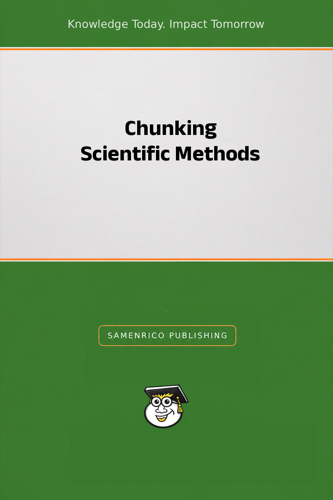
Non-FictionSelf-HelpScienceMethod
Chunking Scientific Methods
Group hypothesis, experiment, analysis into memora
by Zhang Lyndon
Group hypothesis, experiment, analysis into memorable research flow.
Formats
About this book
Free sample
Chapter 1: The 100-Decision Trap--–- Every research project begins with a simple question. How does X affect Y? Is this treatment better than that one? What explains this puzzling observation? The question feels clean, almost innocent.
But the moment you decide to answer it scientifically, something strange happens. The clean question explodes into a thousand smaller decisions.You need to choose a design. Then operationalize your variables. Then select a sample size. Then randomize.
Then control for confounds. Then clean your data. Then pick a statistical test. Then check assumptions. Then interpret p-values.
Then calculate effect sizes. Then write it up. Then respond to reviewers. Each step contains sub-steps. Each sub-step contains micro-decisions.
What alpha level? Two-tailed or one? Parametric or non-parametric? Remove that outlier or keep it? Control for age or not?
By the time you actually run your study, you are holding more discrete decisions in working memory than the human brain was ever designed to handle.This chapter exposes a hidden crisis in scientific training. Traditional methods textbooks teach you what decisions to make. They rarely teach you how to manage the cognitive load of making all of them at once. The result is not just inefficiency. It is errors, paralysis, burnout, and a quiet exodus of talented people from research careers.
But there is a solution. It comes from an unexpected place: the science of how experts chunk information. Before you learn any specific method in this book, you need to understand the problem those methods were designed to solve. That problem has less to do with statistics or design than you might think. It has everything to do with the limits of your attention.The Hidden Mathematics of Research Overload Let us count the decisions.
Not abstractly. Actually count them for a simple two-group experiment comparing a treatment to a control condition with thirty participants per group.Before you collect data, you decide on your research question. That is one decision, but it contains sub-decisions. Is the question novel? Feasible?
Ethical? Answerable with available resources? Call that four sub-decisions. Then you formulate your hypothesis. Directional or non-directional?…
This is the end of the free sample. Get the eBook to keep going. Buy now
Contents
- Chapter 1
- Chapter 2
- Chapter 3
- Chapter 4
- Chapter 5
- Chapter 6
- Chapter 7
- Chapter 8
- Chapter 9
- Chapter 10
- Chapter 11
- Chapter 12
Details
- Author
- Zhang Lyndon
- Publisher
- SamEnrico
- Language
- English
- Genre
- Non-Fiction, Self-Help, Science, Method
- Released
- 2026-06-07
- Pages (approx.)
- 142
- Available as
- eBook, Audiobook

Read better in the ZLOADR app
Your eBooks on your phone or tablet. Sign in with your SamEnrico account and start reading.
More by Zhang Lyndon
 Remote Company Retreats For Remote First CompaniesZhang Lyndon$11.99Remote Company Retreats For Remote First CompaniesZhang Lyndon$11.99
 The Arthritis and Mental Health GuideZhang Lyndon$11.99
 Burnout Prevention Pacing GuideZhang Lyndon$11.99
 The Non Resident US Credit BuildingZhang Lyndon$11.99
 The Cape Town Conspiracy: A Victorian Spy Ring ExposedZhang Lyndon$11.99
 Understanding Shapiro SyndromeZhang Lyndon$17.99
 Sandwich ArtistZhang Lyndon$11.99
 Japanese Scholarship RecommendationZhang Lyndon$12.99
 Coffee Price Europe GuideZhang Lyndon$12.99
 How to Become a Dyed-yarn OperatorZhang Lyndon$11.99
You may also like
 Hong Kong Handover 1997Dunn Johnnie$11.99
 Zumba For Postnatal Recovery CourseNeal Christian$11.99
 Zumba for BeginnersLadner Nikia$11.99
 YouTube Comment Mining GuideHumes Pandora$12.99
 Worry Box MeditationCarlin Rudy$11.99
 Workplace Stress MeditationNguyen Lynn$11.99
 Workplace Stress and Sleep RepairHawley Ivory$11.99
 Workplace Perfectionism CureDelaney Jeffry$11.99
 Workplace Injustice Anger GuideWallen Isabelle$11.99
 Work Addiction and Burnout LinkGreenwood Ester$11.99
 Women in Yoga and WellnessBeattie Galina$11.99
 Women in Stand Up ComedyChun Evangeline$11.99