
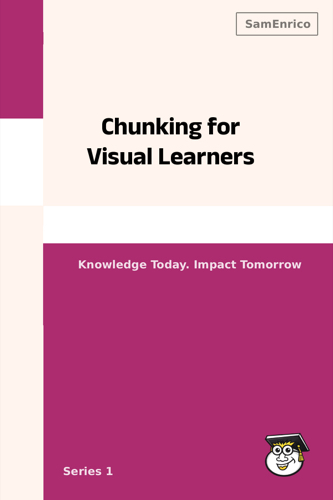
Free sample
Chapter 1: The Pattern-Seeking Brain--–- Every morning, without fail, you perform a miracle of pattern recognition that would humble the world’s most advanced supercomputers. You wake up, open your eyes, and within milliseconds—faster than conscious thought—your brain has identified the ceiling, distinguished it from the wall, recognized the texture of your bedsheets, located the window, assessed the quality of light, and determined whether that shadow in the corner is a jacket draped over a chair or an intruder. You never pause to think, “Let me carefully analyze these visual inputs one by one.” You simply see. You see a room, not 10,000 individual pixels. You see a bed, not cotton fibers and springs.
You see a morning, not a cascade of raw sensory data.This effortless compression of visual information into meaningful wholes is not just a neat party trick of human neurology. It is the single most powerful cognitive tool you possess—and it is the very tool that traditional education, textbooks, and workplace training have systematically ignored. While your brain evolved to process the world in parallel, in patterns, and in wholes, the modern world insists on feeding you information sequentially, linearly, and in fragmented pieces. The result is a constant, low-grade cognitive crisis: information overload, forgetting what you just read, re-reading paragraphs three times, staring at spreadsheets until your eyes blur, and walking away from study sessions feeling exhausted yet empty-handed.This book is built on a deceptively simple proposition: what if you stopped fighting your brain’s natural wiring and started using it? What if the problem is not that you are a “bad learner” or that the material is “too hard,” but that you have been presenting information to yourself in the wrong format?
What if the secret to mastering complex topics, remembering what you learn, and reducing study time by half was not more hours at the desk, but a different way of seeing?This chapter answers the first and most important question: why does chunking work so powerfully for visual learners? We will journey into the cognitive science of working memory, explore the evolutionary origins of visual processing, and uncover the hidden architecture of expert memory. By the end of this chapter, you will understand not just that chunking works, but why your brain was built for it—and why most learning materials are designed against your biology.The Magical Number That Changed Psychology In 1956, a young cognitive psychologist named George Miller published a paper with a deceptively dull title: “The Magical Number Seven, Plus or Minus Two: Some Limits on Our Capacity for Processing Information.” The paper would become one of the most cited works in the history of psychology, and its central finding would reshape our understanding of human cognition for decades to come.Miller’s discovery was both simple and profound: the average human working memory can hold approximately seven items at once—give or take two. That is it. Seven.
You can hold roughly seven digits, seven letters, seven words, or seven discrete concepts in your conscious awareness at any given moment. Try to add an eighth, and something falls off the edge of your mental cliff, lost to the void of forgotten information.This is why phone numbers are seven digits long (in many countries). This is why you can remember a grocery list of about seven items without writing it down, but the eighth item is where you start muttering “eggs, milk, bread, butter, apples, cheese, chicken… wait, what was the last one?” This is why, when someone gives you directions with eight steps, you will reliably forget step four or step seven. Your brain is not broken. Your brain is operating exactly within its design specifications.But here is where Miller’s insight becomes genuinely revolutionary—and where most discussions of his work stop too soon.
Miller’s “seven items” are not seven individual bits of raw information. They are chunks. A chunk is any meaningful unit of information that your brain has learned to treat as a single item. For a child learning to read, the letter “C” is one chunk. For a literate adult, the entire word “CAT” is one chunk—three letters compressed into one mental unit.
For a radiologist, a chest X-ray showing a tumor is one chunk: “cancer,” not 10,000 individual pixels. For a chess master, a board configuration is one chunk: “King’s Indian Defense,” not 32 individual pieces.The difference between a novice and an expert is not that the expert has a larger working memory. The difference is that the expert’s chunks are bigger. Much bigger.The Chunk Size Illusion: Why Experts Remember More Let me give you a concrete demonstration. Below are two sequences.
Read each one once, look away, and try to write them down from memory.Sequence A: F, I, B, A, N, C, C, H, I, C, A, G, OSequence B: FIB, ANCC, HIC, AGOIf you are like most people, you stared at Sequence A and felt a mild sense of panic. Thirteen letters, each seemingly random, each competing for space in your limited working memory. By the time you reached the seventh letter, the first few had already evaporated. Sequence B, however, felt almost trivial. Four groups.
Four chunks. Each chunk takes up one slot in working memory instead of thirteen.But here is the trick: both sequences contain exactly the same letters in the same order. The only difference is how they are grouped. In Sequence A, each letter is its own chunk. In Sequence B, the letters are grouped into meaningful patterns—in this case, recognizable abbreviations (FIB, ANCC, HIC, AGO).
Your brain did not suddenly grow more memory slots. You simply used the slots more efficiently by loading each slot with a larger package of information.This is the fundamental mechanism of all expert performance. A novice chess player looks at a board and sees 32 individual pieces. That is 32 chunks—impossible to hold in working memory, which is why novices feel overwhelmed and make poor strategic decisions. A grandmaster looks at the same board and sees four or five chunks: “King’s Indian Defense, mid-game, kingside pressure, weak pawn structure, imminent queen trade.” Each of those chunks contains within it dozens of individual piece positions, relationships, and tactical possibilities.
But the grandmaster’s working memory is not overloaded because the information has been compressed into a handful of high-density chunks.This compression is not magic. It is the result of thousands of hours of practice—practice that has taught the grandmaster’s brain which pieces belong together, which patterns repeat, and which configurations signal danger or opportunity. The grandmaster has built a library of chunks over time, and those chunks have become automatic. They fire together so quickly and so fluently that they feel like a single thought.Here is the good news: you do not need ten thousand hours to start building your own chunk library. You need a method.
You need to understand how chunks are formed, how they are stored, and how they are retrieved. And you need to know why the visual system is uniquely suited to this task.The Express Lane: Why Visual Processing Outruns…
This is the end of the free sample. Get the eBook to keep going. Buy now
About this book
Details
- Author
- Shore Jeanie
- Publisher
- SamEnrico
- Language
- English
- Genre
- Non-Fiction, Self-Help / Visual
- Released
- 2026-06-07
- Pages (approx.)
- 141
- Available as
- eBook, Audiobook

Read better in the ZLOADR app
Your eBooks on your phone or tablet. Sign in with your SamEnrico account and start reading.
More by Shore Jeanie
 TM For Immune FunctionShore Jeanie$11.99
 Delegation in Law FirmsShore Jeanie$11.99
 Social Anxiety Group Therapy Low CostShore Jeanie$11.99
 Caffeine Road Rage Link GuideShore Jeanie$11.99
 FCPA Money Laundering TiesShore Jeanie$11.99
 Success Attribution Rewiring GuideShore Jeanie$11.99
 Nicotine Free Within 90 DaysShore Jeanie$11.99
 Mussolini DuceShore Jeanie$11.99
 The Bronze Sculptors of Ife: Masters of the Divine FormShore Jeanie$11.99
 Whispers of the Silk Road: The Unseen Caravans That Shaped the WorldShore Jeanie$11.99
 Frozen in Time: The Last Days of the Franklin ExpeditionShore Jeanie$11.99
 The Dancer's Guide to Hootchy-kootchyShore Jeanie$11.99
You may also like
 Hong Kong Handover 1997Dunn Johnnie$11.99
 Zumba For Postnatal Recovery CourseNeal Christian$11.99
 Zumba for BeginnersLadner Nikia$11.99
 YouTube Comment Mining GuideHumes Pandora$12.99
 Worry Box MeditationCarlin Rudy$11.99
 Workplace Stress MeditationNguyen Lynn$11.99
 Workplace Stress and Sleep RepairHawley Ivory$11.99
 Workplace Perfectionism CureDelaney Jeffry$11.99
 Workplace Injustice Anger GuideWallen Isabelle$11.99
 Work Addiction and Burnout LinkGreenwood Ester$11.99
 Women in Yoga and WellnessBeattie Galina$11.99
 Women in Stand Up ComedyChun Evangeline$11.99