
Non-FictionSelf-HelpDecision Skills
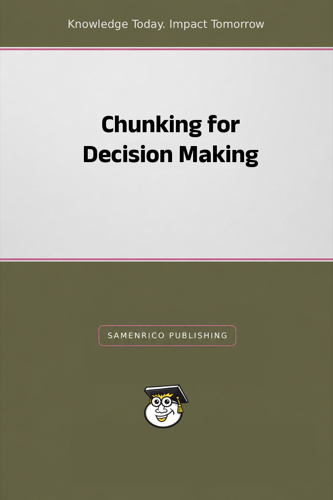
Chunking for Decision Making
Break complex choices into smaller comparison grou
by Leahy Marci
Break complex choices into smaller comparison groups.
Formats
About this book
Free sample
Chapter 1: The Hidden Limit--–- In 1956, a little-known cognitive psychologist named George Miller published a paper that would quietly reshape how we understand the human mind. His argument was deceptively simple: the average person can hold no more than seven discrete pieces of information in their conscious awareness at any given moment. Seven. Plus or minus two. That was it.
Miller wasn’t talking about storage—your brain can archive terabytes of memories. He was talking about the live, burning, real-time processing capacity of human attention. And that number, seven, has proven to be one of the most stubborn constraints in all of psychology.Now consider what happens when you walk into a car dealership. Not a theoretical exercise—a real one. You have twenty different models spread across the lot.
Each model has roughly fifteen attributes: price, fuel efficiency, safety rating, horsepower, torque, cargo space, legroom, warranty length, maintenance cost, resale value, color options, entertainment system, drivetrain type, number of airbags, and crash test ratings. That’s 20 × 15 = 300 discrete pieces of information. Your conscious working memory, according to Miller’s Law, can handle seven. You are trying to pour a firehose into a coffee cup.This chapter is not about the theory of chunking. It is about the anatomy of your own cognitive bottleneck.
Before you can break complex decisions into smaller comparison groups, you must understand exactly why your brain fails when faced with complexity. And it fails not because you are lazy or undisciplined or foolish. It fails because the hardware has limits that no amount of willpower can overcome.The Three Numbers That Rule Your Decisions Let me give you three numbers. Remember them, because they will appear in every chapter of this book.The first number is 7. That is Miller’s Law—the upper bound of your conscious working memory.
When you try to compare more than seven distinct things at once, your brain stops processing and starts guessing. You don’t notice the shift because your brain is very good at hiding its own shortcuts. It feels like you are still thinking. But you are actually…
This is the end of the free sample. Get the eBook to keep going. Buy now
Contents
- Chapter 1
- Chapter 2
- Chapter 3
- Chapter 4
- Chapter 5
- Chapter 6
- Chapter 7
- Chapter 8
- Chapter 9
- Chapter 10
- Chapter 11
- Chapter 12
Details
- Author
- Leahy Marci
- Publisher
- SamEnrico
- Language
- English
- Genre
- Non-Fiction, Self-Help, Decision Skills
- Released
- 2026-06-09
- Pages (approx.)
- 134
- Available as
- eBook, Audiobook

Read better in the ZLOADR app
Your eBooks on your phone or tablet. Sign in with your SamEnrico account and start reading.
More by Leahy Marci
 Financial Uncertainty Coping GuideLeahy Marci$11.99
 Recovery from Anger AddictionLeahy Marci$11.99
 Student Breathing TechniquesLeahy Marci$11.99
 Leading Distributed Teams GuideLeahy Marci$11.99
 The Unstoppable Comeback: How a Legendary Coach Defied the OddsLeahy Marci$11.99
 The Last Banquet of the Sun KingLeahy Marci$11.99
 AI Art Social Media PromotionLeahy Marci$12.99
 Scrum for Atlassian StartupsLeahy Marci$12.99
 Understanding Enolase Deficiency Type 2Leahy Marci$17.99
 How to Start a Dairy Preparation of Milk Products N.e.c. Business (Beginners Guide)Leahy Marci$11.99
 Georgerobinsonite MiningLeahy Marci$11.99
You may also like
 Hong Kong Handover 1997Dunn Johnnie$11.99
 Zumba For Postnatal Recovery CourseNeal Christian$11.99
 Zumba for BeginnersLadner Nikia$11.99
 YouTube Comment Mining GuideHumes Pandora$12.99
 Worry Box MeditationCarlin Rudy$11.99
 Workplace Stress MeditationNguyen Lynn$11.99
 Workplace Stress and Sleep RepairHawley Ivory$11.99
 Workplace Perfectionism CureDelaney Jeffry$11.99
 Workplace Injustice Anger GuideWallen Isabelle$11.99
 Work Addiction and Burnout LinkGreenwood Ester$11.99
 Women in Yoga and WellnessBeattie Galina$11.99
 Women in Stand Up ComedyChun Evangeline$11.99