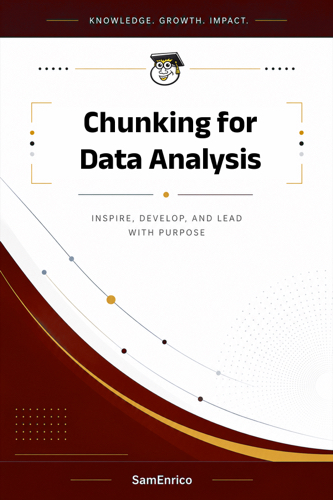
Chunking for Data Analysis
Group statistics and metrics into interpretable ca
by Block Livia
Group statistics and metrics into interpretable categories.
Formats
About this book
Free sample
Chapter 1: The Forty-Seven Metric Disaster--–- Sarah Chen had spent eighteen hours preparing the quarterly analytics report. She had pulled data from seven different sources, cleaned three million rows of transaction logs, built twelve pivot tables, and created a dashboard with forty-seven distinct metrics. Every KPI her VP had ever mentioned was included. Every possible slice of the data was represented. She was proud of her thoroughness.She presented the report at 9:00 AM on a Tuesday.
The VP listened for exactly ninety seconds, squinted at the screen, and asked a question that would haunt Sarah for the rest of her career: "So... what am I supposed to do with all this?"The dashboard had forty-seven numbers. The VP could not find a single actionable insight in any of them. Not because the numbers were wrong—they were mathematically perfect—but because there were simply too many. The human brain, even the brain of a well-compensated vice president, cannot process forty-seven things at once.Three months later, Sarah's competitor presented a one-page report with exactly five numbers.
The VP promoted the competitor.Sarah's story is not unusual. It happens every day in every industry. Analysts drown in their own thoroughness. They mistake volume for value. They believe that if some data is good, more data must be better.
This is the Forty-Seven Metric Disaster, and it is the single most common reason that excellent data analysis leads to terrible business decisions.The Cognitive Bottleneck You Cannot Ignore In 1956, a Harvard psychologist named George Miller published a paper that would become one of the most cited in the history of psychology. Its title was modest: "The Magical Number Seven, Plus or Minus Two: Some Limits on Our Capacity for Processing Information." Miller's finding was simple and devastating: the human working memory can hold between five and nine pieces of information at once. Not fifty. Not ninety. Five to nine.Miller was not studying distracted people.
He was studying motivated, focused individuals under laboratory conditions. Their task was to listen to a sequence of tones, or read a list of words, or observe…
This is the end of the free sample. Get the eBook to keep going. Buy now
Contents
- Chapter 1
- Chapter 2
- Chapter 3
- Chapter 4
- Chapter 5
- Chapter 6
- Chapter 7
- Chapter 8
- Chapter 9
- Chapter 10
- Chapter 11
- Chapter 12
Details
- Author
- Block Livia
- Publisher
- SamEnrico
- Language
- English
- Genre
- Non-Fiction, Self-Help, Data Science
- Released
- 2026-06-11
- Pages (approx.)
- 157
- Available as
- eBook, Audiobook

Read better in the ZLOADR app
Your eBooks on your phone or tablet. Sign in with your SamEnrico account and start reading.
More by Block Livia
 Self Hypnosis For Pain Management WorkbookBlock Livia$11.99
 The Anger Postmortem MethodBlock Livia$11.99
 Exercise Focus Protection GuideBlock Livia$11.99
 Recurring Dream Interpretation GuideBlock Livia$11.99
 Hops & Hustle: The Untold Story of the Beer Barons Who Built AmericaBlock Livia$11.99
 Codex of the Forgotten: The AI ArchaeologistBlock Livia$11.99
 Redbubble Trending DesignsBlock Livia$12.99
 Shape Up Kanban for BasecampBlock Livia$12.99
 Understanding Endomyocardial FibroelastosisBlock Livia$17.99
 How to Start a Prefabricated Buildings or Elements Thereof Made of Wood Business (Beginners Guide)Block Livia$11.99
 Fulfillment Department ManagerBlock Livia$11.99