
Non-FictionSelf-HelpChronotypes
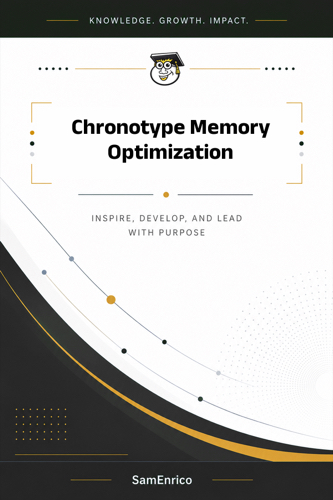
Chronotype Memory Optimization eBook
Match study and work to your natural peak alertnes
Match study and work to your natural peak alertness times.
Formats
Free sample
Chapter 1: The 3-Hour Theft--–- Every morning, millions of people pour their first cup of coffee, open their laptops, and promptly waste the next three hours. They sit through meetings that could have been emails. They reread the same paragraph four times. They check email, then Slack, then email again. At noon, they feel vaguely exhausted and ashamed, having accomplished almost nothing that required real thinking.
The standard explanation for this universal experience is a moral failing: laziness, poor discipline, lack of willpower. That explanation is wrong. Catastrophically wrong.What you are experiencing is not a character flaw. It is a biological mismatch. Your brain has a hidden schedule—a precise, predictable rhythm of high alertness, deep fatigue, and creative rebound—and you have been ignoring it because no one ever told you it existed.
This book exists to correct that silence.Consider the following experiment, conducted by researchers at the University of Michigan. Two groups of students were given the same forty-five-minute lecture on microeconomics. The only difference was the time of day. One group attended at 9:00 AM. The other attended at 4:30 PM.
Both groups took the same test immediately afterward, and then again one week later. The results were not close. The morning group scored 22 percent higher on immediate recall and 31 percent higher on delayed recall. When researchers asked the students why they thought the morning group performed better, the students guessed everything from “the morning teacher was better” to “the morning students were more motivated.” In fact, the teacher was identical, and motivation levels were statistically equal. The only difference was circadian timing.But here is where the story gets genuinely strange.
When the researchers repeated the experiment with a different set of students—this time asking them to solve creative insight problems rather than memorize facts—the pattern reversed. The afternoon group outperformed the morning group by nearly the same margin. The exact same students, the exact same teacher, the exact same room. The only variable was the type of thinking required. Memorization wanted morning.
Creativity wanted afternoon.This is not an anomaly. It is a law of cognitive biology. Your brain is not a machine that runs at constant speed. It is more like a tidal ecosystem, ebbing and flowing in patterns that were carved into your DNA over hundreds of thousands of years of evolution. And for most of your life, you have been swimming against that tide, wondering why you are exhausted.The purpose of this chapter is to introduce you to the hidden pattern that governs your daily cognitive life.
You will learn why your afternoon slump is not a sign of laziness but a predictable biological event. You will discover the three phases that every human brain cycles through each day. And you will begin to see why most productivity advice—the kind that tells you to wake up earlier, push through fatigue, and grind harder—is not just unhelpful but actively harmful to your memory and learning. By the end of this chapter, you will never look at your daily schedule the same way again.The Discovery of the Internal Clock For most of human history, scientists believed that the brain worked like a light switch. You woke up, the brain turned on.
You went to sleep, the brain turned off. Whatever variation occurred in between was assumed to be random noise or individual idiosyncrasy. This view persisted well into the twentieth century, despite overwhelming evidence from everyday experience that people felt sharper at some times and foggier at others. Why did scientists ignore the obvious? Because they lacked the tools to measure what was actually happening inside the brain across the circadian cycle.That changed in the 1970s and 1980s, when researchers began conducting what became known as “constant routine” studies.
In these grueling experiments, participants lived in windowless laboratories for days or weeks at a time, with no clocks, no natural light, and no social cues. They ate the same meals at regular intervals. They stayed awake for extended periods. And throughout, researchers took blood samples, measured body temperature, and administered cognitive tests every hour. The results were shocking.Even when all external time cues were removed, the human brain continued to oscillate in a roughly twenty-four-hour cycle.
Body temperature rose and fell predictably. Cortisol spiked and dipped. Melatonin flooded the system at regular intervals. And cognitive performance—attention, working memory, processing speed, and long-term encoding—fluctuated in lockstep with these physiological rhythms. The brain was not responding to the environment.
The brain was generating its own time.The scientists who conducted these studies had discovered the suprachiasmatic nucleus, a tiny cluster of neurons deep within the hypothalamus that serves as the body’s master clock. This cluster receives direct input from the eyes, which is why light is the single most powerful regulator of circadian rhythms. But crucially, the suprachiasmatic nucleus continues to tick even in complete darkness. Your brain is not a passive receiver of time. It is an active timekeeper, older than your species, older than mammals, older than most of the structures you think of as “you.”What does this have to do with your ability to remember facts, solve problems, or learn a new language?
Everything. Because the oscillations generated by your suprachiasmatic nucleus directly control the release of neurotransmitters that are essential for memory formation. When your brain is in its circadian peak, it floods your cortex with norepinephrine and acetylcholine, two chemicals that sharpen attention and strengthen synaptic connections. When your brain enters its trough, those chemicals drop, and inhibitory neurotransmitters like GABA rise, making it harder to concentrate and easier to become distracted. You are not choosing to feel sharp or foggy.
Your biology is choosing for you.The Three-Phase Pattern Through decades of constant routine studies, chronobiologists have identified a reliable three-phase pattern that appears in virtually every human being, regardless of age, gender, or culture. These phases are not arbitrary divisions; they emerge directly from the shape of the circadian rhythm of core body temperature, which rises throughout the morning, plateaus in the early afternoon, drops sharply in the mid-afternoon, and then rises again in the late afternoon before falling toward bedtime.Phase One: The Peak The peak is your window of highest alertness, fastest processing speed, and strongest encoding ability. During this phase, your brain is essentially optimized for analytic thinking, focused attention, and the consolidation of declarative memory—the kind of memory that allows you to recall facts, dates, vocabulary words, and logical rules. Neuroimaging studies show that during the peak, the dorsolateral prefrontal cortex (responsible for executive function) and the hippocampus (responsible for memory formation) are in a state of heightened connectivity. Information that enters your brain during the peak has a much higher probability of being stored in long-term memory than information that enters at other times.For most people, the peak occurs somewhere between late morning and early afternoon.
But crucially—and this is one of the most important insights in this entire book—the exact timing of the peak varies dramatically from person to person based on their chronotype. We will dive deeply into chronotypes in Chapter 2, but for now, understand that approximately…
This is the end of the free sample. Get the eBook to keep going. Buy now
About this book
Details
- Author
- Whitley Diedra
- Publisher
- SamEnrico
- Language
- English
- Genre
- Non-Fiction, Self-Help, Chronotypes
- Released
- 2026-06-06
- Pages (approx.)
- 134
- Available as
- eBook, Audiobook

Read better in the ZLOADR app
Your eBooks on your phone or tablet. Sign in with your SamEnrico account and start reading.
More by Whitley Diedra
 Detox Medications ListWhitley Diedra$11.99
 Zac Brown Chicken Fried LifeWhitley Diedra$11.99
 Syrian Refugee Therapy GuideWhitley Diedra$11.99
 Name Memory for Music TeachersWhitley Diedra$11.99
 The Illness Stress ShieldWhitley Diedra$11.99
 Freddie Mercury Live AidWhitley Diedra$11.99
 Anger and Disorganized AttachmentWhitley Diedra$11.99
 The Kabaddi Kings of Persia: How a Forgotten Game Conquered the Middle EastWhitley Diedra$11.99The Kabaddi Kings of Persia: How a Forgotten Game Conquered the Middle EastWhitley Diedra$11.99
 Rum & Rebellion: The Smuggler’s Code of the CaribbeanWhitley Diedra$11.99
 Understanding DiplopiaWhitley Diedra$11.99
 How to Produce Sidewalk and Yard SignsWhitley Diedra$11.99
You may also like
 Hong Kong Handover 1997Dunn Johnnie$11.99
 Zumba For Postnatal Recovery CourseNeal Christian$11.99
 Zumba for BeginnersLadner Nikia$11.99
 YouTube Comment Mining GuideHumes Pandora$12.99
 Worry Box MeditationCarlin Rudy$11.99
 Workplace Stress MeditationNguyen Lynn$11.99
 Workplace Stress and Sleep RepairHawley Ivory$11.99
 Workplace Perfectionism CureDelaney Jeffry$11.99
 Workplace Injustice Anger GuideWallen Isabelle$11.99
 Work Addiction and Burnout LinkGreenwood Ester$11.99
 Women in Yoga and WellnessBeattie Galina$11.99
 Women in Stand Up ComedyChun Evangeline$11.99