
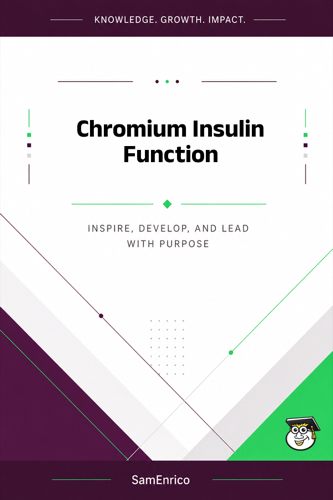
Non-FictionHealth & WellnessChromium
Chromium Insulin Function eBook
Mineral for glucose metabolism.
Mineral for glucose metabolism.
Formats
Free sample
Chapter 1: The 1957 Factor...--–- In the autumn of 1957, a quiet revolution in nutritional science began not in a gleaming research hospital or a pharmaceutical laboratory, but in the rat colonies of the United States Department of Agriculture's Human Nutrition Research Center in Grand Forks, North Dakota. What researchers there observed would eventually reach millions of supplement bottles, thousands of medical papers, and the medicine cabinets of people struggling with blood sugar across the world. Yet the full story—the one that explains both the excitement and the controversy that followed—has never been told quite this way before.The discovery that emerged from those experiments seemed almost accidental. Researchers had been feeding rats carefully purified diets, stripping away everything except the bare minimum of known nutrients. The goal was straightforward: understand what vitamins and minerals were absolutely essential for life.
But something strange kept happening. Rats on these purified diets, despite receiving all the known vitamins and minerals considered essential at the time, consistently developed a peculiar metabolic disturbance. Their bodies struggled to handle sugar. When given a glucose challenge, their blood sugar remained elevated far longer than it should have. They were, in modern terms, becoming glucose intolerant—a state that in humans precedes type 2 diabetes.What happened next would shape decades of research and create a multi-billion dollar supplement industry.
When the researchers added back brewer's yeast or crude liver extract to the rats' diets, the glucose intolerance vanished. Something in those natural substances—something not yet identified as essential—was reversing the problem. The scientists had stumbled upon a biological mystery, and the race to solve it was on.The Isolation of an Unknown Factor The compound they eventually isolated was given a name that reflected both its function and its mystery: the Glucose Tolerance Factor, or GTF. For several years, the exact chemical nature of GTF remained elusive. Researchers knew it contained chromium, but they weren't certain whether chromium alone was the active ingredient or whether GTF was a larger complex in which chromium played a supporting role.
The leading theory, proposed by researcher Walter Mertz and his colleagues, suggested that GTF was a biologically active form of chromium bound to nicotinic acid (niacin) and amino acids, creating a molecule that the body could readily use to potentiate insulin action.The year 1957 became the landmark. In a series of elegant experiments, Mertz and his collaborator Klaus Schwarz demonstrated that rats fed chromium-deficient diets developed impaired glucose tolerance, while those receiving supplemental chromium (either as inorganic salts or as part of natural GTF extracts) maintained normal glucose handling. The conclusion seemed inescapable: chromium was an essential trace mineral, and its primary role was to help insulin do its job.The Essential Mineral Classification At the time, this discovery was received with genuine excitement. The field of trace mineral nutrition was young and full of possibility. Just decades earlier, researchers had established that iodine prevented goiter, that iron cured anemia, that zinc was essential for growth.
Each new essential mineral discovery felt like finding a missing piece in the puzzle of human health. Chromium appeared to be another such piece—one with direct relevance to the growing epidemic of diabetes and heart disease.The logic was compelling and, to many, unassailable. If removing chromium from an animal's diet caused glucose intolerance, and if adding it back reversed that intolerance, then chromium must be essential. This is the same reasoning that had established the essentiality of every other mineral and vitamin in the nutrition canon. The scientific community accepted this conclusion, and chromium took its place alongside zinc, copper, manganese, and selenium as an element required for human health.The practical implications were enormous.
If chromium was essential, then some people might not be getting enough. And if deficiency caused glucose intolerance, then supplementation might prevent or treat diabetes. This line of reasoning, perfectly logical given the evidence available at the time, launched a cascade of research, product development, and public interest that continues to this day.The Rise of a Supplement Giant By the 1980s and 1990s, chromium had become one of the most popular mineral supplements in the United States, second only to calcium in total sales. Health food stores stocked chromium picolinate alongside vitamin C and fish oil. Infomercials promised that chromium would build muscle, burn fat, and stabilize blood sugar.
Bodybuilders used it as a performance enhancer. People with diabetes saw it as a natural alternative to increasing medication. The mainstream medical establishment, while cautious, did not dismiss the possibility. Many doctors recommended chromium to their patients with prediabetes or type 2 diabetes, based on the accumulating but still preliminary evidence.The sales figures told the story. By the late 1990s, annual chromium supplement sales in the United States exceeded $100 million, and some estimates placed the figure much higher when including combination products and multi-nutrients.
Chromium had become a household name, at least among health-conscious consumers. The story of the 1957 discovery was repeated in countless articles, books, and advertisements: chromium, the glucose tolerance factor, the missing mineral that helps insulin work.The Central Tension That Defines This Book But here is where the story takes an unexpected turn—one that most books on this subject either ignore entirely or address only superficially. For all the excitement of that 1957 discovery, for all the subsequent research, for all the millions of people taking chromium supplements today, a fundamental question has never been fully resolved: Is chromium actually essential for humans?This is not a rhetorical question, nor is it asked by skeptics alone. Some of the world's leading biochemists and nutrition scientists have raised serious doubts about whether the animal studies from the 1950s truly proved essentiality, and whether the subsequent decades of research have provided convincing evidence that humans need chromium in the same way they need iodine, iron, or zinc.Consider the evidence. For every other essential mineral, there exists a well-described human deficiency disease.
Iron deficiency causes anemia. Iodine deficiency causes goiter and cretinism. Zinc deficiency causes growth retardation and immune dysfunction. Selenium deficiency, though rare, causes specific cardiomyopathies. Even chromium's fellow trace element manganese, though deficiency is exceptionally rare in humans, has been documented to cause skin rashes, hair depigmentation, and abnormal bone formation in experimental settings.For chromium, no such deficiency syndrome exists.
Despite decades of searching, despite millions of people with unexplained metabolic problems, despite populations living on extremely low-chromium diets, not a single case of isolated chromium deficiency has ever been conclusively documented in a human being. This is not a minor oversight. It is a striking anomaly that has led some researchers to question the entire foundation of chromium's status as an essential nutrient.The Interpretation of the Animal Studies How could the animal studies have been so convincing, yet human evidence remain so elusive? Several explanations have been proposed. One possibility is that the purified diets used in those early rat studies were deficient not only in chromium but in other nutrients that affect glucose metabolism.
When the researchers added back brewer's yeast or liver extract, they were adding back many compounds simultaneously. The improvement in glucose tolerance might have been due to something else entirely—perhaps a combination…
This is the end of the free sample. Get the eBook to keep going. Buy now
About this book
Details
- Author
- Mangum Keitha
- Publisher
- SamEnrico
- Language
- English
- Genre
- Non-Fiction, Health & Wellness, Chromium
- Released
- 2026-06-07
- Pages (approx.)
- 145
- Available as
- eBook, Audiobook

Read better in the ZLOADR app
Your eBooks on your phone or tablet. Sign in with your SamEnrico account and start reading.
More by Mangum Keitha
 Recalled CEO Legal RiskMangum Keitha$11.99
 Liberian Child EscapeMangum Keitha$11.99
 Body Image for ModelsMangum Keitha$11.99
 1857 in Bombay PresidencyMangum Keitha$11.99
 Mindfulness for Chronic DreadMangum Keitha$11.99
 London Pop Up Brand ExperienceMangum Keitha$11.99
 Work Addiction And Mental HealthMangum Keitha$11.99
 Dreams About GhostsMangum Keitha$11.99
 Nefertem's Golden Lute: The Music That Shaped the SunMangum Keitha$11.99
 The Silent Hunter: The Untold Story of the SS-564’s Last VoyageMangum Keitha$11.99
 The Clockwork Revolution: How a Toymaker Changed the WorldMangum Keitha$11.99
 The Complete Guide to the Diabetic DietMangum Keitha$11.99
You may also like
 Hong Kong Handover 1997Dunn Johnnie$11.99
 Zumba For Postnatal Recovery CourseNeal Christian$11.99
 Zumba for BeginnersLadner Nikia$11.99
 YouTube Comment Mining GuideHumes Pandora$12.99
 Worry Box MeditationCarlin Rudy$11.99
 Workplace Stress MeditationNguyen Lynn$11.99
 Workplace Stress and Sleep RepairHawley Ivory$11.99
 Workplace Perfectionism CureDelaney Jeffry$11.99
 Workplace Injustice Anger GuideWallen Isabelle$11.99
 Work Addiction and Burnout LinkGreenwood Ester$11.99
 Women in Yoga and WellnessBeattie Galina$11.99
 Women in Stand Up ComedyChun Evangeline$11.99