
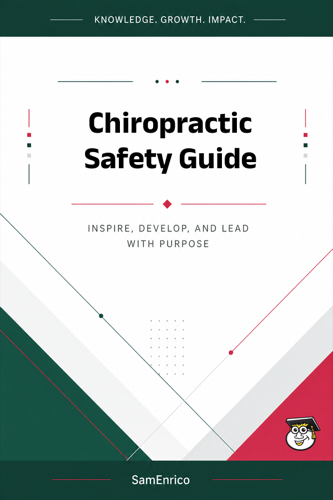
Non-FictionHealth & WellnessSafety
Chiropractic Safety Guide eBook
Understand risks, contraindications, and when to a
Understand risks, contraindications, and when to avoid spinal manipulation.
Formats
Free sample
Chapter 1: The Great Cracking Myth--–- The sound was unmistakable—a sharp, audible pop that echoed through the treatment room. For most people, that sound has become synonymous with successful chiropractic care. Social media feeds are filled with videos of necks twisting, backs torquing, and that satisfying crack drawing millions of views. But here is the truth that those videos never tell you: the crack means almost nothing, and what matters far more is something you cannot hear at all.The cultural icon of the "adjustment crack" has done more to shape public perception of chiropractic care than any textbook, research paper, or safety guideline ever could. Walk into any gym, office break room, or family gathering, and mention chiropractic care.
Someone will likely imitate the sound—a twist of their own neck, perhaps a dramatic groan. Yet this fixation on the audible pop has created a dangerous blind spot. Patients chase the crack. Some chiropractors market the crack. And in that pursuit, the most important questions about safety, technique selection, and individual risk are often never asked.This book exists because of that silence.
The best-selling chiropractic books on the market today focus overwhelmingly on benefits—pain relief, improved mobility, better athletic performance. They tell inspiring stories of recovery. They cite studies showing positive outcomes. What they do not do is dedicate entire chapters to risks, contraindications, and the specific circumstances in which spinal manipulation can cause harm. This chapter—indeed, this entire book—aims to fill that gap.
But before we can understand the dangers, we must first understand what spinal manipulation actually is, how it works, and why the technique your chiropractor chooses matters more than the sound you hear.This chapter will demystify the "crack," break down the physics of High-Velocity, Low-Amplitude thrusts versus mobilization, distinguish between specific and non-specific techniques, and explain what actually happens inside your body during an adjustment. By the end, you will understand why technique choice is the first and most important safety decision you will make as a patient—and you will have a simple checklist to use before any chiropractor touches your spine.The Physics of Force: Understanding HVLAThe most common form of spinal manipulation performed in chiropractic offices worldwide is called High-Velocity, Low-Amplitude thrust, almost always abbreviated as HVLA. Let us decode what those four letters actually mean, because the physics behind them explains virtually everything about both the benefits and the risks.High-Velocity refers to the speed of the thrust. An HVLA adjustment is fast—typically completed in less than 0.5 seconds, often as quickly as 0.1 to 0.3 seconds. This speed is not accidental.
The rapid nature of the thrust serves a specific physiological purpose: it allows the joint to move through its restrictive barrier before the body's protective muscular reflexes can engage. Your muscles naturally tighten when they sense a slow, sustained stretch—a protective mechanism called the stretch reflex. But when a joint is moved very quickly, that reflex does not have time to activate. This is why an HVLA adjustment can restore motion to a stiff joint that will not move with slow stretching.Low-Amplitude refers to the distance the joint is moved. Despite what the sound might suggest, the actual movement of the joint during an HVLA thrust is tiny—typically between 1 and 3 millimeters, or about the thickness of two stacked credit cards.
The thrust does not move the joint through its full range of motion. Instead, it takes the joint to the end of its passive range (the point where further movement would normally require force) and then applies a rapid, shallow push that briefly carries it into the "paraphysiologic space"—a zone of elastic deformation that the joint can enter and then return from without injury. In healthy joints, this is safe. In joints with pathology, it can be catastrophic.The amount of force applied during an HVLA thrust varies by technique, patient size, and practitioner experience. Research using force-sensing tables has measured typical HVLA forces ranging from approximately 400 Newtons to 800 Newtons.
To put that in perspective, 400 Newtons is roughly equivalent to the force of lifting a 40-kilogram (88-pound) weight. Eight hundred Newtons is like lifting 80 kilograms (176 pounds). These forces are concentrated onto a very small contact point—typically the chiropractor's hand or a specialized instrument tip—and delivered over a fraction of a second. That concentration of force over time is what makes HVLA effective for mobilizing stiff joints. It is also what makes it dangerous when applied to vulnerable tissue.Mobilization: The Quieter, Slower Alternative Not all chiropractors use HVLA.
Many incorporate or exclusively use mobilization, a fundamentally different approach that carries a different risk profile. Mobilization involves slow, rhythmic stretching of the joint within its passive range of motion—never pushing beyond the point where tissue resistance is first felt. The speed is measured in seconds, not fractions of a second. The amplitude is larger (the joint is moved through more of its natural range), but because the movement is slow and controlled, the protective muscular reflexes remain active.The key distinction for patient safety is this: mobilization does not involve a thrust. There is no rapid acceleration, no paraphysiologic zone, no cavitation (the crack sound).
Because mobilization works within the joint's normal range and respects the body's protective reflexes, it carries a lower risk of injury to vascular structures, nerves, and weakened bone. For patients with osteoporosis, anticoagulant use, inflammatory arthritis, or hypermobility syndromes, mobilization—or other low-force techniques covered in later chapters—may be safe options when HVLA is contraindicated.However, mobilization has limitations. For a truly restricted joint that has developed adhesions or fibrotic changes within the capsule, slow stretching may not generate enough force to restore motion. This is why many chiropractors prefer HVLA for certain conditions—but the preference for effectiveness must always be balanced against the patient's individual risk profile.The Great Divide: Specific versus Non-Specific Manipulation Within the category of HVLA manipulation itself, there is a critical distinction that most patients never hear about: the difference between specific (short-lever) adjustments and non-specific (long-lever) manipulations. This distinction may be the single most important safety factor you can evaluate as a patient, yet it is almost never discussed in popular chiropractic literature.Specific adjustments, also called short-lever techniques, involve the chiropractor placing direct contact on a single vertebra or joint while using the other hand to stabilize the adjacent segment.
The contact hand delivers the thrust. The stabilizing hand ensures that the force is concentrated precisely on the target motion segment and does not transmit to neighboring joints. This is analogous to using a small, precise tool to loosen a single bolt rather than a large wrench that torques the entire assembly. In the cervical spine, a specific adjustment might involve the chiropractor's thumb or index finger contacting the lateral aspect of a single vertebra, with the other hand supporting the opposite side of the head to prevent rotation of the entire neck.Non-specific manipulation, also called long-lever techniques, uses a longer body part as a lever to move multiple segments simultaneously. In the neck, this typically means the chiropractor places one hand under the patient's chin and the other behind the head, then rotates the…
This is the end of the free sample. Get the eBook to keep going. Buy now
About this book
Details
- Author
- Freitas Dayna
- Publisher
- SamEnrico
- Language
- English
- Genre
- Non-Fiction, Health & Wellness, Safety
- Released
- 2026-06-09
- Pages (approx.)
- 122
- Available as
- eBook, Audiobook

Read better in the ZLOADR app
Your eBooks on your phone or tablet. Sign in with your SamEnrico account and start reading.
More by Freitas Dayna
 Recurring Dreams of DrowningFreitas Dayna$11.99
 MBSR For ExecutivesFreitas Dayna$11.99
 Stress Omega 3 Supplement GuideFreitas Dayna$11.99
 Cognitive Empathy DevelopmentFreitas Dayna$11.99
 Inner Child HypnosisFreitas Dayna$11.99
 Trump ApprenticeFreitas Dayna$11.99
 The Twelve Step Recovery WorkbookFreitas Dayna$11.99
 Self Hypnosis For FocusFreitas Dayna$11.99
 The Last Waltz: How a Single Performance Changed Music ForeverFreitas Dayna$11.99
 Quetzalcoatl's Broken Promise: The Feathered Serpent's Last WarningFreitas Dayna$11.99
 The Quantum Titans: Black Industrialists Who Shaped the Modern WorldFreitas Dayna$11.99
 How to Become a Cracking-and-fanning-machine OperatorFreitas Dayna$11.99
You may also like
 Hong Kong Handover 1997Dunn Johnnie$11.99
 Zumba For Postnatal Recovery CourseNeal Christian$11.99
 Zumba for BeginnersLadner Nikia$11.99
 YouTube Comment Mining GuideHumes Pandora$12.99
 Worry Box MeditationCarlin Rudy$11.99
 Workplace Stress MeditationNguyen Lynn$11.99
 Workplace Stress and Sleep RepairHawley Ivory$11.99
 Workplace Perfectionism CureDelaney Jeffry$11.99
 Workplace Injustice Anger GuideWallen Isabelle$11.99
 Work Addiction and Burnout LinkGreenwood Ester$11.99
 Women in Yoga and WellnessBeattie Galina$11.99
 Women in Stand Up ComedyChun Evangeline$11.99