
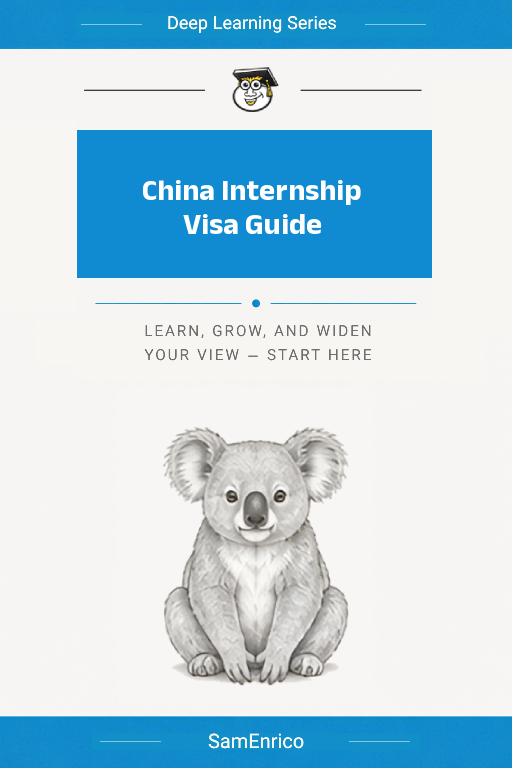
China Internship Visa Guide eBook
Secure internship visa or permission through unive
Secure internship visa or permission through university and employer sponsorship while studying.
Formats
Free sample
Chapter 1: The Deportation Warning...--The email arrived at 11:47 PM on a Tuesday. Liu Wei, the International Student Office coordinator at a top Shanghai university, had attached a single PDF. The subject line read: "URGENT: Visa Violation Notice – Li Wei (Student ID: 2024M028)." Li Wei, a 23-year-old master's student from Germany, had been interning at a tech startup in Huangpu District for six weeks. He had told no one at his university. He had assumed that because the internship was unpaid, because it was "just learning," because his supervisor had promised to write him a recommendation letter afterward, that Chinese immigration law would not care.
He was wrong.The PDF was a deportation order. Li Wei had fifteen days to leave China. He would be fined RMB 15,000. His residence permit would be canceled immediately, meaning he could not complete his thesis research. And a note at the bottom of the document, written in cold bureaucratic Chinese, stated that his re-entry would be barred for two years.
Li Wei had not committed a crime. He had not overstayed his visa. He had simply walked into an office building every morning for six weeks, sat at a desk, answered emails, translated documents, and learned how a Chinese startup operated. In any other country, this might have been called initiative. In China, it was called illegal employment.This book exists because of Li Wei and hundreds of students like him who discover too late that China's internship regulations are not suggestions, not gray areas, not bureaucratic formalities to be ignored.
They are laws with teeth, enforced by an immigration system that tracks foreign residents with precision and punishes violations with severity. The purpose of this chapter is not to frighten you into inaction. The purpose is to ensure that when you pursue an internship in China, you do so legally, confidently, and with complete understanding of the risks you face if you choose the wrong path.The Dangerous Assumption That Gets Students Deported Before we examine the specific laws, regulations, and penalties, we must first confront the assumption that underlies nearly every internship-related visa violation in China. That assumption is simple but deadly: "An internship isn't really work."Students from Western countries, particularly the United States, Canada, Australia, and European nations, arrive in China carrying assumptions shaped by their home countries' labor laws. In many Western jurisdictions, unpaid internships exist in a legal gray area.
Short-term work experiences arranged through personal connections rarely trigger government scrutiny. Universities often take a hands-off approach to off-campus activities as long as grades remain acceptable.China is not those countries.The Chinese immigration system draws no meaningful distinction between "internship," "work-study," "part-time job," "volunteering," or "full-time employment" when it comes to enforcement. The only distinction that matters is whether your residence permit has been properly endorsed. If you are performing activities that benefit an employer—answering emails, attending meetings, writing code, translating documents, conducting research, or any other task that would normally be compensated if done by a local employee—you are working in the eyes of Chinese law. Whether you are paid is irrelevant.
Whether you signed a contract is irrelevant. Whether your supervisor promised it was "just for experience" is irrelevant.Consider the case of Sarah Chen (a pseudonym, though her story is documented in immigration appeal records from 2022). Sarah was a Ph D candidate in biochemistry at a Beijing university. She had completed two years of coursework and had begun her dissertation research. Her advisor suggested she spend three months at a partner research institute in Shenzhen to learn a specific laboratory technique not available in Beijing.
The partner institute was a government-affiliated research center. The work was purely academic. No money changed hands. Sarah did not inform her International Student Office because she did not think the arrangement qualified as "employment" that required approval. She simply took a train to Shenzhen, worked in the lab for twelve weeks, and returned to Beijing.When she re-entered Beijing and presented her residence permit at a routine immigration checkpoint, the officer noticed that her permit had not been endorsed for off-campus activities.
Sarah explained that she had been engaged in academic research, not employment. The officer disagreed. Because Sarah had performed tasks that would normally be performed by paid research assistants—running experiments, recording data, maintaining equipment—the immigration authorities classified her activity as illegal employment. She was fined RMB 10,000 and given thirty days to leave the country. Her Ph D was interrupted.
She eventually completed her degree remotely from her home country, but she has not been permitted to return to China for academic conferences or collaborations.The lesson is brutal but clear: Do not assume that your specific circumstances exempt you from the law. The law applies uniformly. The only protection is proper endorsement.The Legal Framework: Article 22 and Its Implications The foundation of China's internship regulation is Article 22 of the Regulations of the People's Republic of China on Administration of the Entry and Exit of Foreigners, a piece of legislation that took effect in 2013 and has been amended several times since. The relevant text states:"Foreigners holding study-type residence permits who have not had their residence permits endorsed with work-study or internship information may not engage in off-campus work-study or internships."The language is unambiguous. There is no exception for "unpaid positions." There is no exception for "positions lasting less than thirty days." There is no exception for "positions arranged by a professor." There is no exception for "positions that are primarily educational." The only exception is the endorsement itself.What does this endorsement look like in practice?
When a student's residence permit is properly endorsed for internship activities, the permit card will contain an additional annotation—typically in Chinese, though sometimes bilingual—stating the name of the employer, the permitted internship location, the duration of the endorsement, and any restrictions (such as maximum weekly hours). This annotation is affixed by the Exit-Entry Administration Bureau of the local Public Security Bureau, often called the PSB Entry-Exit Bureau in everyday conversation among international students.Without this annotation, any off-campus internship activity is technically illegal. With this annotation, the student may legally intern under the specified terms.It is worth emphasizing that the endorsement is employer-specific and location-specific. If you obtain an endorsement to intern at Company A in Beijing, that endorsement does not permit you to intern at Company B in Shanghai. It does not permit you to intern at Company A's Shanghai office if the endorsement specifies Beijing.
It does not permit you to begin an internship at Company A six months after the endorsement's expiration date. The endorsement is a precise legal instrument, and exceeding its terms is treated as seriously as having no endorsement at all.The Three Illegal Activities Framework and Where Internships Fit Chinese immigration law organizes violations into three categories: illegal entry, illegal residence, and illegal employment. Interning without proper endorsement falls under illegal employment, which is defined in Article 43 of the Exit and Entry Administration Law as:Working without a valid work permit or work-type residence permit Working beyond the scope permitted by one's visa or residence permit Working as a foreign student without proper work-study or internship endorsement…
This is the end of the free sample. Get the eBook to keep going. Buy now
About this book
Details
- Author
- Moeller Kalyn
- Publisher
- SamEnrico
- Language
- English
- Genre
- Non-Fiction, Student's Shortcut, Internships
- Released
- 2026-05-30
- Pages (approx.)
- 154
- Available as
- eBook, Audiobook

Read better in the ZLOADR app
Your eBooks on your phone or tablet. Sign in with your SamEnrico account and start reading.
More by Moeller Kalyn
 Russian Oligarch Enemies GuideMoeller Kalyn$11.99
 Compulsive Spending In Retirement HandbookMoeller Kalyn$11.99
 Overcoming Name Amnesia GuideMoeller Kalyn$11.99
 The Beginner Breath VarietiesMoeller Kalyn$11.99
 Section 301 China Tariffs GuideMoeller Kalyn$11.99
 The Opioid Kingpin: The Rise and Fall of the Pain Pill EmpireMoeller Kalyn$11.99
 The Silk Road Heist: How a Teenage Hacker Brought Down a Billion-Dollar EmpireMoeller Kalyn$11.99
 How to Start a Aviation Insurance Business (Beginners Guide)Moeller Kalyn$11.99
 Transportation Product FitMoeller Kalyn$12.99
 Ostomy CareMoeller Kalyn$11.99
You may also like
 Internships For Dubai StudentsFuentes Lindy$11.99
 Master's AI Internship OpportunitiesAbreu Delmy$12.99
 CS Degree Internship Network GuideMckenney Ariel$12.99
 Internship to Income BlueprintKelly Roderick$12.99
 Rwanda Tech Hub InternshipsHawthorne Brian$12.99
 CS Degree Internship AdvantageCagle Elenor$12.99