
Non-FictionSelf-HelpCognitive Restructuring
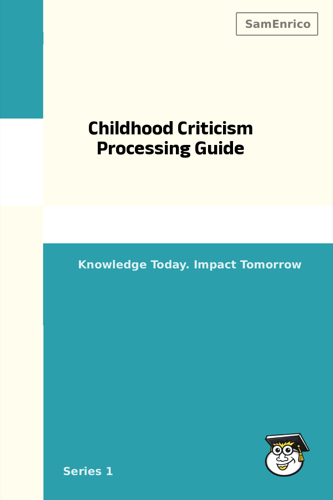
Childhood Criticism Processing Guide eBook
Reinterprets harsh parental feedback as their issu
Reinterprets harsh parental feedback as their issue, not your worth.
Formats
Free sample
Chapter 1: The Gifted Child's Curse--–- You were told you were mature for your age. You were praised for being so easy, so helpful, so quiet. You learned to read a room before you could read a book, to sense a mood shift before you understood what a mood was. And somewhere along the way, you began to believe that your worth depended entirely on your ability to keep everyone around you calm.This is not a badge of honor. It is a survival wound.Let me say that again, because it matters: the traits you were most praised for as a child—your sensitivity to others, your lack of needs, your ability to perform happiness while drowning—were not evidence of advanced development.
They were evidence of a child who learned, very early, that the only safe way to exist was to disappear.Welcome to the first chapter of this guide. Before we can process the criticism you received, before we can hand back the shame that was never yours, we have to understand the soil in which that criticism took root. That soil is the childhood you survived. And the first thing we need to uproot is the myth that you were somehow special in your suffering—that your ability to endure made you strong, rather than quietly fractured.The Compliment That Wasn't Think back. What were the phrases adults used to describe you?"She's so mature for her age.""He's an old soul.""You'd never know anything was wrong with her.""He's so easy—never any trouble.""She's so helpful around the house.""He just seems to understand when to be quiet."If you heard any version of these words, you were being given what I call the "Gifted Child" compliment.
It feels good to hear, especially when the other parts of your childhood felt chaotic, critical, or cold. Finally, someone sees something good in you. Finally, you are being praised instead of picked apart.But here is the truth that no adult told you: that compliment was not about you. It was about how convenient you were making their lives.A truly mature child is not a real thing. Children are supposed to be messy, loud, demanding, curious, selfish, and emotionally unregulated.
That is not pathology—that is development. When a child bypasses those stages and becomes "easy," it is not because they have evolved beyond their years. It is because they have learned, through repetition and fear, that expressing their actual needs is dangerous.Dr. Alice Miller, the Swiss psychoanalyst who spent her career studying childhood trauma, called this phenomenon the "gifted child" syndrome. In her foundational book The Drama of the Gifted Child, she wrote that these children develop an uncanny ability to sense their parents' unconscious needs and to fulfill them.
They become what Miller called a "parental mirror"—reflecting back to the parent whatever image the parent wants to see.The child, meanwhile, loses contact with their own inner reality.Hyper-Attunement: The Survival Superpower There is a term for what you learned to do: hyper-attunement.Hyper-attunement is the intense, involuntary, and exhausting practice of monitoring another person's emotional state in order to predict and prevent danger. It is common in children who grow up in homes with harsh criticism, emotional volatility, neglect, or any environment where the parent's mood is unpredictable and the child's safety depends on keeping that parent stable.Think of it this way: in a healthy home, the parent attunes to the child. The parent notices when the child is hungry, tired, scared, or sad, and responds with care. The child learns that their internal states matter and will be met.In a critical home, the child learns to attune to the parent. The child notices when the parent is tense, tired, angry, or disappointed, and responds by suppressing their own needs to avoid triggering the parent's criticism.
The child learns that their internal states are dangerous and must be hidden.Hyper-attunement is not a choice. It is a biological survival response. Your nervous system learned, the same way it learned to pull your hand from a hot stove, that noticing a shift in your parent's tone or expression could mean the difference between safety and attack.So you got very, very good at it.You could tell by the way your mother set down her coffee cup whether it was a good day or a bad day. You could tell by the pause before your father spoke whether he was going to offer feedback or deliver a verdict. You learned to read micro-expressions—the slight tightening of a jaw, the narrowing of eyes, the sigh that meant disappointment was coming.
You became, in essence, a small, terrified emotional radar system.And here is the cruelest part: because you were never taught that this was a trauma response, you were praised for it. Adults called you empathetic. They called you perceptive. They called you a good listener. They had no idea—and neither did you—that your "empathy" was actually a state of low-grade hypervigilance.
You weren't feeling what others felt because you were emotionally generous. You were feeling what others felt because your survival depended on predicting their next move.The False Self: The Person You Had to Become When a child learns that their authentic self—with its real needs, real emotions, and real desires—is either ignored or punished, they do the only thing a child can do: they build a replacement.This is what Alice Miller called the False Self.The False Self is a performative identity constructed to keep the parent (and later, the world) comfortable. It is the version of you that says "I'm fine" when you are falling apart. It is the version that smiles at criticism and promises to do better. It is the version that laughs at the joke that stung, that agrees with the opinion that crushed you, that apologizes for existing in a way that inconveniences anyone.The False Self is not a lie.
It is a survival strategy. And it works—for a while.In childhood, the False Self protects you. You learn exactly which behaviors earn approval and which trigger criticism. You become an expert at performing goodness, quietness, helpfulness, and achievement. You learn to swallow your anger, bury your disappointment, and silence your questions.
You become, in the eyes of the critical parent, a "good child."But the False Self comes with a devastating hidden cost: you begin to lose touch with your true self.You stop knowing what you actually feel because you are too busy managing what others feel. You stop knowing what you actually want because you are too busy wanting what keeps you safe. You stop knowing who you actually are because you have spent so many years being who you needed to be.And then the criticism comes.Why Criticism Felt Like Annihilation If you grew up with harsh parental criticism, you know that it never felt like simple feedback. It felt like the ground opening beneath you. It felt like a punch to the chest.
It felt like something fundamental in you was being exposed as wrong, broken, or unworthy.That was not an overreaction. That…
This is the end of the free sample. Get the eBook to keep going. Buy now
About this book
Details
- Author
- Mcgovern Angelyn
- Publisher
- SamEnrico
- Language
- English
- Genre
- Non-Fiction, Self-Help, Cognitive Restructuring
- Released
- 2026-06-05
- Pages (approx.)
- 108
- Available as
- eBook, Audiobook

Read better in the ZLOADR app
Your eBooks on your phone or tablet. Sign in with your SamEnrico account and start reading.
More by Mcgovern Angelyn
 Coworker Conflict Stress GuideMcgovern Angelyn$11.99
 Jhansi Fort SiegeMcgovern Angelyn$11.99
 Eisenhower For Career PlanningMcgovern Angelyn$11.99
 Immigrant Construction Tycoon BlueprintMcgovern Angelyn$11.99
 Handling Guilt Trips EffectivelyMcgovern Angelyn$11.99
 Empathy for Exhausted ParentsMcgovern Angelyn$11.99
 Cognitive Ease MarketingMcgovern Angelyn$11.99
 LSE Online Library AccessMcgovern Angelyn$12.99
 HSP Emotion FilterMcgovern Angelyn$11.99
 The Lion of the West: Cyrus the Great and the Birth of LiberalismMcgovern Angelyn$11.99
 Silent Signals: The Unseen Battle of the Cold War’s Secret Radio WarMcgovern Angelyn$11.99
 Letters from the Edge: The Daring Love Story of the First Kiwi Bungy JumpersMcgovern Angelyn$11.99
You may also like
 Hong Kong Handover 1997Dunn Johnnie$11.99
 Zumba For Postnatal Recovery CourseNeal Christian$11.99
 Zumba for BeginnersLadner Nikia$11.99
 YouTube Comment Mining GuideHumes Pandora$12.99
 Worry Box MeditationCarlin Rudy$11.99
 Workplace Stress MeditationNguyen Lynn$11.99
 Workplace Stress and Sleep RepairHawley Ivory$11.99
 Workplace Perfectionism CureDelaney Jeffry$11.99
 Workplace Injustice Anger GuideWallen Isabelle$11.99
 Work Addiction and Burnout LinkGreenwood Ester$11.99
 Women in Yoga and WellnessBeattie Galina$11.99
 Women in Stand Up ComedyChun Evangeline$11.99