
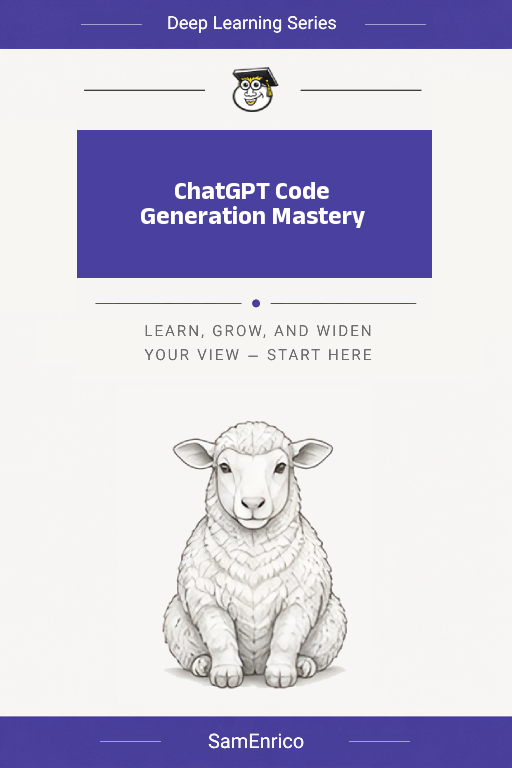
ChatGPT Code Generation Mastery eBook
Write precise prompts to generate functions classe
by Howe Sabina
Write precise prompts to generate functions classes and entire modules with ChatGPT.
Formats
Free sample
Chapter 1: The Vibe Coding Trap--–- Every developer I know has fallen into it. Including me. Especially me.It was a Tuesday afternoon in March, and I was staring at a production outage that I had caused. Not with bad code I wrote myself, but with code I had asked Chat GPT to write for me. The prompt seemed so innocent: "Write a function to process user payments." Three minutes later, I had elegant-looking Python code with clean type hints and what appeared to be proper error handling.
I copied it into our codebase, ran the tests (which passed), and deployed.Six hours later, our payment system was processing transactions twice. The function had a subtle race condition that only appeared under load. The AI had generated code that worked perfectly in isolation but failed catastrophically in production. The worst part? I had no idea how to fix it because I had not written it.
I had become a copy-paste engineer, and my team was paying the price.That was my wake-up call. It was the moment I realized that using Chat GPT for coding was not a shortcut. It was a trap. A trap that promised speed but delivered technical debt. A trap that felt productive but was silently destroying my engineering judgment.This book is the story of how I escaped that trap.
And more importantly, how you can avoid falling into it in the first place.The Rise of the AI-Assisted Developer Let us start with some context. You are reading this book because you have heard the hype. Chat GPT can write code. Git Hub Copilot can autocomplete entire functions. Claude can debug complex errors.
The internet is flooded with videos of developers building entire applications in a single afternoon using nothing but AI prompts.And it is all true. Sort of.The large language models of today—GPT-4, GPT-5, Claude 3, and their competitors—are genuinely impressive. They have been trained on billions of lines of code from public repositories, documentation, forums, and tutorials. They have seen more code than any human could read in a thousand lifetimes. They can generate functions, classes, modules, and even entire microservices in seconds.But here is what the hype does not tell you.
Those impressive demos are carefully curated. They showcase the 10% of AI outputs that work beautifully while hiding the 90% that contain subtle bugs, security vulnerabilities, or architectural flaws. The viral tweet about "building a startup in one weekend with Chat GPT" does not include the three weeks of debugging that followed.The current state of AI code generation is best described as "dangerously competent." The code looks right. It reads right. It passes the initial tests.
But it fails in ways that are uniquely difficult to diagnose because you did not write it. You do not know what assumptions the AI made. You do not know what edge cases it silently ignored. You do not know what security vulnerabilities it inherited from the training data.This is not a condemnation of the technology. It is a call to maturity.
AI coding tools are here to stay, and they will only get more powerful. But using them effectively requires a completely different mindset than most developers have adopted.The Snippet Mentality and Why It Fails The most common way developers use Chat GPT is what I call the "Snippet Mentality." You have a problem. You type a vague prompt into Chat GPT. You get back a code snippet. You copy it.
You paste it. You move on.This feels productive. You solved your problem in thirty seconds instead of ten minutes. But you have actually created a larger problem that will surface later. Here is why.First, snippets have no context.
When Chat GPT generates a function in isolation, it does not know about your codebase's patterns, naming conventions, error handling strategies, or logging requirements. The function will work in isolation but will feel foreign when integrated. It will use different variable naming than your other functions. It will handle errors differently. It will log differently.
Over time, your codebase becomes a patchwork of inconsistent styles, each maintained by a different version of an AI that never talked to itself.Second, snippets bypass your engineering judgment. When you write code yourself, you think about edge cases. You consider performance implications. You question your assumptions. When you copy a snippet, you skip all of that.
The code looks correct, so you assume it is correct. This is a cognitive bias called "automation bias"—the tendency to trust automated systems even when they are wrong. And Chat GPT is wrong more often than it appears.Third, snippets accumulate technical debt at an accelerated rate. A 2019 study from the University of Cambridge found that code written using AI assistants had 40% more security vulnerabilities than human-written code. A 2023 study from Stanford found that developers using AI assistants wrote code with more bugs, not fewer, because they spent less time reviewing the generated code.
The AI was not making them faster. It was making them sloppier.Fourth, snippets prevent learning. The process of struggling through a problem is how you build mental models of how code works. When you outsource the struggle to an AI, you outsource the learning too. You become dependent on the tool, unable to function when the tool fails.
And the tool will fail. Always.The Vibe Coding Trap Defined I have a name for this pattern of behavior. I call it the Vibe Coding Trap.Vibe coding is what happens when you stop engineering and start guessing. Instead of writing precise, deterministic prompts, you write what feels right in the moment. "Make a login page." "Write a function to sort stuff." "Fix this error please." These prompts feel productive because they require almost no cognitive effort.
You just vibe along, letting the AI figure out what you meant.But here is what happens when you vibe code.You generate a function. It works for the happy path but fails silently for edge cases. You do not notice because you only tested the happy path. The function goes to production.Two weeks later, a user enters a null value. The function crashes.
You debug. You realize the AI assumed the input would never be null. You add a null check. You redeploy.One week later, a user enters a value that triggers a recursive call deeper than the recursion limit. The function crashes again.
You debug again. You realize the AI did not consider recursion depth. You rewrite the function iteratively.One month later, a security audit reveals that the function is vulnerable to injection attacks. The AI used string concatenation instead of parameterized queries. You rewrite the function again.By the time you have fixed all the issues, you have spent more time debugging and rewriting than you would have spent writing the function correctly from scratch.
But worse, you have introduced three production incidents that damaged user trust and consumed your team's incident response bandwidth.The Vibe Coding Trap looks like productivity but delivers technical debt. It feels like speed but moves you backward.The Five Signs You Are Already in the Trap Before we go further, let me…
This is the end of the free sample. Get the eBook to keep going. Buy now
About this book
Details
- Author
- Howe Sabina
- Publisher
- SamEnrico
- Language
- English
- Genre
- Non-Fiction, AI Operator
- Released
- 2026-05-29
- Pages (approx.)
- 139
- Available as
- eBook, Audiobook

Read better in the ZLOADR app
Your eBooks on your phone or tablet. Sign in with your SamEnrico account and start reading.
More by Howe Sabina
 Contract Abstraction for In House CounselHowe Sabina$11.99
 Teacher Imposter Syndrome FixHowe Sabina$11.99
 Lenin AprilHowe Sabina$11.99
 Diarrhea in PregnancyHowe Sabina$11.99
 Sleep Consolidates Memory GuideHowe Sabina$11.99
 Parent Burnout PreventionHowe Sabina$11.99
 The Eighty Years WarHowe Sabina$11.99
 Vision Fast Leadership CourseHowe Sabina$11.99
 Listening to Suicidal FeelingsHowe Sabina$11.99
 The Lioness of Nubia: Amanishakheto and the Glory of KushHowe Sabina$11.99
 The Last Out: Kirk Gibson’s Impossible 1988 Walk-OffHowe Sabina$11.99
 Echoes of the Fire Mountain: The Scientist Who Listened to a VolcanoHowe Sabina$11.99
You may also like
 AI Presentation WorkbookSommers Tonda$11.99
 PowerPoint Copilot MasteryConway Lanita$11.99
 Branded AI DecksWindham Loni$11.99
 AI Presentation CourseGrooms Olin$11.99
 AI Presentation CertificationBlank Dolly$11.99
 AI Deck Version ControlMedley Lorina$11.99
 AI Deck Update AutomationFraser Tresa$11.99
 AI Deck Myths DebunkedCrittenden Romelia$11.99
 AI Deck Customization GuideDove Hannelore$11.99
 AI Bullet to Slide ConverterKohn Eloisa$11.99
 AI Deck Notes CreatorBarela Sunday$11.99
 AI Deck Outline GeneratorAshmore Morgan$11.99