
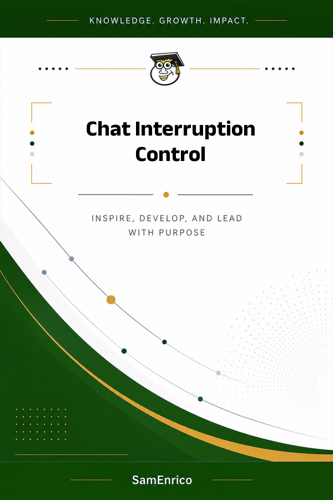
Chat Interruption Control eBook
Use status indicators and scheduled deep work hour
Use status indicators and scheduled deep work hours in team messaging apps.
Formats
Free sample
Chapter 1: The Twenty-Three Minute Heist--–- A senior software engineer once told the author about his most productive day in months. It was not a day when he wrote brilliant code or solved a long-standing architectural problem. It was not a day when he received a promotion or closed a difficult deal. It was the day the company's chat server went down for six hours. “I got more done in those six hours than in the previous two weeks,” he said.
“I didn't realize how much context switching was costing me until the switch was gone.”The author has heard this story in various forms from dozens of professionals across industries. A marketing director who turned off Slack for a morning and completed a quarter's worth of campaign planning. A nurse manager who silenced her pager for two hours and finally finished the staffing schedule that had been hanging over her head for weeks. A lawyer who closed his firm's internal chat app for an afternoon and wrote a brief that his partners called “the best work you've ever done.” The common thread is not talent or intelligence or work ethic. The common thread is interruption.
Or rather, the absence of it.This chapter is about what happens when the chat bubble appears. It is about the hidden costs that most workers never calculate, the cognitive taxes they pay dozens of times per day without ever seeing the receipt. The author will show you exactly what constant interruption is doing to your focus, your work quality, your stress levels, and your team's bottom line. The numbers are staggering. The research is irrefutable.
And the fix is already in your hands.The Context Switching Tax When a worker is interrupted, they do not simply lose the time of the interruption itself. That would be bad enough. A thirty-second chat notification takes thirty seconds to read and dismiss. But the real cost is what happens after. The worker must return to their previous task.
They must remember where they were. They must rebuild the mental context that was shattered by the notification. This is called the context switching cost, and it is the single largest drain on knowledge worker productivity that no one is measuring.The research is sobering. Gloria Mark, a professor at the University of California Irvine who has studied workplace interruptions for over two decades, found that after a brief interruption, it takes an average of twenty-three minutes to fully return to a complex task. Twenty-three minutes.
That is not the time to glance at a message and glance back. That is the time to re-enter the state of deep concentration where your best work happens. A single chat notification can cost nearly half an hour of productivity.But here is where the math becomes terrifying. Most knowledge workers are not interrupted once per day. The University of California Irvine study found that the average office worker is interrupted every eleven minutes.
A study of software developers found that they average only ten minutes of uninterrupted work per hour. Let the author do the math for you. If you are interrupted every eleven minutes, and each interruption costs twenty-three minutes of recovery time, you are spending more time recovering from interruptions than you are actually working. Your day is not eight hours of work punctuated by interruptions. Your day is eight hours of interruption recovery punctuated by brief moments of panicked work.The author has run this calculation with hundreds of teams.
The response is always the same. First, disbelief. Then, a quiet dawning horror. Then, anger. Because the workers already knew.
They felt it. They just did not have the numbers.Consider an organization with one hundred knowledge workers. If each worker loses just two hours per day to interruption recovery (a conservative estimate given the every-eleven-minutes finding), that is two hundred hours per day. Over a two hundred-fifty-day working year, that is fifty thousand hours of lost productivity. At an average loaded cost of seventy-five dollars per hour, that is nearly four million dollars per year.
The equivalent of fifteen full-time employees. Doing nothing. Recovering from chat notifications.The Myth of Multitasking The author has never met a worker who claims to be bad at multitasking. Everyone believes they are the exception. The software engineer who can answer chat while debugging.
The project manager who can write emails while listening to a status update. The executive who can skim messages during a strategy presentation. They are not exceptions. They are victims of a cognitive illusion.The human brain cannot perform two complex tasks simultaneously. This is not an opinion.
It is a finding from functional magnetic resonance imaging studies. When a person attempts to multitask, the brain does not process both tasks at once. It switches rapidly between them. Each switch carries a cost. The brain activates different regions for different tasks, and the transition from one region to another consumes metabolic energy and time.
Workers who multitask are not being more productive. They are being more tired.The author has watched this play out in real time. A designer working on a complex interface. A chat notification appears. The designer glances at it, answers briefly, and returns to the design.
From the outside, it looks like a ten-second interruption. But inside the designer's brain, something more costly has happened. The neural network that was holding the design's information has been partially dismantled. The designer must rebuild it. The designer may not even notice the rebuild.
But the design takes longer. The quality suffers. The designer feels vaguely frustrated without knowing why.The research on multitasking has another layer that is even more unsettling. Chronic multitaskers are not getting better at multitasking. They are getting worse at focusing.
A Stanford University study compared heavy multitaskers to light multitaskers on a series of attention tests. The heavy multitaskers performed worse on every metric. They were more easily distracted. They were worse at ignoring irrelevant information. They were less able to switch between tasks efficiently.
The researchers concluded that heavy multitaskers have “developed a broader attention span” that is actually a deficit. They are not better at doing many things at once. They are worse at doing one thing at a time.The Anxiety of the Unread Badge The author has a confession. She used to keep her chat notifications on all the time. She believed that responsiveness was a virtue.
She believed that quick replies signaled reliability. She believed that ignoring a message was rude. Then she noticed something strange. On weekends, when she deliberately did not open her work chat, she felt lighter. Her shoulders dropped.
Her breathing slowed. Her thoughts were clearer. The chat notifications were not just interrupting her work. They were interrupting her nervous system.Chat interruptions are not neutral events. They carry an emotional charge.
An unread message badge creates a state of anticipatory anxiety. The worker wonders: who is messaging? Is it urgent? Is it a problem? Is it my manager?
Is it about the thing I was worried about? This anxiety persists even when the worker chooses not to check the message. Cal Newport, the computer scientist who coined the term…
This is the end of the free sample. Get the eBook to keep going. Buy now
About this book
Details
- Author
- Ortega Guadalupe
- Publisher
- SamEnrico
- Language
- English
- Genre
- Non-Fiction, Self-Help
- Released
- 2026-06-07
- Pages (approx.)
- 103
- Available as
- eBook, Audiobook

Read better in the ZLOADR app
Your eBooks on your phone or tablet. Sign in with your SamEnrico account and start reading.
More by Ortega Guadalupe
 NVC for StepfamiliesOrtega Guadalupe$11.99
 Migraine Supplement GuideOrtega Guadalupe$11.99
 Collaborative Documentation GuideOrtega Guadalupe$11.99
 Night Binge Eating GuideOrtega Guadalupe$11.99
 Stress and Menstrual DisordersOrtega Guadalupe$11.99
 Duolingo Language InfluencerOrtega Guadalupe$11.99
 School Age Nap Needs GuideOrtega Guadalupe$11.99
 Blue Zone Friendship QualityOrtega Guadalupe$11.99
 The Vanishing of Flight 1956: The Pilot Who Disappeared Mid-AirOrtega Guadalupe$11.99
 The Marble Masters: Carving the Soul of Renaissance FlorenceOrtega Guadalupe$11.99
 Botticelli’s Venus: Birth of the Renaissance IdealOrtega Guadalupe$11.99
 How to Start a Hobby in DIY audioOrtega Guadalupe$11.99
You may also like
 Workplace Stress MeditationNguyen Lynn$11.99
 Volcano Monitoring ScientistCox Alexis$11.99
 The Tech Professional NetAguiar Nevada$11.99
 The Morning Metta RitualCanales Anya$11.99
 The Chunking Memory TechniqueClanton Hyacinth$11.99
 The Beginner Mistake FixAmmons Cassondra$11.99
 Surrendering to What IsGrimm Reatha$11.99
 Self Hypnosis for Fear of FireBillups Eli$11.99
 Road Rage for Professional DriversBrackett Janise$11.99
 Psychiatric Ward Nurse StressDunning Wyatt$11.99
 Observation vs Evaluation NVCTimmons Alda$11.99
 Networking for Nonprofit ProfessionalsPoole Jesse$11.99