
Non-FictionSelf-HelpCharityGiving
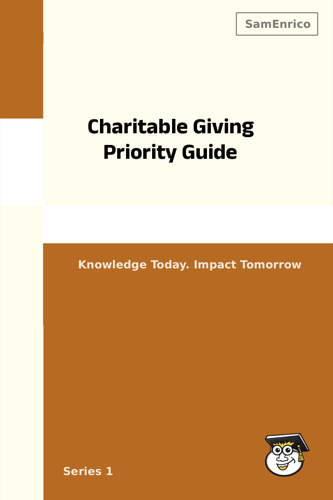
Charitable Giving Priority Guide eBook
Sort donation requests using mission alignment and
Sort donation requests using mission alignment and urgency framework.
Formats
Free sample
Chapter 1: The Inbox Tsunami--You wake up at 6:47 AM. Before you’ve had coffee, before you’ve kissed your partner goodbye, before you’ve remembered what day it is, your phone buzzes. An email. Subject line: “URGENT: Match expires at midnight.” You swipe it away. Another buzz.
“Children will go hungry without you.” Another. “Your last gift saved lives—can we count on you again?” By 7:15 AM, you have donated $500 to three different organizations. You cannot remember their names by lunch. By dinner, you have received twelve more requests. By bedtime, you feel exhausted, vaguely guilty, and somehow less generous than when you woke up.This is not a failure of your character.
This is a failure of your system.The modern donor is drowning. Not in need—there has always been need—but in requests. Email, social media, direct mail, text messages, phone calls, gala invitations, peer-to-peer fundraisers, Giving Tuesday campaigns, end-of-year appeals, monthly giving drives, capital campaigns, emergency disaster relief funds, and the quiet, persistent guilt of a friend who says, “It’s for a good cause.” Each request is engineered. Each deadline is calculated. Each image is selected by a team of professional fundraisers who know exactly what they are doing: triggering your amygdala, bypassing your prefrontal cortex, and extracting a donation before you have time to think.This chapter is not a critique of fundraisers.
Fundraisers are doing their job. This chapter is a critique of you—not your intentions, which are noble, but your process, which is broken. You are giving reactively. And reactive generosity is not generosity at all. It is a tax on your attention.The Diagnosis: Why the Urgent Always Beats the Important In 2011, behavioral economists Daniel Kahneman and Amos Tversky (whose work would later win a Nobel Prize) identified a cognitive bias they called the “scarcity effect.” When humans perceive that something is limited—time, money, spots, matching funds—they assign it disproportionate value.
A $100 donation requested with a deadline feels more urgent than a $1,000 donation requested without one, even if the latter achieves ten times the impact.Charities know this. They have internalized it. A 2019 study of nonprofit fundraising appeals found that 73% of all emails sent during December contained at least one scarcity trigger: “only 5 spots left,” “matching grant expires at midnight,” “last chance to give.” These are not lies. They are framing. And framing works.Consider the neuroscience.
When you read the words “URGENT” or “last chance,” your amygdala—the ancient, reptilian part of your brain responsible for fear and survival—lights up like a Christmas tree. Simultaneously, your prefrontal cortex, the seat of rational planning and long-term thinking, dims. You are literally less intelligent when you feel urgency. This is not a metaphor. This is a measurable physiological response.The result is what this book calls the Scarcity Trap: a cycle in which donors give impulsively to loud, immediate asks, then feel compassion fatigue, then give less overall, then feel guilty, then give impulsively again.
Repeat ad infinitum.The Data on Reactive Giving The Indiana University Lilly Family School of Philanthropy has tracked donor behavior for over two decades. Their findings are sobering. Reactive donors—defined as those who give primarily in response to direct appeals rather than a personal strategic plan—give 40% less over a five-year period than strategic donors. But the numbers get worse. After a major disaster appeal (think hurricanes, earthquakes, or global pandemics), reactive donors are 60% more likely to stop giving entirely for a period of six to eighteen months.
Fundraisers call this “compassion fatigue.” The donors themselves call it “burnout.”There is a second, less visible cost: Philanthropic Fragmentation. When you say yes to every ask, your money scatters across dozens of causes. You give $50 to a food bank, $100 to a cancer research foundation, $25 to a political campaign, $500 to a disaster relief fund, and $1,000 to your alma mater. Each gift is defensible in isolation. Together, they accomplish nothing.
No single cause receives enough capital to move the needle. The food bank cannot hire a new driver. The cancer researchers cannot fund a clinical trial. The disaster relief fund spends more on administrative overhead processing small donations than it delivers in aid.Fragmentation is the silent killer of philanthropic impact. And it is a direct consequence of reactive giving.The Difference Between Responding and Executing Let us pause here and make a distinction that will shape the rest of this book.Responding is what you do when an email lands in your inbox.
You read the subject line. You feel the tug of urgency. You click a button. You are done. The transaction lasts thirty seconds.
The guilt lasts a little longer.Executing is what you do when you have a plan. You wake up knowing your priorities. You have a budget. You have a list of pre-vetted organizations. You have a framework for sorting new requests.
When an email arrives, you do not feel the tug—or rather, you feel it and you set it aside. You run the request through your system. You decide. You act. The whole process takes ten minutes, and at the end, you feel clarity, not guilt.Most donors are responders.
This book will make you an executor.The Reactivity Self-Assessment Before we go any further, you need to know where you stand. Below is the Reactivity Self-Assessment, a ten-question diagnostic tool that will score your “reactive generosity index” from 0 (completely strategic) to 100 (completely chaotic). Answer honestly. No one is watching.*For each statement, score yourself: 0 = Never, 1 = Rarely, 2 = Sometimes, 3 = Often, 4 = Always.*I have donated to a charity within the last thirty days without first checking its financial health.I have donated because an email said “URGENT” or “matching grant expires soon.”I have donated to a friend’s fundraiser without understanding the organization.I have donated to a disaster relief appeal for a region I have never visited or researched.I have felt guilty after donating because I was not sure the money would be well spent.I have donated to more than ten different charities in a single year.I cannot name my top three philanthropic priorities without checking my records.I have donated to a cause because someone asked me in person, not because I planned it.I have said “yes” to a request and later thought, “I should have said no.”I have no written budget for my annual giving.Scoring: Add your total. 0-15: Low reactivity (strategic donor).
16-30: Moderate reactivity (occasionally impulsive). 31-40: High reactivity (reactive donor). 41-50: Extreme reactivity (your inbox owns you).If you scored above 30, you are in the majority. Most donors do. But awareness is the first step toward change.The Last Ten Gifts Exercise Now that you have a sense of your reactivity, let us make it concrete.
Take out a piece of paper or open a blank document. Create three columns:| Who Asked? | Why I Said Yes | What Was the Outcome? |List your last ten donations. Not your ten largest—your last ten.
Work backward from today. For each gift, write down:The name of the organization or individual who requested the donation.The specific reason you said yes (e.g., “I felt guilty,” “The email had a matching grant,” “A…
This is the end of the free sample. Get the eBook to keep going. Buy now
About this book
Details
- Author
- Hillman Maren
- Publisher
- SamEnrico
- Language
- English
- Genre
- Non-Fiction, Self-Help, Charity, Giving
- Released
- 2026-06-09
- Pages (approx.)
- 126
- Available as
- eBook, Audiobook

Read better in the ZLOADR app
Your eBooks on your phone or tablet. Sign in with your SamEnrico account and start reading.
More by Hillman Maren
 Legal Networking GuideHillman Maren$11.99
 Newborn Sleep Patterns HandbookHillman Maren$11.99
 Self Esteem for Seniors with Hearing LossHillman Maren$11.99
 Hair Loss From ChemotherapyHillman Maren$11.99
 The Frozen Frontier: Canada's Arctic PioneersHillman Maren$11.99
 Understanding Mental Retardation Psychosis MacroorchidismHillman Maren$17.99
 UN Sustainable Development Goals CareersHillman Maren$12.99
 Promotion Business Case For EngineersHillman Maren$12.99
 How to Start a Pea Splitters Business (Beginners Guide)Hillman Maren$11.99
 Shredding Truck OperatorHillman Maren$11.99
You may also like
 Hong Kong Handover 1997Dunn Johnnie$11.99
 Zumba For Postnatal Recovery CourseNeal Christian$11.99
 Zumba for BeginnersLadner Nikia$11.99
 YouTube Comment Mining GuideHumes Pandora$12.99
 Worry Box MeditationCarlin Rudy$11.99
 Workplace Stress MeditationNguyen Lynn$11.99
 Workplace Stress and Sleep RepairHawley Ivory$11.99
 Workplace Perfectionism CureDelaney Jeffry$11.99
 Workplace Injustice Anger GuideWallen Isabelle$11.99
 Work Addiction and Burnout LinkGreenwood Ester$11.99
 Women in Yoga and WellnessBeattie Galina$11.99
 Women in Stand Up ComedyChun Evangeline$11.99