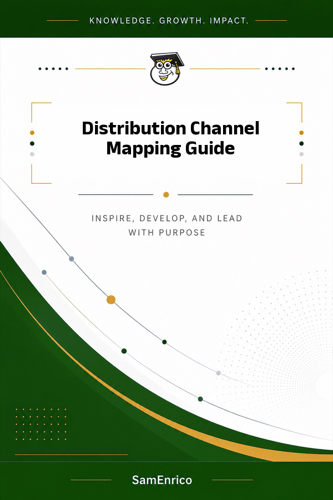
Channel Positioning Map eBook
Plot competitors across direct, retail, wholesale,
Plot competitors across direct, retail, wholesale, and digital distribution channels.
Formats
Free sample
Chapter 1: The Day Your Channels Declared War--The email arrived at 6:47 AM on a Tuesday.Subject line: Urgent – Price Violation Notice.You opened it expecting the usual – a routine alert from a junior analyst. Instead, your largest retail partner was threatening to drop your entire category by Friday. Their reason? Your DTC website had run a 15% off promotion for email subscribers, and a customer had shown them the screenshot. Meanwhile, your Amazon seller central dashboard was flashing red: the buy box had been suppressed on your flagship product because an unauthorized reseller was listing it below MAP.
And in the wholesale division, your oldest distributor had just cancelled their Q4 order, citing "channel confusion" among their retail customers.It was 6:48 AM. You hadn't had coffee yet. And your channels had just declared war on each other – and on you.This is not a hypothetical scenario. It happens every day to founders, brand strategists, and heads of sales across every industry. The CPG brand that wakes up to find its DTC discount undercutting its biggest grocery partner.
The electronics company whose Amazon listings are a price war wasteland. The fashion label whose wholesale partners are selling last season's inventory at 70% off, destroying the brand's premium positioning everywhere else. The beauty brand that launched on Tik Tok Shop only to discover that every other channel is now demanding the same promotional terms.If any of this sounds familiar, you are not alone. You are also not failing. You are experiencing what this book calls the Channel Overlap Crisis – a structural condition of modern commerce where your own distribution channels compete with each other, eroding margins, confusing customers, and exhausting your team.The old rules of channel strategy no longer apply.
For decades, the conventional wisdom was simple: pick a primary channel and dominate it. Direct-to-consumer brands were told to avoid retail. Retail brands were warned away from DTC. Wholesale was for scale, not brand building. Marketplaces were for commodity products, not premium positioning.
These rules were never universally true, but they provided a sense of order – a way to think about distribution without constant anxiety.That era is over.Today, customers expect to find you everywhere – on your own website, on Amazon, in Target, at a boutique across town, and on a Tik Tok live stream at 2 PM on a Tuesday. They will discover your brand on Instagram, research it on You Tube, compare prices on Google Shopping, read reviews on Reddit, try it at a friend's house, and buy it from whichever channel offers the best combination of price, speed, and convenience. They do not care about your channel strategy. They do not care about your partner agreements. They care about getting what they want, when they want it, at a price that feels fair.And when your channels are misaligned, the customer feels it immediately.
They see a lower price on Amazon and wonder why your own website is more expensive. They find a product in a retail store, check the price online, and walk out to buy it from a marketplace instead – leaving the retailer angry at you. They receive a promotional email for a discount that their local store won't honor. They return a product bought on your DTC site to a wholesale partner's location, creating a returns nightmare that no one anticipated.These are not edge cases. These are the everyday realities of multi-channel commerce in 2026.
And they are happening to you whether you have one channel or ten.The Myth of Channel Selection Here is the first truth this book will teach you: there is no such thing as a single-channel brand anymore.Oh, you might think you are a DTC brand. You might have built your entire business on your own website, your own email list, your own social following. But your customers are still finding you on Amazon – even if you don't sell there. They are still seeing your products on Tik Tok Shop – listed by resellers you've never heard of. They are still walking into retail stores and asking for your product – creating demand that someone else will fulfill if you won't.The moment your brand has any awareness at all, you exist in every channel.
The only question is whether you control that existence or whether it controls you.Consider Nike. For years, Nike was the poster child for selective distribution. They sold through premium retail partners (Foot Locker, Dick's Sporting Goods) and their own flagship stores, but they famously avoided Amazon. In 2017, under pressure from investors, Nike relented and began selling a limited selection on Amazon. The results were disastrous – not because Amazon is a bad channel, but because Nike's wholesale partners immediately rebelled.
The same sneakers available on Amazon for the same price were suddenly competing with the same sneakers in Foot Locker, where Nike had invested millions in exclusive displays and associate training.Nike pulled out of Amazon in 2019. The headlines celebrated it as a victory for brand control. But here is what the headlines missed: Nike didn't exit Amazon because Amazon was failing. Nike exited Amazon because their other channels were failing because of Amazon. The problem was never the marketplace.
The problem was the lack of a coherent map that showed how each channel should relate to the others.Or consider Peloton. The exercise brand built a billion-dollar business on direct-to-consumer sales – expensive bikes and treadmills sold exclusively through their own website and showrooms. Then the pandemic hit, demand surged, and Peloton scrambled to add retail partnerships with Amazon and Dick's Sporting Goods. The result? Channel chaos.
Customers who had paid full price on Peloton's website saw lower prices on Amazon. Retail partners who had invested in floor space saw Peloton's own showrooms offering better service. And when demand normalized after the pandemic, Peloton was left with a multi-channel mess they have not yet untangled.Nike and Peloton are not cautionary tales about the dangers of multi-channel distribution. They are cautionary tales about the dangers of unmapped multi-channel distribution. Neither company had a visual representation of where their competitors sat, where their own channels overlapped, or where the white space for profitable growth actually existed.
They made channel decisions reactively – responding to investor pressure, competitive moves, or short-term sales spikes – rather than strategically.This book will give you the map they lacked.The Five Symptoms of the Channel Overlap Crisis Before we build that map, you need to diagnose whether you are already in crisis. Most brands are. They just don't know it yet because the symptoms have become normalized – the background noise of modern commerce.Here are the five unmistakable symptoms of the Channel Overlap Crisis. If you recognize any of them, your channels are at war.Symptom One: Confused Pricing You have different prices on different channels for the same product. Maybe your DTC site has a permanent 10% discount for email subscribers.
Maybe your Amazon listing is competitively priced but your wholesale partners demand MAP compliance. Maybe your retail partners are running promotions that undercut everyone else.Confused pricing is not just a margin problem. It is a trust problem. When customers see inconsistent prices, they stop believing that your brand has any integrity. They learn to…
This is the end of the free sample. Get the eBook to keep going. Buy now
About this book
Details
- Author
- Guillory Jacquelyne
- Publisher
- SamEnrico
- Language
- English
- Genre
- Non-Fiction, Strategic Atlas, Channel Strategy
- Released
- 2026-06-08
- Pages (approx.)
- 149
- Available as
- eBook, Audiobook

Read better in the ZLOADR app
Your eBooks on your phone or tablet. Sign in with your SamEnrico account and start reading.
More by Guillory Jacquelyne
 Improv for Social AnxietyGuillory Jacquelyne$11.99
 Fired for Misconduct GuideGuillory Jacquelyne$11.99
 Almoravid Invasion ImpactGuillory Jacquelyne$11.99
 Joyful Learning GuideGuillory Jacquelyne$11.99
 The Investor Difficult TalkGuillory Jacquelyne$11.99
 Self Esteem and Social MediaGuillory Jacquelyne$11.99
 Public Speaking for Technical ExpertsGuillory Jacquelyne$11.99
 The Golden Quill of the Nile: Poets of Ancient KemetGuillory Jacquelyne$11.99
 Brewmasters of the Black Forest: The Ale That Defied EmpiresGuillory Jacquelyne$11.99
 How to Produce Computer CleanersGuillory Jacquelyne$11.99
 A Collector's Handbook to the Sunbeam-talbot Ten (1938-40)Guillory Jacquelyne$11.99
 How to Produce Outdoor BenchesGuillory Jacquelyne$11.99