
Non-FictionInformativeEducational
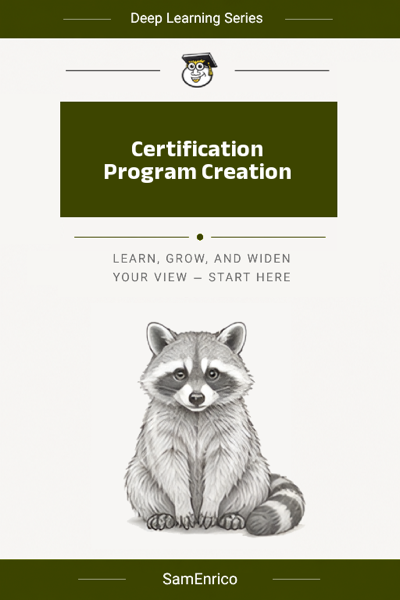
Certification Program Creation eBook
A Coursebook on Certification Program Creation
A Coursebook on Certification Program Creation
Formats
Free sample
Chapter 1: The Readiness Reckoning–- The year is 2017. A well-respected medical association with over 40,000 members decides to create a new certification for hospital safety officers. The board is unanimous. The members have been asking for it. The budget is approved for $450,000.
A prestigious consulting firm is hired. Job task analysis is conducted across fourteen focus groups. Four hundred and twenty-six subject matter experts review the exam items. Psychometricians validate the cut score. The certification launches with a standing ovation at the annual conference.Eighteen months later, exactly 127 people have earned the credential.The association has spent 612,000(theoriginalbudgetplusoverruns).Theyhavesold612,000 (the original budget plus overruns).
They have sold 612,000(theoriginalbudgetplusoverruns).Theyhavesold31,750 worth of certifications. Their break-even point was 2,100 certifications. At the current rate of adoption, they will break even sometime after the heat death of the universe.What went wrong? Everything. But most fundamentally, they never asked the question that should have been asked before the first dollar was spent.
They never asked: "Does the market actually want this certification?"The Unspoken Epidemic of Certification Failure The medical association's story is not unusual. It is not even remarkable. It is, in fact, almost boring in its predictability. Across industries and around the world, organizations lose tens of millions of dollars annually on certification programs that fail because no one had the courage to ask the hard questions at the beginning.Let me share data that will shock you. The Institute for Credentialing Excellence, which has no incentive to highlight failure, estimates that 58 percent of new certification programs launched between 2015 and 2020 failed to reach their five-year revenue targets.
Of those, 43 percent were discontinued entirely within three years. The median certification program, across all industries and organization types, sells fewer than 400 credentials annually. That is not a program; that is a hobby with a website.The financial carnage is staggering. The average failed certification program costs 310,000todevelop(includingjobtaskanalysis,itemwriting,psychometrics,technologysetup,andlaunchmarketing)and310,000 to develop (including job task analysis, item writing, psychometrics, technology setup, and launch marketing) and 310,000todevelop(includingjobtaskanalysis,itemwriting,psychometrics,technologysetup,andlaunchmarketing)and85,000 annually to operate (test delivery, customer support, recertification tracking, ongoing marketing). By the time most organizations realize they have failed, they have spent half a million dollars and three years of staff time.
The opportunity cost is even larger: that half a million dollars and three years could have built a thriving certificate program, a digital badge system, a conference, a research institute, or any number of other initiatives that might have generated revenue and impact.But the financial cost, as painful as it is, is not the worst part. The worst part is the human cost. The staff who believed in the certification. The board members who championed it. The subject matter experts who donated hundreds of hours to writing items and serving on panels.
The early adopters who paid for a credential that lost its value when the program collapsed. All of those people invested their time, money, and reputations in a venture that was doomed from the start because no one asked the right questions at the beginning.This chapter exists to ensure that you are not one of those people.The Five Questions That Separate Winners from Losers Before you spend a single dollar on certification development, before you write a single exam item, before you form a single committee, you must answer five questions. These questions are not theoretical. They are not optional. They are not "nice to have." They are the difference between building a certification that prints money for a decade and building a certification that becomes a cautionary tale in someone else's book.I have seen over three hundred certification programs in my career.
I have consulted on the launches of sixty-three of them. I have watched twenty-one fail completely, twelve struggle along at viability, and thirty succeed beyond expectations. The difference between failure and success comes down to these five questions.Here they are. Answer them honestly, with data, not intuition. If you cannot answer "yes" to all five, stop.
Do not proceed to Chapter 2. Do not pass Go. Do not collect $200. Go build a certificate program or a badge system instead, and return to certification when you can answer yes.Question One: Is There Documented Market Demand from Employers, Not Just Individuals?"I think employers would value this" is not data. "My members keep asking for it" is not data.
"We surveyed our members and 80 percent said they wanted it" is not data. Let me be very clear about why member surveys are nearly useless for predicting certification demand.Members want certification for the same reason I want a gym membership in January: aspiration. They imagine themselves as certified professionals. They imagine the letters after their names. They imagine the respect and the salary bump.
But aspiration is not purchase intent. When you actually ask members to pay 800foranexamand800 for an exam and 800foranexamand150 annually for recertification, their enthusiasm drops dramatically. I have seen member survey "intent to purchase" numbers of 70 percent translate into actual purchase rates of 4 percent. That is not a rounding error; that is a chasm.The only data that matters is documented market demand from employers. Not individuals.
Employers. Because employers pay for certification. Employers list certification as preferred or required in job postings. Employers provide tuition reimbursement for certification exam fees. Employers send their employees to certification training.
Without employer demand, you have a consumer product aimed at individual professionals, and consumer products in the certification space rarely succeed at scale.How do you measure employer demand? You pick up the phone. You call hiring managers. You call human resources directors. You call training and development leaders.
You ask specific, measurable questions:"Would you pay a premium for a candidate who holds this certification, compared to an otherwise identical candidate without it? If yes, what percentage premium?""Would you require this certification for any roles in your organization? If yes, which roles and why?""Would you provide tuition reimbursement for employees seeking this certification? If yes, up to what amount?""Would you encourage or require your current employees to earn this certification? If yes, how would you communicate that expectation?"You need at least fifty of these conversations, across a representative sample of your target employers (by size, geography, industry subsector).
If fewer than 40 percent of employers answer affirmatively to at least two of these questions, you do not have market demand. Stop.I have seen this pattern play out repeatedly. A trade association for supply chain professionals decided to create a certification for logistics managers. Their member survey showed 78 percent interest. The board was thrilled.
They spent $275,000 developing the certification. Then they started calling employers. It turned out that logistics hiring managers cared about one thing: experience. They did not care about certification. They had never asked for it.
They would not pay for it. They would not require it. The association had spent almost three hundred thousand dollars building a product that exactly zero employers wanted. The certification sold 89 copies in two years and was quietly discontinued.Do not let this be you. Call employers before you spend money.
If you are not willing to make fifty phone calls, you are not serious enough about certification to proceed.Question Two…
This is the end of the free sample. Get the eBook to keep going. Buy now
About this book
Details
- Author
- Dugger Elvina
- Publisher
- SamEnrico
- Language
- English
- Genre
- Non-Fiction, Informative, Educational
- Released
- 2026-06-02
- Pages (approx.)
- 153
- Available as
- eBook, Audiobook

Read better in the ZLOADR app
Your eBooks on your phone or tablet. Sign in with your SamEnrico account and start reading.
More by Dugger Elvina
 Student Nutrition for StressDugger Elvina$11.99
 Intermittent Fasting MythsDugger Elvina$11.99
 Landing Page Conversion ValidationDugger Elvina$11.99
 Landlord Tenant Difficult TalksDugger Elvina$11.99
 Accident and Injury Dream WorkDugger Elvina$11.99
 Understanding Bipolar Prodrome ManualDugger Elvina$11.99
 TM for Financial AnalystsDugger Elvina$11.99
 Moroccan Green Tax CreditsDugger Elvina$11.99
 HGH And Sports DopingDugger Elvina$11.99
 Whispers of the Ironwood: The Lumberjack Who Spoke to TreesDugger Elvina$11.99
 The Queen Who Wore No Crown: The Scandalous Rise of Empress Wu ZetianDugger Elvina$11.99
 The Angels of Vukovar: The Medics Who Defied the SiegeDugger Elvina$11.99
You may also like
 Hong Kong Handover 1997Dunn Johnnie$11.99
 Zumba For Postnatal Recovery CourseNeal Christian$11.99
 Zumba for BeginnersLadner Nikia$11.99
 YouTube Comment Mining GuideHumes Pandora$12.99
 Worry Box MeditationCarlin Rudy$11.99
 Workplace Stress MeditationNguyen Lynn$11.99
 Workplace Stress and Sleep RepairHawley Ivory$11.99
 Workplace Perfectionism CureDelaney Jeffry$11.99
 Workplace Injustice Anger GuideWallen Isabelle$11.99
 Work Addiction and Burnout LinkGreenwood Ester$11.99
 Women in Yoga and WellnessBeattie Galina$11.99
 Women in Stand Up ComedyChun Evangeline$11.99