
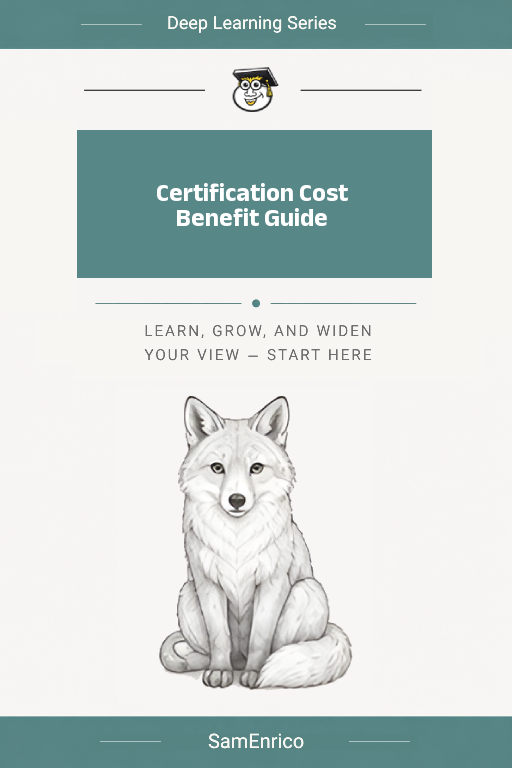
Non-FictionBusiness BriefCost Benefit
Certification Cost Benefit Guide eBook
Calculate ROI of sustainability certifications inc
Calculate ROI of sustainability certifications including premium pricing and market access.
Formats
Free sample
Chapter 1: The $47 Billion Blind Spot--–- In 2025, companies around the world spent an estimated $47 billion on sustainability certifications. That sum exceeds the GDP of more than sixty countries. It is enough to buy every single electric vehicle sold globally that year, twice over. And yet, fewer than one in five of those companies could tell you, with any degree of confidence, whether their certifications actually made them a single dollar of profit.This is not a niche problem for sustainability officers to ponder quietly in annual reports. It is a systemic capital allocation failure that cuts across every industry, every region, and every business model.
From a family-owned coffee roaster in Vermont paying 3,500annuallyfororganiccertification,toamultinationalelectronicsconglomeratespending3,500 annually for organic certification, to a multinational electronics conglomerate spending 3,500annuallyfororganiccertification,toamultinationalelectronicsconglomeratespending15 million on a portfolio of environmental and social labels, the same question haunts conference rooms and spreadsheets alike: Are we investing or just signaling?The answer, for the vast majority, is that they are doing both—without knowing which is which.This book exists because that ambiguity is no longer acceptable. The regulatory landscape has shifted. The consumer has become simultaneously more demanding and more skeptical. And the cost of entry for global supply chains now increasingly requires a certification passport, whether you like it or not. The question is no longer whether to certify.
The question is which certifications will pay you back, which will break even, and which are quietly draining your bottom line.This chapter, and the twelve that follow, will give you a precise, data-driven, and battle-tested framework to answer that question. But before we get to the spreadsheets, the A/B tests, and the decision matrices, we must confront a more fundamental reality: most companies are flying blind on certification ROI. And that blindness is costing them billions.The Certification Paradox: More Trust, Less Clarity Sustainability certifications exist to solve a very specific market failure: information asymmetry. When a company claims its product is "eco-friendly," "sustainable," or "responsibly sourced," consumers have no practical way to verify that claim. They cannot fly to the factory, inspect the supply chain, or audit the labor practices.
They must trust the company. And companies, as a group, have done a terrible job of earning that trust.Enter the third-party certifier. Organizations like the Forest Stewardship Council (FSC), Fair Trade International, B Lab (for B Corp), and the International Organization for Standardization (ISO) step in as trusted intermediaries. They audit, verify, and label. In theory, this solves the information problem.
In practice, it creates a new one: a dizzying proliferation of certifications, each with its own cost structure, audit frequency, consumer recognition, and financial impact.A single product can carry the FSC logo for responsible forestry, the Fair Trade logo for farmer welfare, the Carbon Neutral certification for climate impact, and the B Corp seal for the company behind it. Each of those labels required an application fee, an audit, internal labor hours, and ongoing compliance costs. Each of them signals something slightly different to a slightly different segment of consumers. And each of them may or may not be generating a return.This is the certification paradox: we have more trust infrastructure than ever before, but less clarity on what that infrastructure actually delivers financially.The 2025 systematic review published in Business Strategy and the Environment analyzed 187 peer-reviewed studies on certification outcomes. Its conclusion was stark: while individual certifications often show positive financial effects in isolated case studies, the aggregate picture is one of extreme variance.
Some certifications deliver ROI north of 300 percent. Others consistently destroy value. And the difference is not random. It is predictable based on a handful of variables that most companies never measure.Why Your Current Certification Strategy Is Probably Leaking Money Let me share a story that illustrates the problem better than any statistic. In 2024, a midsized furniture manufacturer in North Carolina—let us call them Heritage Woodworks—approached my research team for help.
They had been FSC certified for eight years. They had paid their annual audit fees, maintained their chain-of-custody documentation, and prominently displayed the FSC logo on every product page and every piece of packaging. They assumed the certification was paying for itself through premium pricing and market access.When we ran the numbers, we discovered something disturbing. Heritage Woodworks had never actually tested whether customers would pay a premium for FSC-certified furniture. They had simply set their prices at the same level as non-certified competitors and assumed the label would drive volume.
But they had no baseline. They did not know how many sales they would lose if they dropped the certification. They did not know how many they would gain if they raised prices. They were spending roughly $47,000 per year on certification costs (audit fees, internal labor, supply chain tracing) with absolutely no data on what they were getting in return.We ran an A/B test on their e-commerce site. For eight weeks, half of their visitors saw the FSC logo on product pages.
Half saw the same product images with the logo removed. The result? No statistically significant difference in conversion rates. Not a single percentage point. Heritage Woodworks had been spending nearly fifty thousand dollars a year on a certification that their customers did not notice, did not care about, and would not pay extra for.The only reason they had not dropped it sooner was fear—fear of losing their wholesale accounts with a few large retailers that required FSC certification for certain categories.
Those accounts represented about 22 percent of their revenue. For those, the certification was essential. For their direct-to-consumer business, it was a pure sunk cost.This is the kind of waste that hides in plain sight. It is not fraud. It is not incompetence.
It is simply the absence of a rigorous ROI framework. And it is everywhere.The Three Value Channels: A New Mental Model To fix this problem, we need a common language for talking about certification returns. Over the course of researching this book and advising dozens of companies, we have identified exactly three ways that a certification can generate financial value. I call them the Three Value Channels. Every certification you hold, or consider holding, should be evaluated against all three.
Most companies evaluate against one or two. That is where the blind spots live.Channel One: Operational Savings. Management system certifications like ISO 14001 (environmental management) and ISO 50001 (energy management) drive value by lowering your operating costs. They force you to measure waste, energy use, water consumption, and material efficiency. When you measure those things, you find savings.
A textile factory that implements ISO 14001 typically reduces energy use by 5 to 15 percent in the first eighteen months. Those savings go straight to the bottom line. This channel is predictable, measurable, and largely independent of customer behavior.Channel Two: Premium Pricing and Volume Lift. Eco-labels like Fair Trade, FSC, and Energy Star drive value by changing customer behavior. Some customers will pay a higher price for a certified product.
Others will choose a certified product over an identical non-certified product at the same price. Both effects increase revenue. This channel is less predictable than operational savings because it depends on category, brand strength, distribution…
This is the end of the free sample. Get the eBook to keep going. Buy now
About this book
Details
- Author
- Burkhart Ulysses
- Publisher
- SamEnrico
- Language
- English
- Genre
- Non-Fiction, Business Brief, Cost Benefit
- Released
- 2026-06-01
- Pages (approx.)
- 155
- Available as
- eBook, Audiobook

Read better in the ZLOADR app
Your eBooks on your phone or tablet. Sign in with your SamEnrico account and start reading.
More by Burkhart Ulysses
 Self Esteem for Age Gap CouplesBurkhart Ulysses$11.99
 Emotional Creativity DevelopmentBurkhart Ulysses$11.99
 Medication Assisted Recovery PrimerBurkhart Ulysses$11.99
 Tenant Screening HandbookBurkhart Ulysses$11.99
 Antwerp Heist TrialBurkhart Ulysses$11.99
 Ukrainian Refugee FamilyBurkhart Ulysses$11.99
 International Sales AccountingBurkhart Ulysses$11.99
 Maharishi Mahesh YogiBurkhart Ulysses$11.99
 The Silent Exodus: How a Forgotten Migration Reshaped the WorldBurkhart Ulysses$11.99
 Silent Diplomacy: The Forgotten Spy Who Saved the Cold WarBurkhart Ulysses$11.99
 How to Become a Rod-mill TenderBurkhart Ulysses$11.99
 How to Produce Step StoolsBurkhart Ulysses$11.99
You may also like
 Hong Kong Handover 1997Dunn Johnnie$11.99
 Zumba For Postnatal Recovery CourseNeal Christian$11.99
 Zumba for BeginnersLadner Nikia$11.99
 YouTube Comment Mining GuideHumes Pandora$12.99
 Worry Box MeditationCarlin Rudy$11.99
 Workplace Stress MeditationNguyen Lynn$11.99
 Workplace Stress and Sleep RepairHawley Ivory$11.99
 Workplace Perfectionism CureDelaney Jeffry$11.99
 Workplace Injustice Anger GuideWallen Isabelle$11.99
 Work Addiction and Burnout LinkGreenwood Ester$11.99
 Women in Yoga and WellnessBeattie Galina$11.99
 Women in Stand Up ComedyChun Evangeline$11.99