
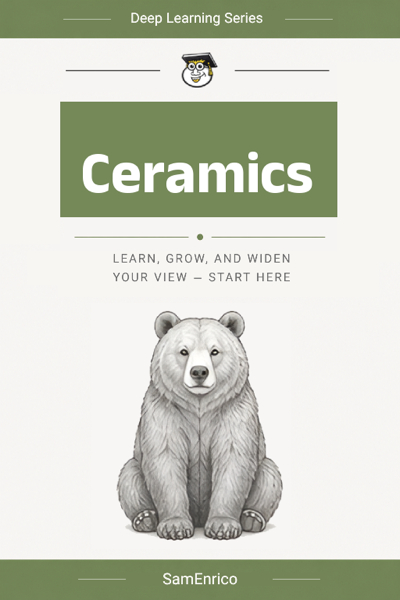
Non-FictionInformativeEducational
Ceramics eBook
A Coursebook on Ceramics
by Smoot Theola
A Coursebook on Ceramics
Formats
Free sample
Chapter 1: The Mud That Remembers...–- Before you throw a single pot, before you touch a wheel or open a bag of clay, you need to understand something that most pottery books skip entirely: clay is not a passive material waiting for your command. It is a record-keeper. Every fingerprint, every uneven pressure, every moment of impatience or care—the clay remembers. It remembers the temperature of the room where you wedged it, the humidity of the day you threw it, the exact angle of your wrist when you pulled a wall. This is not mysticism; it is physics.
Ceramics is the only art form where the material undergoes a permanent, irreversible transformation. Paint can be painted over. Wood can be re-sanded. But once clay passes through fire, its story is fixed forever in silica and alumina.This is why so many beginners quit after their first firing. They open the kiln expecting beauty and find catastrophe: cracked bottoms, warped rims, handles that have separated like divorced couples, glaze that has crawled into islands of confusion.
And because no one explained why, they assume they lack talent. They do not lack talent. They lack a relationship with the material. They have not yet learned to listen to what the mud is telling them.This chapter is not a history lesson in the conventional sense. You will not be tested on dates or dynasty names.
Instead, this is an origin story—not just of ceramics, but of your place within a continuum of makers stretching back thirty thousand years. By the time you finish reading, you will understand why a Chinese potter from the Song Dynasty and a Greek vase painter from the fifth century BCE and a contemporary ceramic artist in a Brooklyn studio are all asking the same questions you will ask: How do I make this hold water? How do I make it beautiful? How do I make it mean something? And, most urgently: How do I keep it from exploding in the kiln?The First Memory: 29,000 BCESomewhere in what is now the Czech Republic, in a landscape of limestone caves and cold rivers, an anonymous person did something unprecedented.
They dug clay from a riverbank—ordinary, grey, plastic earth—and shaped it into a figurine. Not a tool. Not a weapon. A woman with exaggerated breasts, wide hips, and no face. The Venus of Dolní Věstonice is only 4.4 inches tall, but it represents a cognitive revolution.
Someone, for the first time in human history, looked at mud and saw not dirt but image.But here is what most books do not tell you: the Venus was not fired intentionally. The figurine was found among ash and bone fragments, suggesting it was deliberately placed in a fire—perhaps as an offering, perhaps as a ritual destruction. The firing was uneven, reaching only about 800°C in some places and 1200°C in others. Parts of the figurine cracked; others vitrified partially. The maker did not control the process.
But they observed the result. And observation is where all ceramic knowledge begins.For the next twenty millennia, fired clay remained rare and sacred. The first vessels—simple pinch pots found in Japanese Jōmon culture (circa 14,000 BCE)—were not for cooking. They were for storage of nuts, seeds, and perhaps spiritual substances. The breakthrough came when someone realized that clay could be shaped into a container and fired to waterproof it.
A dry seed stored in a woven basket would rot if moisture seeped in. A dry seed stored in a fired clay pot would survive the winter. The Neolithic Revolution—the shift from hunting and gathering to agriculture—was enabled in part by ceramic storage. Without pots, surplus grain was impossible. Without surplus grain, cities were impossible.
Every civilization you have ever studied owed something to a potter who figured out how to keep water on the inside and weather on the outside.The Three Great Bodies: A Vocabulary for Understanding Before we go further, we need a shared language. All clay falls into three categories based on what happens when you fire it. Forget brands, forget supplier names, forget the romantic appeal of "wild clay" for now. These three categories are the alphabet of ceramic possibility.Earthenware is the oldest and most accessible clay body. It fires at low temperatures (approximately 1700–2100°F, or Cone 08–04 in pyrometric cone language—we will explain cones in Chapter 10).
It remains porous after firing, meaning it will absorb water unless glazed. Its colors range from buff and terra cotta to deep red and grey, depending on iron content. The strength of earthenware is its forgiving nature: it dries slowly, warps little, and can be fired in primitive kilns. The weakness? It is soft.
A knife will scratch it. Acidic foods will stain unglazed surfaces. Most of the world's ancient pottery is earthenware because it was the only option available.Stoneware fires hotter (approximately 2100–2300°F, Cone 5–10). At these temperatures, the clay begins to vitrify—that is, silica particles melt and flow together, sealing pores. Stoneware is waterproof even without glaze, though most potters glaze it anyway for surface reasons.
It is hard, durable, and resistant to thermal shock. Stoneware is the workhorse of studio pottery: dinner plates, mugs, casseroles, and storage jars. Its weakness is that it demands more from your kiln and your skill. Drying must be slower, throwing more precise, and the firing schedule more controlled. But the reward is a pot that may outlive your grandchildren.Porcelain is the aristocrat.
Firing at the highest temperatures (approximately 2200–2450°F, Cone 8–12), porcelain is made from kaolin—pure white clay with large hexagonal platelets. When fired to maturity, porcelain becomes translucent, ringing like a bell when tapped. It is also brutally unforgiving. Porcelain warps easily, slumps in the kiln, and reveals every mistake in your throwing. A fingerprint on porcelain is not a charming mark of the maker; it is a flaw.
Most beginners should avoid porcelain for at least a year. But those who master it find a material that approaches the perfection of glass while retaining the warmth of hand.These three bodies are not rigid categories; crossovers exist. Iron-rich stoneware blurs into earthenware. Porcelain mixed with sand becomes a different creature. But understanding the triangle of temperature, vitrification, and plasticity gives you a framework for every clay decision you will ever make.The Golden Ages: When Ceramics Changed Everything History is not linear.
Progress in ceramics did not march steadily from crude earthenware to perfect porcelain. Instead, specific cultures, in specific centuries, made leaps that transformed the material forever. Three of these leaps matter to you as a maker.Song Dynasty China (960–1279 CE): The Invention of Glaze as Painting Before the Song, glaze was primarily functional—a waterproof coating. The Chinese potters of the Song Dynasty discovered that by controlling the kiln atmosphere (introducing reduction, which we will cover in Chapter 10), they could transform iron oxide in the glaze from brown to jade green. The result was celadon, a glaze of such depth and softness that poets compared it to "the sky after rain, waiting for the clouds to break."But the Song did more than chemistry.
They elevated ceramics to the status of painting. The Jun ware of this period used opalescent blue glazes that seemed…
This is the end of the free sample. Get the eBook to keep going. Buy now
About this book
Details
- Author
- Smoot Theola
- Publisher
- SamEnrico
- Language
- English
- Genre
- Non-Fiction, Informative, Educational
- Released
- 2026-05-08
- Pages (approx.)
- 131
- Available as
- eBook, Audiobook

Read better in the ZLOADR app
Your eBooks on your phone or tablet. Sign in with your SamEnrico account and start reading.
More by Smoot Theola
 Change Resistance Anger WorkbookSmoot Theola$11.99
 The Disenfranchised Grief GuideSmoot Theola$11.99
 Business Innovation WorkbookSmoot Theola$11.99
 Breaking the Cycle of Compulsive BehaviorSmoot Theola$11.99
 Default Effect InfluenceSmoot Theola$11.99
 The Southern Cross and the Stars: New Zealand's Scientific OdysseySmoot Theola$11.99
 Understanding TrimethylaminuriaSmoot Theola$17.99
 International Franchise InsuranceSmoot Theola$12.99
 How to Become a Plant OperatorSmoot Theola$11.99
You may also like
 Hong Kong Handover 1997Dunn Johnnie$11.99
 Zumba For Postnatal Recovery CourseNeal Christian$11.99
 Zumba for BeginnersLadner Nikia$11.99
 YouTube Comment Mining GuideHumes Pandora$12.99
 Worry Box MeditationCarlin Rudy$11.99
 Workplace Stress MeditationNguyen Lynn$11.99
 Workplace Stress and Sleep RepairHawley Ivory$11.99
 Workplace Perfectionism CureDelaney Jeffry$11.99
 Workplace Injustice Anger GuideWallen Isabelle$11.99
 Work Addiction and Burnout LinkGreenwood Ester$11.99
 Women in Yoga and WellnessBeattie Galina$11.99
 Women in Stand Up ComedyChun Evangeline$11.99