
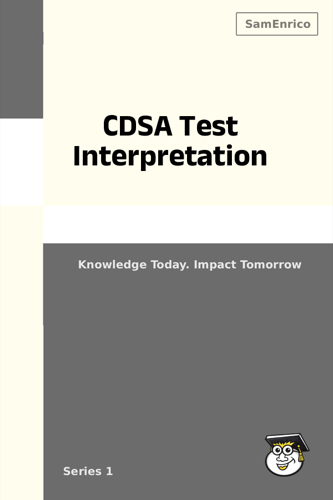
Non-FictionHealth & WellnessComprehensive Stool
CDSA Test Interpretation eBook
Decodes Comprehensive Digestive Stool Analysis res
Decodes Comprehensive Digestive Stool Analysis results.
Formats
Free sample
Chapter 1: The Gut Illusion...--The average person will experience digestive symptoms for eleven years before finding a solution that actually works. Eleven years of bloating after meals, of rushing to find a bathroom, of canceling plans because your stomach decided today was not your day. Eleven years of being told "it's just IBS" or "eat more fiber" or "try reducing stress" – none of which address the root cause because your doctor never ordered the one test that could have answered everything on day one.This chapter exists because that eleven-year delay is not your fault. It is a failure of conventional medical algorithms that prioritize ruling out emergencies over investigating chronic dysfunction. And it is a failure that the Comprehensive Digestive Stool Analysis – the CDSA – was designed to correct.Before we dive into the mechanics of test interpretation, before we discuss elastase thresholds or calprotectin cutoffs or the precise colony counts that separate health from dysbiosis, we must first answer a more fundamental question: Why does this test exist, and why has no one told you about it?The answer reveals a uncomfortable truth about modern medicine.
The tests your doctor typically orders – complete blood count, metabolic panel, thyroid function, maybe a C-reactive protein – are designed to detect disease, not dysfunction. They will tell you if you have cancer, if your liver is failing, if your white blood cell count signals leukemia. They will not tell you why you cannot digest fat. They will not tell you why your beneficial bacteria have been replaced by gas-producing pathogens. They will not tell you why your gut is inflamed at a low, chronic level that never quite crosses the threshold into inflammatory bowel disease but nevertheless ruins your quality of life.This is the gap the CDSA fills.
And understanding that gap is the first step toward interpreting your results.The IBS Diagnosis: A Confession of Ignorance Disguised as Medical Certainty Let us begin with a term you have almost certainly encountered: Irritable Bowel Syndrome, or IBS. Approximately twelve percent of adults in North America carry this label. It is the most common diagnosis made by gastroenterologists. And it is, with very few exceptions, a confession that your physician does not know what is actually wrong with you.This is not an insult to physicians. It is a structural limitation of the diagnostic tools they are trained to use.IBS is formally defined as a "functional gastrointestinal disorder" – a condition characterized by chronic abdominal pain and altered bowel habits (diarrhea, constipation, or alternating) in the absence of detectable structural or biochemical abnormalities on standard testing.
Notice the key phrase: "in the absence of detectable structural or biochemical abnormalities on standard testing." The diagnosis of IBS does not mean your gut is normal. It means your gut is abnormal in ways that standard testing fails to capture.Think about what this implies. Your doctor orders a colonoscopy, which looks at the structure of your large intestine. It comes back normal. Your doctor orders basic blood work, which looks for anemia, inflammation, and nutritional deficiencies.
It comes back normal. Your doctor orders a celiac serology panel. It comes back normal. Your doctor might even order an upper endoscopy with biopsy. Normal.And so, by process of elimination, you receive the diagnosis: IBS.But here is the problem that the creators of the CDSA recognized decades ago.
The absence of detectable pathology on these tests does not mean your gut is functioning properly. It means the tests were not designed to measure function. A colonoscopy shows you the walls of your colon. It does not tell you what is living inside that colon. A complete blood count tells you if you are anemic.
It does not tell you if you are absorbing the iron from your food. A celiac panel tells you if you have the autoimmune form of gluten intolerance. It does not tell you if you have non-celiac gluten sensitivity, which is far more common.This is the diagnostic gap. And into this gap have fallen millions of patients with treatable, often curable conditions: exocrine pancreatic insufficiency, small intestinal bacterial overgrowth, bile acid malabsorption, dysbiosis, occult infections, and a dozen other diagnoses that the CDSA can identify but that standard testing systematically misses.The CDSA Difference: From Exclusion to Discovery The Comprehensive Digestive Stool Analysis represents a fundamentally different approach to gastrointestinal assessment. Where standard medicine asks "Is there a disease present?" the CDSA asks "Is the digestive system functioning optimally?" These are not the same question, and the difference explains why the CDSA can find answers where other tests return only silence.A standard stool culture ordered by most primary care physicians looks for three things: Salmonella, Shigella, and Campylobacter.
These are acute, severe pathogens that cause violent illness within hours of exposure. If you have been sick for three months, you do not have an acute Salmonella infection. Your doctor's test will come back negative, and you will be told "no infection found."The CDSA culture looks for over thirty different bacterial species, including the ones that cause chronic, low-grade symptoms: Klebsiella, Proteus, Citrobacter, Pseudomonas, Enterobacter, and many others. These bacteria are not "pathogens" in the classic sense – they are commensal organisms that belong in the gut at low levels. The problem is not their presence.
The problem is their quantity. When they overgrow, they produce gas, inflammation, and metabolic byproducts that disrupt normal digestion. A standard culture cannot detect this overgrowth because the lab is not looking for it. The CDSA quantifies bacterial colonies, telling you exactly how many of each species are present and whether that number exceeds the threshold for symptomatic overgrowth.But the CDSA goes even further. For every bacterial species identified, the test performs antimicrobial sensitivity testing.
This means the lab actually exposes your specific bacterial strain to various natural and pharmaceutical agents – oregano oil, berberine, grapefruit seed extract, rifaximin, ciprofloxacin, and more – to determine which ones kill it effectively. This is personalized medicine at its most practical. Instead of guessing which herbal protocol might work, you receive a report showing that your Klebsiella strain is 100 percent susceptible to oregano oil but completely resistant to berberine. The guesswork disappears.Beyond Bacteria: The Five Domains of CDSA Analysis To understand what the CDSA reveals, you must understand that the test is not a single measurement but a composite of five distinct domains of analysis. Each domain answers a different question about your digestive health.
And each domain must be interpreted in the context of the others.Domain One: Macroscopy. This is the physical examination of the stool specimen – the Bristol Chart classification, the color, the consistency, the presence of visible mucus or blood. Before any laboratory analysis begins, the technician records these observations. A greasy, floating stool suggests fat malabsorption. A yellow stool suggests rapid transit with bile acid loss.
Visible mucus, as we will discuss in detail in Chapter Three, is always clinically significant and warrants investigation, though it does not automatically equal inflammatory bowel disease. The macroscopic examination is your first clue to what is going wrong, and it costs nothing but attention.Domain Two: Biochemistry. This domain measures the chemical environment of the stool. Pancreatic…
This is the end of the free sample. Get the eBook to keep going. Buy now
About this book
Details
- Author
- Laporte Collette
- Publisher
- SamEnrico
- Language
- English
- Genre
- Non-Fiction, Health & Wellness, Comprehensive Stool
- Released
- 2026-06-10
- Pages (approx.)
- 150
- Available as
- eBook, Audiobook

Read better in the ZLOADR app
Your eBooks on your phone or tablet. Sign in with your SamEnrico account and start reading.
More by Laporte Collette
 Tinnitus Sleep ManagementLaporte Collette$11.99
 Empathy Without Taking On StressLaporte Collette$11.99
 Mindfulness Meditation for RegretLaporte Collette$11.99
 Argentina Remote Tax GuideLaporte Collette$11.99
 TM for Emotional EatingLaporte Collette$11.99
 Sleep Apnea Driving RisksLaporte Collette$11.99
 Kurosawa DreamsLaporte Collette$11.99
 Pomodoro For ChoresLaporte Collette$11.99
 The Battle of the Aegates: Rome's Naval Gambit That Broke Carthage (241 BC)Laporte Collette$11.99
 Love Letters from the Pacific: The Secret Correspondence of a WAC and a MarineLaporte Collette$11.99
 The Last Broadcast: The Strange Fate of the SS Ourang MedanLaporte Collette$11.99
 Programming Foundations with PythonLaporte Collette$11.99
You may also like
 Hong Kong Handover 1997Dunn Johnnie$11.99
 Zumba For Postnatal Recovery CourseNeal Christian$11.99
 Zumba for BeginnersLadner Nikia$11.99
 YouTube Comment Mining GuideHumes Pandora$12.99
 Worry Box MeditationCarlin Rudy$11.99
 Workplace Stress MeditationNguyen Lynn$11.99
 Workplace Stress and Sleep RepairHawley Ivory$11.99
 Workplace Perfectionism CureDelaney Jeffry$11.99
 Workplace Injustice Anger GuideWallen Isabelle$11.99
 Work Addiction and Burnout LinkGreenwood Ester$11.99
 Women in Yoga and WellnessBeattie Galina$11.99
 Women in Stand Up ComedyChun Evangeline$11.99