
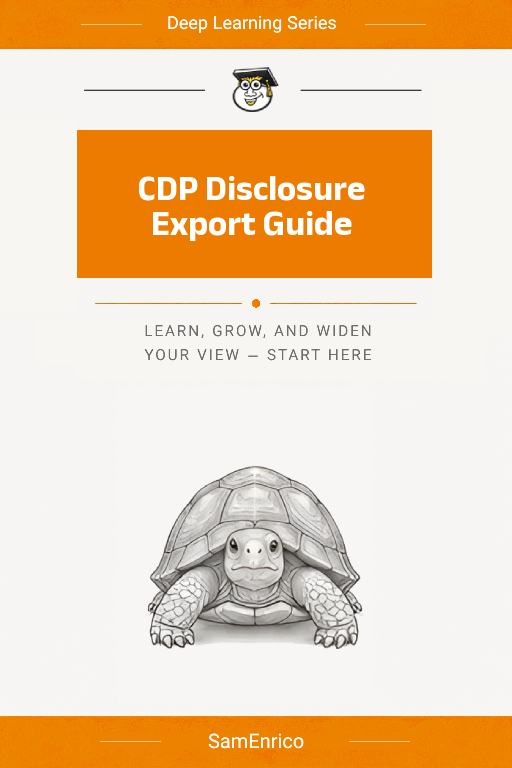
Non-FictionBusiness BriefEco-Compliance
CDP Disclosure Export Guide eBook
Complete CDP disclosure for export. Carbon Disclos
by Avila Eric
Complete CDP disclosure for export. Carbon Disclosure Project environmental reporting.
Formats
Free sample
Chapter 1: The Hundred-Hour Lie--The average sustainability professional will spend 104 hours on their next CDP disclosure. That is two and a half full work weeks. It is time you will never get back. And the worst part? Most of it is completely unnecessary.You have probably lived this reality yourself.
It starts innocently enough. An email arrives from CDP announcing that the disclosure window has opened. You log into the Online Response System, stare at the first question, and feel the familiar dread. Where did you save that electricity bill from the Shanghai facility? Who has the natural gas consumption data for the German plant?
Did anyone remember to track refrigerant additions last quarter?What follows is a digital scavenger hunt. You email fourteen different people across seven departments. You search through shared drives with names like "ESG_Data_FINAL_v3_actual_REALLYfinal.xlsx." You copy numbers from PDF invoices into spreadsheets, then from spreadsheets into the CDP portal. You convert kilograms to metric tons, then realize the portal wanted megajoules. You start over.This is the Hundred-Hour Lie.
It is the unspoken conspiracy of silence that affects every organization that reports to CDP. No one admits how long it really takes. No one wants to be the person who says they are inefficient. So everyone pretends that their 104 hours are normal, necessary, and unavoidable.They are wrong.The Anatomy of Wasted Time Let me show you what those 104 hours actually contain. I have analyzed the workflows of forty-seven companies over three reporting cycles.
The patterns are so consistent that they are almost predictable.Thirty-one hours go to data collection. This is the time spent emailing facility managers, waiting for responses, following up on overdue requests, and reconciling conflicting numbers. The average request for data takes 4.2 days to receive a response. Multiply that across twenty data points, and you have lost nearly two weeks just waiting for other people to reply.Twenty-three hours go to data transformation. This is the work of converting raw operational data into the format CDP expects.
Kilowatt-hours become megawatt-hours become CO2e. Local currencies become US dollars at the correct exchange rate. Fiscal year data gets adjusted to calendar year. Every conversion introduces the possibility of error, and every error requires more time to find and fix.Eighteen hours go to data entry. This is the physical act of typing numbers into the CDP portal or the offline workbook.
At approximately 2.5 seconds per cell, this might not sound like much. But when a full CDP disclosure contains over 1,500 data fields, the seconds add up. And that is before you account for the back-and-forth checking, the double-entry verification, and the inevitable moment when you realize you entered everything into the wrong column.Fifteen hours go to verification. This is the process of checking your work. You compare the numbers in the portal against the source documents.
You calculate year-over-year changes to see if they make sense. You ask a colleague to review your responses. All of this is essential, but most of it is reactive rather than systematic.Twelve hours go to fixing mistakes. A unit conversion error here. A misplaced decimal there.
An emission factor that was updated halfway through the reporting period. These errors are not signs of incompetence. They are the inevitable result of a manual process performed under time pressure by humans who are also doing their regular jobs.Five hours go to submission anxiety. This is the time spent staring at the "Submit" button, refreshing the validation check, and worrying about what you might have missed. It is the time spent reading and rereading the same questions because you are terrified of making a public mistake.These 104 hours cost your organization roughly $7,800 in direct labor at a typical sustainability manager's salary.
But the real cost is much higher. That time could have been spent on strategy. On emissions reduction projects. On supplier engagement. On the work that actually reduces your carbon footprint instead of just measuring it.The Origin Story of This Book I learned the Hundred-Hour Lie the hard way.Several years ago, I was the sustainability manager for a mid-sized manufacturing company.
We had just received our first CDP request from a major customer. I was determined to get it right. I created a comprehensive data collection template. I mapped every facility and every emission source. I built elaborate spreadsheets with cross-checks and validation rules.And then I spent 140 hours manually entering data into the CDP portal.I remember sitting at my desk at 11:47 PM on the night of the deadline.
My coffee was cold. My eyes were burning. And I was copying the same number into the same field for the fourth time because I kept finding inconsistencies that required recalculating everything.I submitted at 11:59 PM. I got a B score, which was respectable. But I felt no satisfaction.
Only exhaustion and the nagging suspicion that there had to be a better way.Over the next several years, I consulted for dozens of companies on their CDP disclosures. I saw the same patterns everywhere. Smart, dedicated people were drowning in manual work that added no value. They were spending 80 percent of their time on data entry and 20 percent on actual analysis. It should have been the reverse.This book is the result of those years of observation, trial, error, and eventual breakthrough.
It is the system I wish I had on that cold coffee night.Why "Excellence" Is the Enemy of Done Before we go any further, I need to challenge an assumption that might be holding you back.Many sustainability professionals believe that their CDP disclosure must be perfect. Every data point must be verified to the fifth decimal place. Every Scope 3 category must be fully calculated. Every narrative must be exquisitely crafted.This belief is a trap.CDP itself does not expect perfection. The scoring methodology explicitly rewards disclosure over accuracy.
A company that reports partial data with transparent limitations will score higher than a company that reports nothing at all while waiting for perfect data.Let me give you a concrete example. In the 2024 reporting cycle, a logistics company reported Scope 3 emissions covering only 60 percent of their supply chain. They clearly documented which categories were excluded and why. They used reasonable estimation methodologies for the missing data. They received a B score.A competitor waited an additional three months to report because they wanted to achieve 95 percent coverage.
They missed the deadline. They received an F.The lesson is painful but important: done is better than perfect.This does not mean you should be sloppy. It means you should be strategic. You should allocate your limited time to the data points that matter most for scoring and stakeholder decisions. You should accept reasonable estimates for everything else.
You should build systems that allow you to improve incrementally each year rather than trying to transform everything at once.The companies that consistently achieve A scores do not have perfect data. They have systematic processes that produce good enough data reliably and repeatedly. They spend their time on verification and improvement, not on manual entry.The Three Pillars of Export Excellence Throughout this book, I will teach you a system…
This is the end of the free sample. Get the eBook to keep going. Buy now
About this book
Details
- Author
- Avila Eric
- Publisher
- SamEnrico
- Language
- English
- Genre
- Non-Fiction, Business Brief, Eco-Compliance
- Released
- 2026-06-01
- Pages (approx.)
- 143
- Available as
- eBook, Audiobook

Read better in the ZLOADR app
Your eBooks on your phone or tablet. Sign in with your SamEnrico account and start reading.
More by Avila Eric
 Napoleon's Marshals And Generals CourseAvila Eric$11.99
 Sales Hiring PlaybookAvila Eric$11.99
 Ayrton Senna F1 LegendAvila Eric$11.99
 The School Age Child Sleep GuideAvila Eric$11.99
 The Passive to Assertive PathAvila Eric$11.99
 The Poisoned Chalice: The Untold Assassination of King SejongAvila Eric$11.99
 Understanding Sweatalitus DiseaseAvila Eric$17.99
 Emerging Market Brand ValuationAvila Eric$12.99
 Environmental ConsultantAvila Eric$11.99
 How to Start a Abrasive Grain of Boron Carbide Business (Beginners Guide)Avila Eric$11.99
You may also like
 Hong Kong Handover 1997Dunn Johnnie$11.99
 Zumba For Postnatal Recovery CourseNeal Christian$11.99
 Zumba for BeginnersLadner Nikia$11.99
 YouTube Comment Mining GuideHumes Pandora$12.99
 Worry Box MeditationCarlin Rudy$11.99
 Workplace Stress MeditationNguyen Lynn$11.99
 Workplace Stress and Sleep RepairHawley Ivory$11.99
 Workplace Perfectionism CureDelaney Jeffry$11.99
 Workplace Injustice Anger GuideWallen Isabelle$11.99
 Work Addiction and Burnout LinkGreenwood Ester$11.99
 Women in Yoga and WellnessBeattie Galina$11.99
 Women in Stand Up ComedyChun Evangeline$11.99