
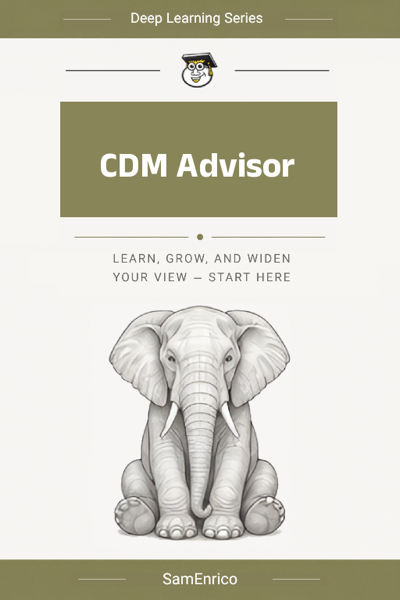
Non-FictionInformativeEducational
CDM Advisor eBook
A Coursebook on CDM Advisor
by Derr Stacie
A Coursebook on CDM Advisor
Formats
Free sample
Chapter 1: The Coordinator Is Dead...-- The email arrived at 7:43 AM on a Tuesday. Maya, a former site manager who had recently pivoted into health and safety consulting, was reviewing her morning coffee when her phone buzzed. The subject line read: “Urgent – HSE on site.” The body was worse: “The inspectors are asking who the Principal Designer is. I don’t know what that means. I thought that was your job.
Please call immediately.”She called. The client, a regional retail chain’s facilities manager named Derek, answered in a whisper. “They’re walking around with clipboards. One of them asked for the Construction Phase Plan. I gave them the risk assessment from last year’s refurb.
He raised an eyebrow, Maya. An actual eyebrow. I think I’m in trouble.”Maya closed her eyes. She had sent Derek a Client Briefing Note three weeks ago. She had explained the difference between the old CDM Coordinator role and the new Principal Designer role.
She had even highlighted the sentence that said: “You, the client, must appoint a Principal Designer in writing before any design work begins.” Derek had not appointed anyone. He had assumed Maya would “just handle it.”This chapter is about why Derek’s assumption – common, understandable, and legally catastrophic – is rooted in a fundamental shift in UK construction safety law. It is about the death of the CDM Coordinator and the birth of a very different set of duties. And it is about why, if you are a CDM Advisor, your first job is not to fill out forms. Your first job is to ensure everyone understands that the old way of thinking is dangerously out of date.The Evolution from CDM 2007 to CDM 2015To understand where we are, you must understand where we came from.
The Construction (Design and Management) Regulations have existed in some form since 1994, but the most significant transformation occurred in 2015. That year, the Health and Safety Executive (HSE) published CDM 2015, which replaced the previous 2007 version. On the surface, it looked like a routine update. In practice, it was a revolution.Under CDM 2007, there were eight duty holder roles. The most relevant for this discussion was the CDM Coordinator.
This person was responsible for advising the client on health and safety matters, facilitating communication between duty holders, and preparing the health and safety file. The role was administrative in nature. A good CDM Coordinator was organised, diligent, and thorough. A bad one – and the HSE found many bad ones – was a bureaucratic box-ticker who collected paperwork but never visited the site, never challenged a dangerous design, and never asked the difficult question: “Why are we building this in a way that will kill someone?”The HSE’s review of CDM 2007 found that the Coordinator role had become disconnected from actual risk. Coordinators were often appointed late (sometimes after construction had already started).
They had no authority over designers. They produced reams of documentation that no one read. And because their fee was often a percentage of project value, there was a perverse incentive to keep projects moving rather than to stop them when safety was compromised.CDM 2015 abolished the CDM Coordinator entirely.That decision sent shockwaves through the industry. Thousands of people who had built careers as CDM Coordinators suddenly had to reinvent themselves. Some succeeded.
Many did not. The ones who failed were those who simply changed their business cards from “CDM Coordinator” to “CDM Advisor” while doing exactly the same thing. That is not how the regulations work.The Two New Duty Holders: Principal Designer and Principal Contractor In place of the Coordinator, CDM 2015 introduced two new roles: the Principal Designer and the Principal Contractor. This was not a rebranding. It was a fundamental reallocation of responsibility.The Principal Designer is responsible for planning, managing, monitoring, and coordinating health and safety during the pre-construction phase (Regulation 11).
That means the Principal Designer must be involved from the very first sketch. They must ensure that architects, structural engineers, service engineers, and all other designers are addressing safety at the drawing board – not leaving it to be solved on site. The Principal Designer must also ensure that information flows between designers so that no one designs something that contradicts someone else’s safety assumptions.The Principal Contractor is responsible for planning, managing, monitoring, and coordinating health and safety during the construction phase (Regulation 12). That means the Principal Contractor must take the information prepared by the Principal Designer (including the residual risk register, which we will cover in Chapter 5) and turn it into a Construction Phase Plan that tells every worker on site what the hazards are and how they are controlled.The critical point – and the one that Derek the retail manager missed – is that these roles must be appointed in writing before any design or construction work begins. You cannot “just handle it” informally.
You cannot assume someone will fill the gap. If no Principal Designer is appointed, the client is automatically in breach of their duties. And if an incident occurs, the HSE will ask for the appointment letter. If you cannot produce it, you have already lost.Why the Cultural Shift Matters: From Administration to Design The abolition of the CDM Coordinator was not just about changing job titles. It was about changing a culture.Under the old regime, safety was often treated as an administrative add-on.
The design team would produce their drawings. The contractor would produce their method statements. And the CDM Coordinator would produce a file that sat on a shelf, untouched, until the project was complete. Safety was something you documented after the fact.CDM 2015 flips this model. Safety must be designed in from the start.
The Principal Designer’s job is to ask, at every design review meeting: “Have we eliminated this hazard? If not, why not? And if we cannot eliminate it, who have we told?” This is not paperwork. This is engineering judgment. It requires the Principal Designer to understand construction methods, materials, and human factors.
It requires them to push back when an architect specifies a fragile roof light because it “looks nice” without considering the maintenance worker who will have to clean it in ten years.This cultural shift has profound implications for the CDM Advisor. You are not the Principal Designer (unless you are appointed as such). You are an advisor to the client and to the design team. But your role is not passive. You must educate, challenge, and escalate.
You must know when to say: “If you do not appoint a Principal Designer by Friday, I will write you a letter stating that you are in breach of your legal duties, and I will copy the HSE.” That letter is a career-defining moment. You must be willing to write it.The Legal Backbone: ACo P, L153, and the Territorial Scope Before we go further, we need to establish the legal hierarchy that governs everything in this book. CDM 2015 is supported by two key documents, and confusing them is a common mistake.The Approved Code of Practice (ACo P) – officially titled “Managing health and safety in construction” (L153, but the ACo P is the part with legal standing) – has…
This is the end of the free sample. Get the eBook to keep going. Buy now
About this book
Details
- Author
- Derr Stacie
- Publisher
- SamEnrico
- Language
- English
- Genre
- Non-Fiction, Informative, Educational
- Released
- 2026-05-25
- Pages (approx.)
- 147
- Available as
- eBook, Audiobook

Read better in the ZLOADR app
Your eBooks on your phone or tablet. Sign in with your SamEnrico account and start reading.
More by Derr Stacie
 The Workaholic Approval Seeking CureDerr Stacie$11.99
 Validation for Toxic BehaviorDerr Stacie$11.99
 French Revolution PaintingDerr Stacie$11.99
 Hormonal Balance Decoded GuideDerr Stacie$11.99
 The Lion of Castile: Ferdinand III and the Reconquista's Final TriumphDerr Stacie$11.99
 German Krankheit Raise ImpactDerr Stacie$12.99
 How to Produce a Barbecue GrillDerr Stacie$11.99
 How to Become a Packing-line WorkerDerr Stacie$11.99
You may also like
 Hong Kong Handover 1997Dunn Johnnie$11.99
 Zumba For Postnatal Recovery CourseNeal Christian$11.99
 Zumba for BeginnersLadner Nikia$11.99
 YouTube Comment Mining GuideHumes Pandora$12.99
 Worry Box MeditationCarlin Rudy$11.99
 Workplace Stress MeditationNguyen Lynn$11.99
 Workplace Stress and Sleep RepairHawley Ivory$11.99
 Workplace Perfectionism CureDelaney Jeffry$11.99
 Workplace Injustice Anger GuideWallen Isabelle$11.99
 Work Addiction and Burnout LinkGreenwood Ester$11.99
 Women in Yoga and WellnessBeattie Galina$11.99
 Women in Stand Up ComedyChun Evangeline$11.99