
Non-FictionSelf-HelpSensory Rest
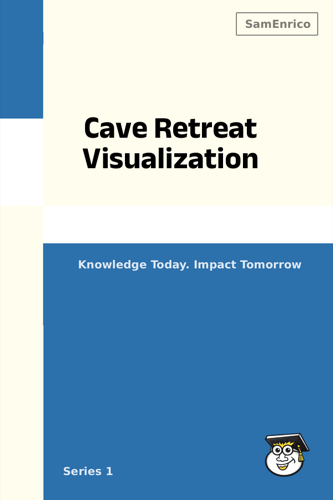
Cave Retreat Visualization eBook
Enter a safe stone sanctuary for complete sensory
by Robb Ardis
Enter a safe stone sanctuary for complete sensory withdrawal and rest.
Formats
Free sample
Chapter 1: The Noise Inventory--–- You are reading this because somewhere, in a room no one else can see, a part of you is already searching for a door. Not a door out of your life—you don't want to escape existence itself. You want to escape the volume of existence. The endless ping. The screen that glows at 2:00 AM.
The open-floor-plan office where you can hear three conversations, two phone rings, and a coffee grinder simultaneously. The open-plan apartment where your roommate's laughter, your neighbor's subwoofer, and the garbage truck's reverse beep all compete for your amygdala's attention. You are not broken. You are not weak. You are not "bad at relaxing." You are a mammalian nervous system trying to function in an environment that did not exist when your nervous system evolved.Your ancient ancestors lived in a world of relatively few sensory inputs.
Wind. Rain. The crackle of a fire. The sound of a predator—which required immediate attention, but was rare. The rest of the time, the world was quiet.
Dark at night. Spacious during the day. The human brain evolved to expect long stretches of low sensory input punctuated by brief, intense bursts of high-alert necessity. That is the operating system you inherited. That is the software you are running, right now, while your phone buzzes in your pocket and your email tab shows 1,247 unread messages and the fluorescent light above your desk hums at a frequency your ears have learned to ignore but your nervous system never forgot.The problem is not that you cannot rest.
The problem is that you are trying to rest inside a machine designed to keep you awake.This book offers a different solution. Not a meditation app that asks you to "notice your breath" while your toddler screams in the next room. Not a wellness guru who tells you to "just let go" while your brain is locked in a cage of rumination. Not another gentle suggestion that you should try harder to relax—as if relaxation were a muscle you haven't bothered to flex. The solution is older than any of those things.
It is a cave. A stone sanctuary. A place you build inside your mind, not as a fantasy escape, but as a functional neurological tool for sensory withdrawal and deep rest.But before you can build that sanctuary, you must understand what you are withdrawing from. You cannot seal a door until you know what lies on the other side. You cannot rest until you know what is keeping you awake.This is the work of Chapter One.
The Noise Inventory.The Myth of the "Calm Person"Let us begin by dismantling a dangerous fiction: the idea that some people are naturally calm and others are not. You have met these supposedly calm people. They drink one cup of coffee in the morning and forget to finish it. They sleep through thunderstorms. They can sit in an airport during a delay and read a paperback novel without checking their phone every forty-five seconds.
You look at them and think: They have something I do not have.They do not.What they have is a lower baseline of sensory exposure. Not a different brain—a different environment. Most people who appear effortlessly calm have unconsciously arranged their lives to minimize unpredictable sensory input. They live on quiet streets. They work in offices with doors.
They do not have children who wake at 3:00 AM or partners who watch action movies at full volume or jobs that demand they monitor six chat channels simultaneously. Their calm is not a personality trait. It is a boundary. And boundaries can be learned.The research supports this. In a landmark 2018 study published in Current Directions in Psychological Science, researchers found that what people call "dispositional mindfulness" (the natural tendency to be calm and present) correlates more strongly with environmental load than with any genetic marker.
In other words, calm people are not born calm. They have simply accumulated fewer sensory triggers per day. Their noise inventory is shorter than yours.That is good news. It means you can shorten your noise inventory. You cannot eliminate all triggers—life is life—but you can name them.
And naming is the first act of control.Your Personal Noise Inventory: What Keeps You Awake Close your eyes for a moment. Do not visualize anything yet. Just listen. What do you hear right now? Not the big sounds—the obvious ones.
The small sounds. The hum of a refrigerator. The distant thrum of traffic. The high-pitched whine of a phone charger. The sound of your own breathing, which you usually ignore.
Now open your eyes. What do you see? Not the beautiful things. The loud things. The pile of laundry that needs folding.
The notification badge on your email app. The crack of light under the door that you have never been able to seal. Now pay attention to your skin. Is the temperature comfortable? Or are you too warm under a blanket, too cool near a vent, aware of a tag scratching the back of your neck?You have just taken the first step of the Noise Inventory.The Noise Inventory is a three-day log of every sensory trigger that elevates your cortisol.
It is not a journal of your feelings. It is not a diary of your thoughts. It is a literal list of specific, measurable, external stimuli that cause your nervous system to shift from rest to alert. You will carry a small notebook—or a note on your phone—and every time you notice a sensory event that makes you tense, flinch, sigh, or look up, you will write it down. You will note the time, the location, the sense involved (sight, sound, touch, smell, or a combination), and a 1-10 rating of how strongly it grabbed your attention.Here is an example of what that might look like after three days:*8:15 AM, kitchen.
Sound. Roommate's blender. 7/10. Sudden loud roar. Made me spill coffee.**9:47 AM, office.
Sight. Slack notification dot turned orange. 6/10. Immediate urge to check it.**11:02 AM, car. Sound.
Squeaking brake. 4/10. Not loud but unpredictable pattern. Kept waiting for next squeak.**12:30 PM, grocery store. Sight/Sound.
Fluorescent light flicker + PA announcement. 8/10. Could not focus on shopping list.**2:15 PM, home desk. Touch. Rough seam on shirt sleeve.
3/10. Low-grade annoyance all afternoon.**4:40 PM, phone. Sound. Email whoosh. 9/10.
Heart rate spiked. Turned out to be spam.**7:30 PM, living room. Sight. Partner scrolling Tik Tok on couch across from me. 5/10.
Peripheral movement distracting.**10:05 PM, bedroom. Light. Streetlight through curtains. 4/10. Enough to keep eyes from fully relaxing.*After three days, you will have a list.
That list is your enemy. Not in a dramatic, must-destroy sense. In a practical, tactical sense. Every item on that list is something your cave must help you withdraw from. You cannot remove the roommate's blender.
You cannot turn off the streetlight. But you can build a sanctuary that, for twenty minutes a day, makes those triggers irrelevant.Most people, when they complete the Noise Inventory for the first time, experience two emotions in rapid succession. First: validation. "Oh, I am not crazy. There really are twenty-seven things making me…
This is the end of the free sample. Get the eBook to keep going. Buy now
About this book
Details
- Author
- Robb Ardis
- Publisher
- SamEnrico
- Language
- English
- Genre
- Non-Fiction, Self-Help, Sensory Rest
- Released
- 2026-06-09
- Pages (approx.)
- 147
- Available as
- eBook, Audiobook

Read better in the ZLOADR app
Your eBooks on your phone or tablet. Sign in with your SamEnrico account and start reading.
More by Robb Ardis
 Scramble Sahara Desert BordersRobb Ardis$11.99
 Hydroxyzine AnxietyRobb Ardis$11.99
 GAD And Time ManagementRobb Ardis$11.99
 Neurodivergent ResilienceRobb Ardis$11.99
 Small Talk for Doctors VisitsRobb Ardis$11.99
 Parent Anger and AnxietyRobb Ardis$11.99
 Disaster Loss Tax Strategies WorkbookRobb Ardis$11.99
 The Surgeon's Heart: Love and Discovery in Renaissance FlorenceRobb Ardis$11.99
 The Storm Over Malacca: Portugal’s Fight for the Spice Kingdoms (1511)Robb Ardis$11.99
 How to Produce Heat Insulation MaterialsRobb Ardis$11.99
 Vendor Code of Conduct TemplateRobb Ardis$12.99
 Sendwave Remittance Exit GuideRobb Ardis$12.99
You may also like
 Hong Kong Handover 1997Dunn Johnnie$11.99
 Zumba For Postnatal Recovery CourseNeal Christian$11.99
 Zumba for BeginnersLadner Nikia$11.99
 YouTube Comment Mining GuideHumes Pandora$12.99
 Worry Box MeditationCarlin Rudy$11.99
 Workplace Stress MeditationNguyen Lynn$11.99
 Workplace Stress and Sleep RepairHawley Ivory$11.99
 Workplace Perfectionism CureDelaney Jeffry$11.99
 Workplace Injustice Anger GuideWallen Isabelle$11.99
 Work Addiction and Burnout LinkGreenwood Ester$11.99
 Women in Yoga and WellnessBeattie Galina$11.99
 Women in Stand Up ComedyChun Evangeline$11.99