
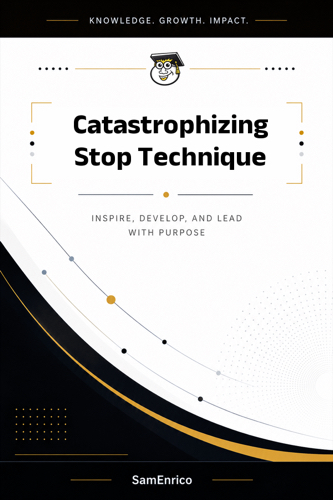
Non-FictionSelf-HelpCatastrophizing
Catastrophizing Stop Technique eBook
Interrupt worst case thinking with reality testing
Interrupt worst case thinking with reality testing.
Formats
Free sample
Chapter 1: The Crystal Ball Lie--–- Every night at 11:47 p.m., without fail, Marie’s brain would begin its ritual. She would be lying in bed, the house silent, her husband already asleep beside her. And then, like a switch being flipped, her mind would project a movie onto the darkness. In this movie, her teenage son—who had texted “driving home” forty-five minutes ago—was wrapped around a telephone pole. She could see the twisted metal, the flashing lights, the officer walking up her driveway to deliver the news.
Her heart would pound. Her palms would sweat. She would fight the urge to call him, knowing that if he didn’t answer, the movie would become real.Every night. For three years.The remarkable thing? Her son had never once been in an accident.
The worst thing that ever happened was traffic. But Marie’s brain didn’t care about the evidence. It cared about the possibility. And in the kingdom of possibility, the worst-case scenario is always the loudest.Marie is not unusual. She is not broken.
She is, in fact, perfectly human. And the mechanism running the show inside her head—the one that turns a late text into a funeral—is the same mechanism that has kept our species alive for two hundred thousand years. It is also, in the modern world, the same mechanism that is quietly ruining your sleep, your relationships, and your peace of mind.This chapter is not about calming you down. It is not about positive thinking or manifesting better outcomes. It is about something far more practical and far more urgent: understanding that your brain’s prediction about the future is not a fact.
It is a story. And like all stories, it can be rewritten.The Invention of the Future Let us begin with a paradox. Human beings are the only animals who can imagine the future in vivid, narrative detail. A squirrel can bury a nut and retrieve it months later, but it cannot lie awake at night worrying about whether the nut will be there. A dog can learn that a leash means a walk, but it cannot catastrophize about the walk being cancelled.
The ability to simulate what has not yet happened—to run mental models of tomorrow, next week, or next year—is arguably the crowning achievement of the human prefrontal cortex.But every gift comes with a curse.The curse is this: we hate uncertainty so much that we will invent a bad story just to have a story at all. Uncertainty is neurologically expensive. When you do not know what will happen next, your brain must hold multiple possibilities in mind simultaneously. That requires energy, attention, and cognitive bandwidth. It is uncomfortable.
It is draining. So your brain does what any efficient system does: it collapses the possibilities into a single narrative, usually the most emotionally charged one, and calls it a prediction.This is the Crystal Ball Lie. The lie is that you can see the future. The tragedy is that you believe your own prediction as if it were already true.Consider the last time you sent an important email or text message and did not receive an immediate reply. What happened inside your head?
For many people, the sequence goes something like this: silence → they must be ignoring me → they are angry at me → they are going to end the relationship → I will be alone. In less than ten seconds, you have traveled from a neutral event (no reply) to a catastrophic outcome (abandonment) with zero evidence. That is not rational analysis. That is myth-making.And you are not alone in doing it. The bestselling book The Art of Thinking Clearly by Rolf Dobelli catalogues dozens of cognitive biases that distort our judgment.
Two of them are particularly relevant here. The first is the Overconfidence Effect: we are systematically more certain of our judgments than the evidence warrants. When you predict that your boss’s silence means you are about to be fired, you feel 80% certain. But the actual probability—based on base rates, past behavior, and alternative explanations—might be 2%. Your brain does not care about the 2%.
It feels the 80%.The second is Hindsight Bias: after something happens, we retroactively convince ourselves that we knew it all along. Your son arrives home twenty minutes late. You had worried about a crash. He walks through the door, safe. Hindsight bias whispers: “See?
I was worried for nothing. That was silly.” But the next night, when he is late again, your brain forgets the forty-seven times he arrived safely and remembers only the one time you worried. Hindsight bias rewrites history to make your anxiety feel justified, which guarantees that you will worry again tomorrow.Together, these two biases create a closed loop. Overconfidence makes you trust your worst-case predictions. Hindsight bias erases the memory of false alarms.
The loop tightens. The spiral deepens.The Negativity Bias: Why Your Brain Prefers Disaster To understand why catastrophizing feels so automatic, you have to understand something uncomfortable about your own neurology. Your brain is not designed to make you happy. It is designed to keep you alive. And in the ancestral environment—the savannas and caves where our cognitive architecture evolved—the cost of missing a threat was death.Imagine two early humans.
One of them hears a rustle in the bushes and thinks, “Probably just the wind.” The other thinks, “Lion.” The optimist gets eaten. The pessimist survives. Over hundreds of thousands of years, natural selection favored the brains that assumed the worst. We are the descendants of the worriers. The phrase “stop worrying” is not advice; it is a fight against four hundred thousand years of evolutionary engineering.This is called the negativity bias.
Negative events are more memorable, more emotionally intense, and more physiologically activating than positive events of equal magnitude. You will remember a single criticism for days while forgetting nine compliments you received in the same hour. You will lose $100 and feel worse than you would feel good about finding $100. This asymmetry is not a bug. It is a feature.
A brain that overreacts to potential threats lives to pass on its genes.The problem is that the modern world is not the savanna. The rustle in the bushes is almost never a lion. The delayed text is almost never a death. The ambiguous silence from your boss is almost never a firing. But your brain does not know this.
It is using ancient hardware to process modern information. The result is catastrophic thinking that is perfectly tuned for a world that no longer exists.This is why telling a catastrophizer to “calm down” never works. It is like telling a person on fire to stop being warm. The fire is real to their nervous system. Before you can reason with the content of a catastrophic thought, you must first address the physiological alarm.
(We will return to this in Chapter 2, which introduces the first tool for lowering arousal before attempting any kind of reality testing.)Micro-Myths: The Stories You Tell Yourself Ancient cultures created myths to explain natural disasters. Why does the volcano erupt? The gods are…
This is the end of the free sample. Get the eBook to keep going. Buy now
About this book
Details
- Author
- Dotson Lesley
- Publisher
- SamEnrico
- Language
- English
- Genre
- Non-Fiction, Self-Help, Catastrophizing
- Released
- 2026-06-11
- Pages (approx.)
- 149
- Available as
- eBook, Audiobook

Read better in the ZLOADR app
Your eBooks on your phone or tablet. Sign in with your SamEnrico account and start reading.
More by Dotson Lesley
 Vegan Pregnancy NutritionDotson Lesley$11.99
 Counting Breaths for CalmDotson Lesley$11.99
 Workplace Accountability PartnerDotson Lesley$11.99
 De escalation for FirefightersDotson Lesley$11.99
 Morning Green SmoothieDotson Lesley$11.99
 Creative Confidence BuildingDotson Lesley$11.99
 Virtual Networking SkillsDotson Lesley$11.99
 The Damascus Shadow: The Double Agent Who Betrayed Two SpiesDotson Lesley$11.99
 The Silent Warriors: How Argentine Footballers Fought ApartheidDotson Lesley$11.99
 A Collector's Handbook to the Mazda 110s CoupeDotson Lesley$11.99
 How to Start a Agricultural Research (other Than Biotechnological) Business (Beginners Guide)Dotson Lesley$11.99
 How to Produce VodkaDotson Lesley$11.99
You may also like
 Hong Kong Handover 1997Dunn Johnnie$11.99
 Zumba For Postnatal Recovery CourseNeal Christian$11.99
 Zumba for BeginnersLadner Nikia$11.99
 YouTube Comment Mining GuideHumes Pandora$12.99
 Worry Box MeditationCarlin Rudy$11.99
 Workplace Stress MeditationNguyen Lynn$11.99
 Workplace Stress and Sleep RepairHawley Ivory$11.99
 Workplace Perfectionism CureDelaney Jeffry$11.99
 Workplace Injustice Anger GuideWallen Isabelle$11.99
 Work Addiction and Burnout LinkGreenwood Ester$11.99
 Women in Yoga and WellnessBeattie Galina$11.99
 Women in Stand Up ComedyChun Evangeline$11.99