
Non-FictionMental WealthRisk Assessment
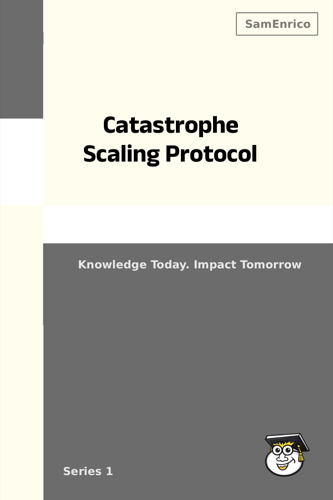
Catastrophe Scaling Protocol eBook
Size worst case probabilities to realistic proport
Size worst case probabilities to realistic proportions before presentations.
Formats
Free sample
Chapter 1: The Garage Dragon--–- The first time I saw a brilliant strategy die, it didn't die from bad data, poor execution, or even a竞争对手. It died from a sentence that began with four words: "But what if..."The year was 2015. I was consulting for a mid-sized renewable energy company that had spent eighteen months developing a breakthrough solar storage system. The engineering was sound. The market demand was verified.
The manufacturing costs were competitive. The CEO, a sharp veteran named Elena, had secured preliminary commitment from a major utility for a pilot deployment worth $40 million.The presentation was scheduled for 10 AM on a Tuesday. The board room held twelve people: seven board members, three executives, and two external advisors. Elena had prepared a masterful deck. She walked through the technical specifications, the competitive landscape, the financial projections, and the implementation timeline.
Everything was clean, conservative, and evidence-based.Then came the question from the board's most senior member, a man named Harold who had built his career on asking the one question no one else would ask."But what if the battery chemistry fails catastrophically?" Harold said, leaning back in his leather chair. "What if, six months into deployment, one of these units catches fire and burns down a customer's facility? What's the worst case?"Elena paused. She had prepared for technical questions, cost questions, even regulatory questions. But this?
The battery chemistry had been tested for twelve thousand cycles. The failure rate was 0.002 percent per unit per year. There was no evidence of catastrophic fire risk. But Harold wasn't asking for evidence. He was asking for imagination."Well," Elena began, "I suppose the worst case would be a complete failure of thermal management leading to thermal runaway, which could theoretically cause a fire that spreads to adjacent structures, possibly resulting in property damage, liability claims, and reputational harm.""How much?" Harold pressed."I...
I can't give you a precise number. It would depend on so many factors.""Give me a range.""Maybe $10 million to $200 million, depending on the scale."Harold nodded slowly. Then he turned to the other board members. "So there's a chance, however small, that this project could expose us to a $200 million loss?"The room went quiet. Elena tried to explain the probability—0.002 percent per unit per year, which over a ten-year deployment across five hundred units amounted to something like a 0.01 percent cumulative probability.
But the damage was done. The number $200 million was now floating in the air like a ghost. No one remembered the 0.01 percent. Everyone remembered the $200 million.The board tabled the vote. Three weeks later, they killed the project.
The utility partner walked away. Eighteen months of work, $4 million in R&D, and a legitimate breakthrough in renewable energy storage—all killed by a worst-case scenario that had roughly the same probability as being struck by lightning while holding a winning lottery ticket.That was the day I realized that worst-case scenarios, no matter how improbable, have a special power over human decision-making. They are the dragons we keep in our garages—vivid, terrifying, and almost certainly not there. But try telling that to your amygdala when someone asks, "But what if..."The Anatomy of a Phantom Threat Let me be precise about what happened in that boardroom, because the mechanics of this phenomenon are essential to understanding how to defeat it.The human brain evolved in an environment where threats were immediate, concrete, and high-probability. A rustle in the grass might be a predator.
A sudden drop in temperature might precede a deadly storm. In that environment, the cost of ignoring a threat was often death, while the cost of responding to a false alarm was merely wasted energy. Natural selection therefore favored brains that over-detected threats. Better to flee from a shadow that turns out to be a rock than to ignore a lion disguised as a shadow.This is called the smoke detector principle, named by the economist and risk scholar Cass Sunstein. Smoke detectors are designed to be hypersensitive.
They trigger false alarms frequently because the cost of a missed fire is catastrophic relative to the cost of a false alarm. Your brain operates on the same logic.Here's the problem: the smoke detector principle works beautifully for immediate, physical threats. It works terribly for probabilistic, abstract, long-horizon risks presented in boardrooms. Your brain cannot tell the difference between a lion in the grass and a $200 million worst-case scenario that has a 0.01 percent chance of occurring. Both trigger the same fight-or-flight response.This is why the dragon in the garage is such a useful metaphor.
Imagine I tell you there is a dragon in your garage. You know, rationally, that dragons don't exist. But now try not to think about the dragon. Try to walk into the garage without scanning for heat, shadows, or sulfur smells. You can't.
The mere suggestion of a threat, however implausible, hijacks your attention.In boardrooms, the dragon is introduced by the four words: "But what if..." Once the dragon is invoked, it becomes the center of the conversation. All the data, all the analysis, all the careful probability assessments—they fade into the background. The dragon fills the room.Risk vs. Uncertainty: The Critical Distinction You Must Make Before we can scale catastrophes to realistic proportions, we need to understand a distinction that most business leaders ignore at their peril: the difference between risk and uncertainty.This distinction was first formalized by the economist Frank Knight in 1921, and it remains one of the most underutilized tools in decision-making.Risk is when you know the possible outcomes and you can assign probabilities to them. Rolling a die is risk.
You know the six possible outcomes, and you know each has a 16.67 percent probability. A factory defect rate of 0.5 percent is risk. You have historical data, you know the distribution, and you can calculate expected values.Uncertainty is when you either don't know the possible outcomes, or you cannot assign meaningful probabilities to them. Launching a completely novel product into a new market is uncertainty. A geopolitical crisis that has no historical precedent is uncertainty.
A new AI system whose failure modes are unknown is uncertainty.Here's the critical insight that most presenters miss: When someone asks "But what if..." they are almost always moving the conversation from risk to uncertainty without acknowledging the shift.In the solar storage case, the actual risk (the tested failure rate of 0.002 percent per unit per year) was a well-understood risk. But Harold's question—"What if the battery chemistry fails catastrophically?"—shifted the frame to uncertainty. He wasn't asking about the known failure modes. He was asking about unknown failure modes, unobserved scenarios, hypothetical catastrophes that had never occurred in testing.Once the conversation shifts to uncertainty, probabilities become impossible to defend. You cannot prove that a catastrophic failure will not happen because you cannot prove a negative.
And in the absence of probability, the imagination runs wild. The dragon grows larger with each passing second.The first step in the Catastrophe Scaling Protocol is therefore to recognize when you are dealing with risk (quantifiable) versus uncertainty (not quantifiable) and to refuse to let uncertainty masquerade as risk.The Availability…
This is the end of the free sample. Get the eBook to keep going. Buy now
About this book
Details
- Author
- Prater Manuela
- Publisher
- SamEnrico
- Language
- English
- Genre
- Non-Fiction, Mental Wealth, Risk Assessment
- Released
- 2026-06-06
- Pages (approx.)
- 152
- Available as
- eBook, Audiobook

Read better in the ZLOADR app
Your eBooks on your phone or tablet. Sign in with your SamEnrico account and start reading.
More by Prater Manuela
 The Sleep Recovery ProtocolPrater Manuela$11.99
 Social Media Conflict AngerPrater Manuela$11.99
 Senior Low Vision Self Esteem CoursePrater Manuela$11.99
 Breaking the Shame Cycle From ChildhoodPrater Manuela$11.99
 The Gold Rush Scandal: How Wall Street’s First Insider Traders Rigged the MarketPrater Manuela$11.99
 Understanding Lymphocytic VasculitisPrater Manuela$17.99
 Precision Fermentation GuidePrater Manuela$12.99
 Executive Summary Decision MakersPrater Manuela$12.99
 Implementation LeadPrater Manuela$11.99
 How to Become a Drapery HangerPrater Manuela$11.99
You may also like
 Hong Kong Handover 1997Dunn Johnnie$11.99
 Zumba For Postnatal Recovery CourseNeal Christian$11.99
 Zumba for BeginnersLadner Nikia$11.99
 YouTube Comment Mining GuideHumes Pandora$12.99
 Worry Box MeditationCarlin Rudy$11.99
 Workplace Stress MeditationNguyen Lynn$11.99
 Workplace Stress and Sleep RepairHawley Ivory$11.99
 Workplace Perfectionism CureDelaney Jeffry$11.99
 Workplace Injustice Anger GuideWallen Isabelle$11.99
 Work Addiction and Burnout LinkGreenwood Ester$11.99
 Women in Yoga and WellnessBeattie Galina$11.99
 Women in Stand Up ComedyChun Evangeline$11.99